In Conversation with Yooyun Yang

For our upcoming exhibition Urban Dwellers, LVH Art sat down with Yooyun Yang to talk about how her paintings capture the solitude, tension, and fleeting moments of urban life.
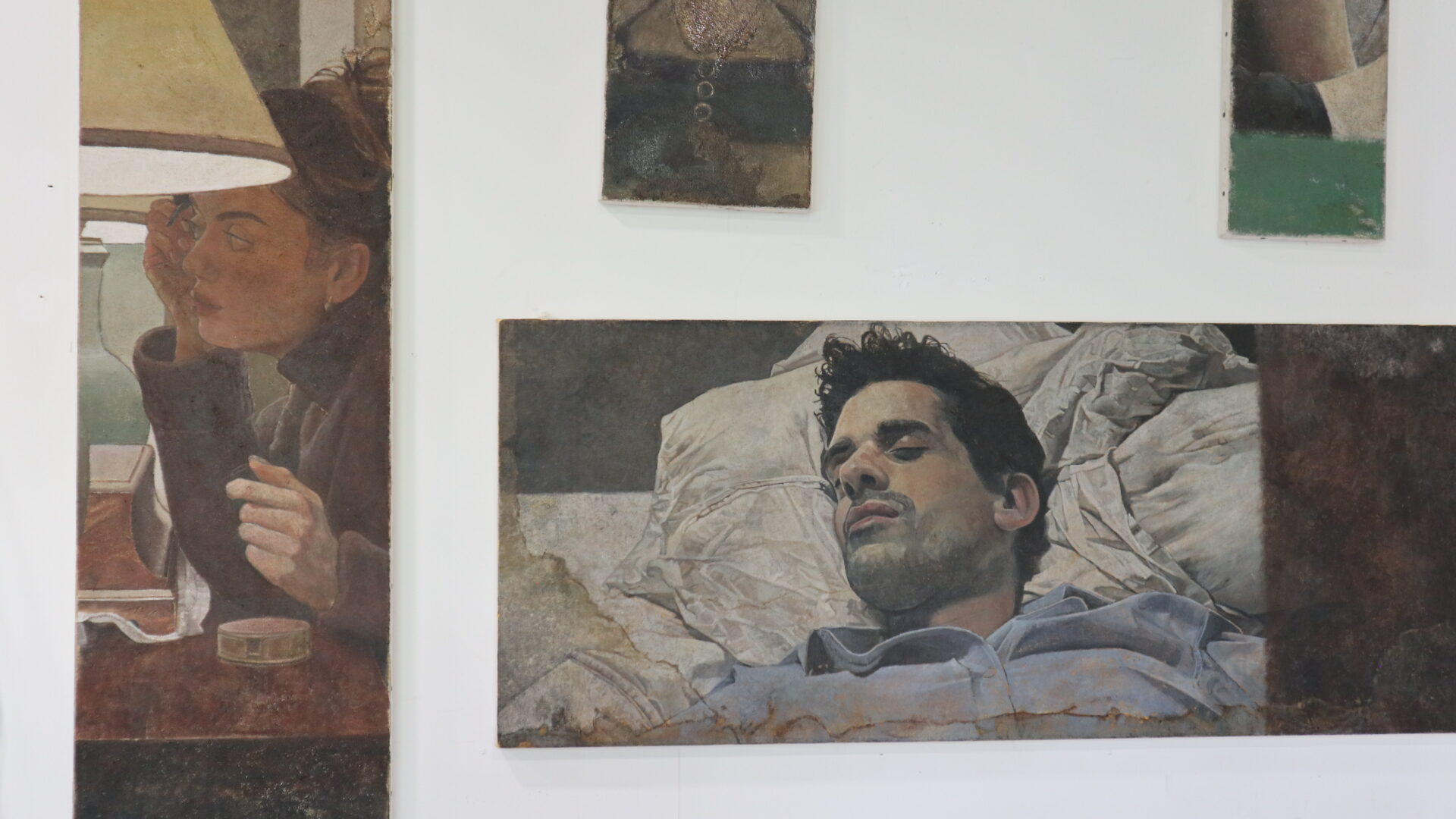
Yooyun Yang (b. 1985) is a South Korean painter whose work transforms fleeting and estranged moments of daily life into enigmatic visual excerpts. Trained in oriental painting, she works with diluted acrylic on jangji, a traditional Korean handmade paper made from mulberry bark. This paper is more absorbent than others, allowing her smoothly rendered brushwork to blend seamlessly with its fibers. Her compositions begin with photographs she takes herself, which she crops and distorts into close-up fragments. This technique allows the familiar to shift into the uncanny. Figures often appear partially hidden, faces blurred or turned away, and gestures abruptly cut, creating a sense of solitude and psychological tension. Yang’s work captures what she calls the “age of anxiety,” revealing the alienation and emotional pressure commonplace in urban life.
LVH Art: Can you walk us through your creative process? Do you have specific rituals or routines that help you when you’re creating?
Yooyun Yang: I usually think about what kind of painting I want to draw in my head first, and then start drawing right away. In the past, I used to make esquisses or small sketches in my drawing book before beginning the main work, but these days, I just do a very simple pencil sketch and get started right away. I think that a painting has the potential to change throughout the process, so I try to stay open to those possibilities as I work.

LVH Art: Many of your paintings begin with photographs you’ve taken yourself. What qualities do you look for when selecting an image to develop into a painting? Can you describe your process of translating a photograph into a painted work, and what tends to shift, disappear, or emerge in that transformation?
Yooyun Yang: I habitually take photos of moments I come across in everyday life. I don’t like to stage scenes or deliberately construct images that I want to draw. I frequently return to photos taken a long time ago because the subjects and themes I want to draw at each time are different. Sometimes, parts of an image that I didn’t notice before suddenly catch my eye when I look at it again after some time has passed. Rather than following the original photo exactly, I tend to crop out unnecessary parts, and exaggerate or alter the elements that left an impression on me or that I want to emphasize. Because of this process, what disappears or changes in each work is always different.
LVH Art: Many of your works feel as if they’re seen from a specific, sometimes hidden or bizarre viewpoint. How do you think about perspective and the act of looking when composing a work?
Yooyun Yang: This is a very important question for me. At the beginning of my work, I wanted to find hidden points or gaps that people generally don’t notice. Since long ago, I have had a habit of focusing not on the centre of a landscape or object but on its edges or corners, or looking at things askew rather than straight on. Perhaps this was an effort to see things differently. This way of observing has naturally been reflected in my work since I was young. Until now, the results of my attitude toward subjects have influenced my paintings. However, recently, I have been more concerned with the cause and process behind that attitude rather than the results. In the process of observing and interpreting a subject, we often encounter misunderstandings. I believe these misunderstandings are not negative but rather necessary. From them, new interpretations arise, which sometimes become the foundation for new works.

LVH Art: The cinematic quality of your work often makes everyday details appear uncanny. Do you think urban life itself already carries this sense of the strange?
Yooyun Yang: I could say that. I was born and raised in the city. The constant noise and changes in the city naturally influenced my life. The city itself has many different personalities. I was born in an old part of town but spent my childhood in a newly developed area, and after becoming an adult, I returned to live in the old town again. The two parts of the city looked very different and had distinct environments. For me, having grown up in a planned and organised new town, the old district felt faintly familiar yet strikingly unfamiliar to me. Tangled power lines like a spider’s web, a power plant that seemed asleep during the day but appeared menacingly awake with its red lights at night, ever- present construction sites, and the way old buildings quickly disappear and are replaced new ones in the blink of an eye — all of these urban scenes deeply influenced my early work.
LVH Art: You’ve described your paintings as being like “a thorn in the mind” or “a gentle fever.” Could you expand on what you mean with these metaphors, and how they reflect the kind of experience you hope to create for the viewer?
Yooyun Yang: Since I was young, I have thought, “Others will paint happy and pretty pictures well, so I will paint pictures that are not like that.” From childhood, my natural temperament has drawn me closer to darkness than brightness, and to negativity rather than positivity. Each of us has our own dark parts or secrets that we cannot reveal. Even if we share them with others, I believe there are some parts that are difficult to convey in words and thus cannot be fully empathised with. The word “melancholy” is a single word, but the feeling of “melancholy” is different for every individual. Emotions are like waves — they cannot be held in one’s hands, they cannot be defined by a single colour, and they constantly shift and change every moment. Perhaps what I wish is to make people look into the corners of their own hearts that they had forgotten, or tried to turn away from. I value the moments when we confront those emotions.

LVH Art: You often work with diluted acrylic on Jangji paper. What draws you to this material?
Yooyun Yang: When I was in middle school, I first encountered Hanji, traditional Korean paper. Among the many types of Hanji, Jangji was the one I used. Compared to regular drawing paper, Hanji has a distinctive texture and absorbs water very well, qualities that suited me perfectly. While preparing for art college entrance exams, everyone around me was using standard drawing paper, but I was the only one using Jangji. Because of this, I naturally chose Oriental painting as my major in university. During my college years, I painted using traditional pigments instead of acrylic paints. Traditional pigments are delicate and sensitive, making them challenging to work with. Around the time I graduated, I started using acrylic paints, which were easier to handle than traditional pigments. I also felt that the opaque and muted colours of acrylics suited my work better than the clear and transparent tones of traditional pigments. Since then, I have continued to use acrylic paints.

LVH Art: Can you speak in detail about Seeing (2024). What were some of the ideas or themes you were exploring while creating it? How did the work evolve during the process/ Did it change from your original idea?
Yooyun Yang: This work reflects my thoughts on the act of simply looking, as the title suggests. At some point, we began to look into the small screens in our hands countless times throughout the day. When we gaze at these screens, others can observe us in an unguarded state. Conversely, I observe others in their unguarded moments. They show different faces when looking at their small screens compared to when they make eye contact with someone else. I often enjoy observing people in this state. This work is also part of a series created sequentially after a work titled ‘Taking’. We constantly capture something with small objects in our hands throughout the day, habitually looking at those tiny screens. These small devices, which never leave our hands, are paradoxical: they represent the widest world to us while simultaneously confining us to the smallest spaces. I wanted to express these thoughts that often come to me while using my phone through this series.
LVH Art’s List: What to See in Paris during Art Basel this Year
LVH Art’s List: What to See in Paris during Art Basel this Year
In Conversation with Isabelle and Christine d’Ornano