In Conversation with Paul Robas

Ahead of LVH Art’s Urban Dwellers exhibition, we spoke to Vienna-based Romanian painter Paul Robas about how his process turns distortion and layering into intimate portraits of fading memory.
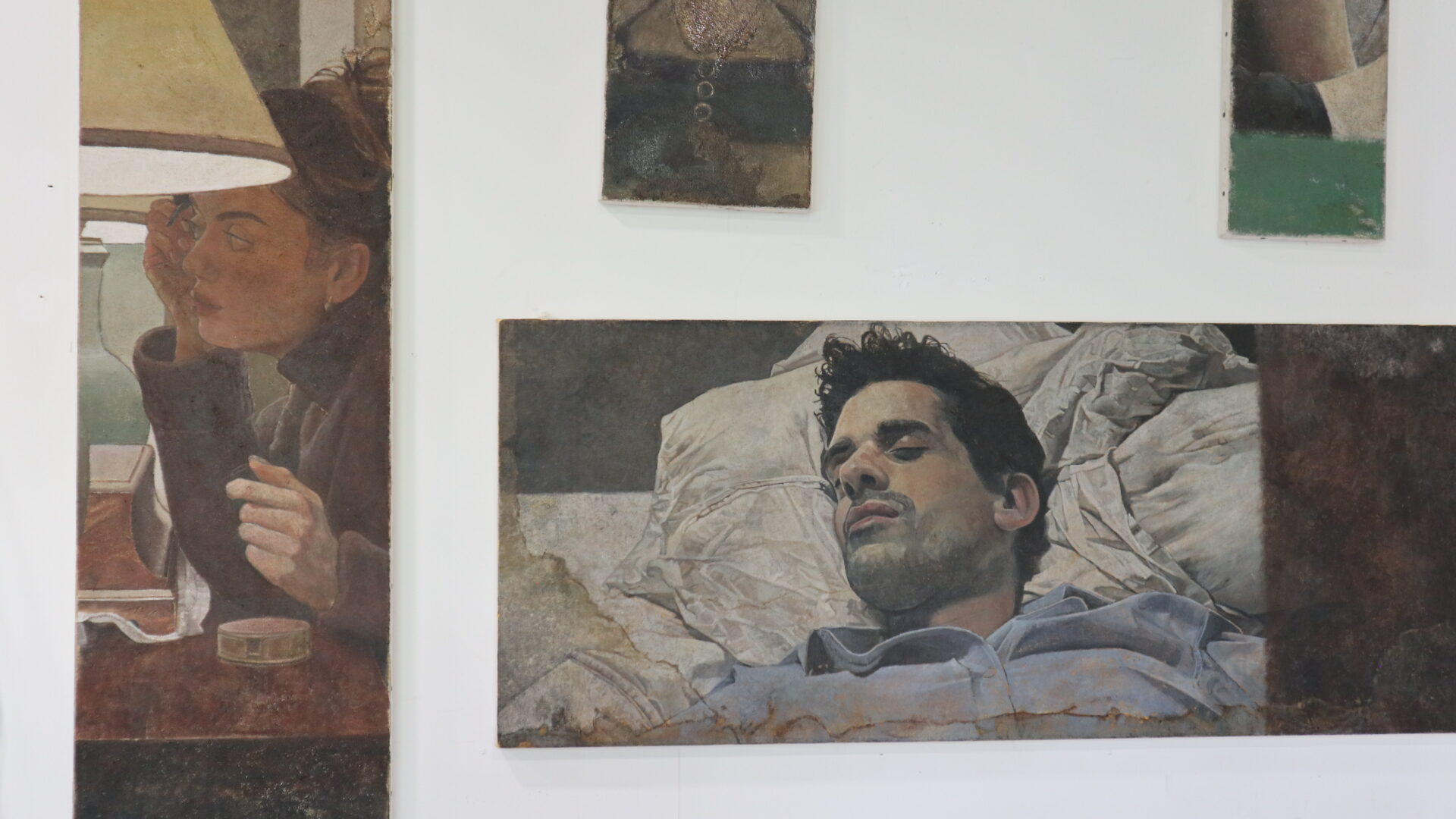
Paul Robas (b. 1989) is a Vienna-based Romanian artist whose work explores memory, perception, and the shifting relationship between the real and the imagined. Working primarily in painting, he begins with found or digitally altered photographs which he subjects to a process of layering, distortion, and surface manipulation. Blurred faces and textured grounds emerge as portraits that feel both intimate and elusive, evoking the sensation of fading memories. Imperfections and surface disruptions are not hidden but embraced, becoming essential to the meaning of the work. Through this painterly language, Robas challenges traditional notions of portraiture and creates a space where figures seem suspended between personal history and universal experience.
LVH Art: Could you share a bit about your creative process? Are there any specific routines, rituals, or habits that help you get into a creative flow?
Paul Robas: I don’t have a strict creative process or fixed ritual. Mostly, I go out, talk to people, interact, take walks. In these random moments ideas come unexpectedly. I try to stay open and keep an eye out for interesting things. As soon as I see or think about something I could use, I either take a photo or write it down so I don’t forget. Then comes the processing phase, but the initial phase is really as open as possible.

LVH Art: Do you sketch, or do you mainly take photographs?
Paul Robas: I write down a description of an idea: how the work should look and approximately how I’ll compose it. I write it in words — that’s the first thing, because I’ve forgot so many ideas in the past. Afterwards I do sketches of roughly how I think it should look. Then comes computer work: I compose the reference images digitally. I try to get it as close to the final image as possible — not colour-wise, as colour is a separate process, but in terms of the composition.

LVH Art: The figures in your paintings often originate from photographs. Do you source these images from archives and found material, or do you also take your own photographs?
Paul Robas: It’s a bit of both. I used to use more archive images, but I always modify them a lot: distorting or processing them in Photoshop to achieve a certain look. Recently I’ve photographed friends, and I’ll continue doing that. I studied photography for a while, so I enjoy controlling the light and gently directing how the person moves — but I try to keep it spontaneous, not theatrical. I’m also thinking to mix these two worlds: found images with my own photographs and see what comes out. I don’t want to limit myself to one approach.
LVH Art: Could you tell us more about the work Kill Switch, which will be included in the show? Where did the inspiration come from, and are there any interesting facts about the work?
Paul Robas: Kill Switch is based on a found image, I’m not sure of the origin. The original context and source is not important in relation to my work. I am always interested in the image itself and what interested me was the lost gaze of the person, almost as if they’re experiencing a mental crash. I’m fascinated by how painting can shift psychological states with just a small change: a line or a colour can move a figure from ecstasy to despair. The title ‘Kill Switch’ comes from the technical term for a mechanism that shuts off a system to protect it from damage. I made an analogy to the human mind reaching a breaking point and instinctively switching off. The tear in the eye and the distant gaze suggests an endpoint, but also the possibility of a new beginning.

LVH Art: Colour plays a significant role in your work. Do you approach colour instinctively, or is it a carefully planned and structured element in your process?
Paul Robas: My sketches and collages are mainly for composition; I can’t really fix the colours at that stage. When I start painting, many decisions are made instinctively along the way. I never have everything fixed at the beginning. It’s hard to explain, but I need to see it in my head, then on the canvas. For example I might start with a base layer of orange or yellow and then think: what works next to this?
I prefer to build colour directly on the canvas by painting transparent layers. This approach lets the colours blend optically, right before your eyes, creating tones and nuances you simply can’t achieve by pre-mixing the end result feels more vibrant and complex. You can really lose yourself in the layers, discovering new shades and subtle details the longer you look.
LVH Art: Many of your works carry a dreamlike, even unsettling atmosphere. Is this something you actively seek to create, or does it emerge naturally through your process?
Paul Robas: It’s very intentional. I’ve always been fascinated by the fragility of perception, and how memory begins to distort the moment almost as soon as it passes. With time, memories slip further into obscurity and even become directed narratives of our own making. And even in real time, perception is rarely precise. Light bounces, colours blur, shadows interfere; we never truly see a perfectly clear, stable image. Photography can freeze clarity under certain conditions, but that feels too staged, almost theatrical. My paintings aim to capture the unstable nature of both memory and experience — fleeting, imperfect, and layered.

LVH Art: Are there any writers or artists who inspire you? Any particular art movements?
Paul Robas: I’m not really a fan of specific movements, but I do come across painters whose work I like. Sometimes I’ll see a painting that interests me and then research the artist further. For example, I like the Belgian painter Léon Spilliaert for his atmospheric, almost monochromatic compositions. I recently saw works by Vilhelm Hammershøi in Copenhagen. He paints interiors and fragments of buildings with reduced, vibrating colours, and I was fascinated to experience his work in person for the first time. From Monet and Turner, I take a deep fascination with light itself — whether it is dissolving in mist, scattering off water, or thickened into abstraction, their treatment of atmosphere continues to shape how I look at the world. I’ve also admired Victor Man since I first saw his work in 2015.


LVH Art’s List: What to See in London This October