In Conversation with Orfeo Tagiuri

For the forthcoming Urban Dwellers exhibition curated by LVH Art, we spoke with Orfeo Tagiuri about the stories, materials and rhythms that shape his practice.
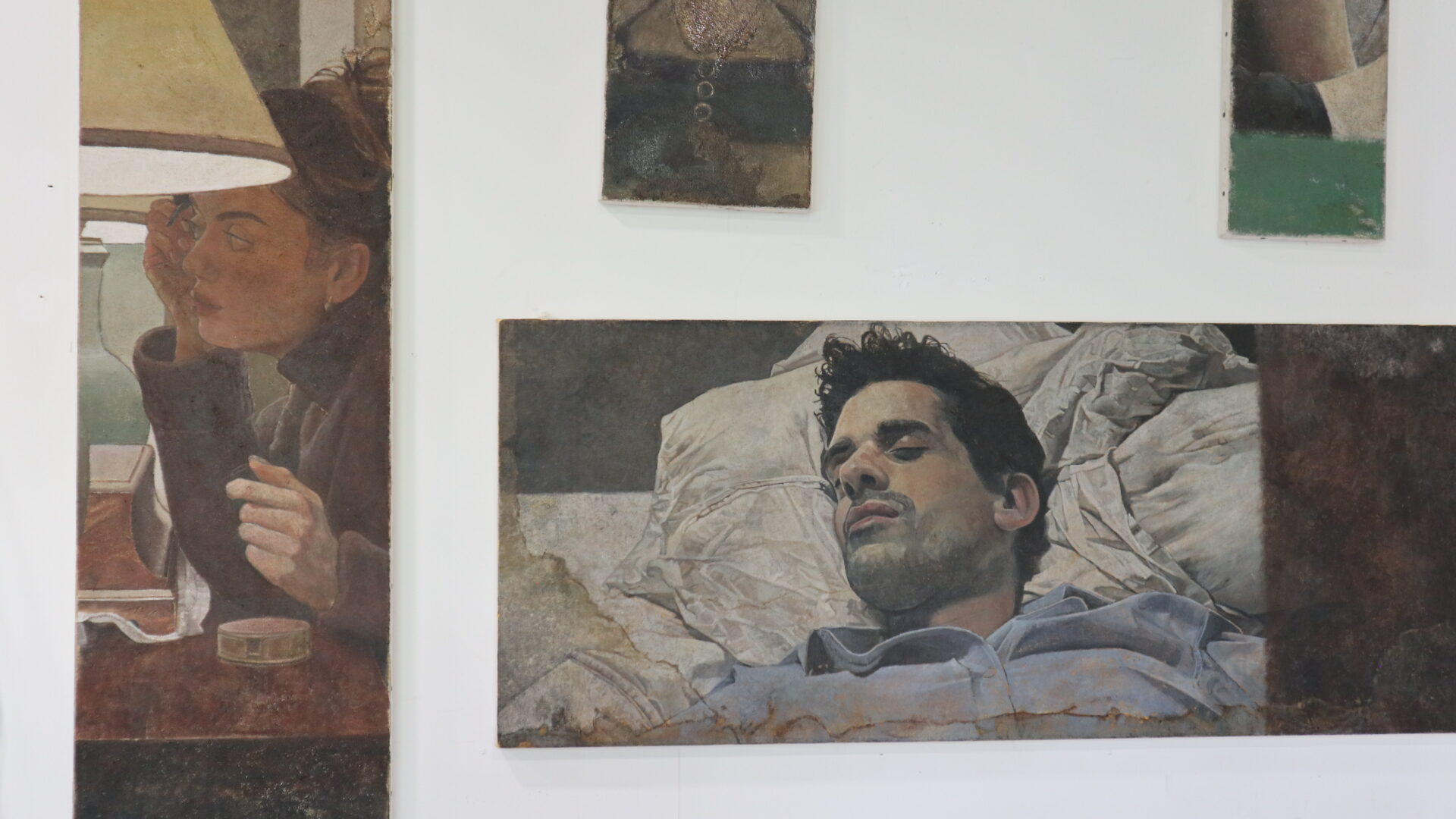
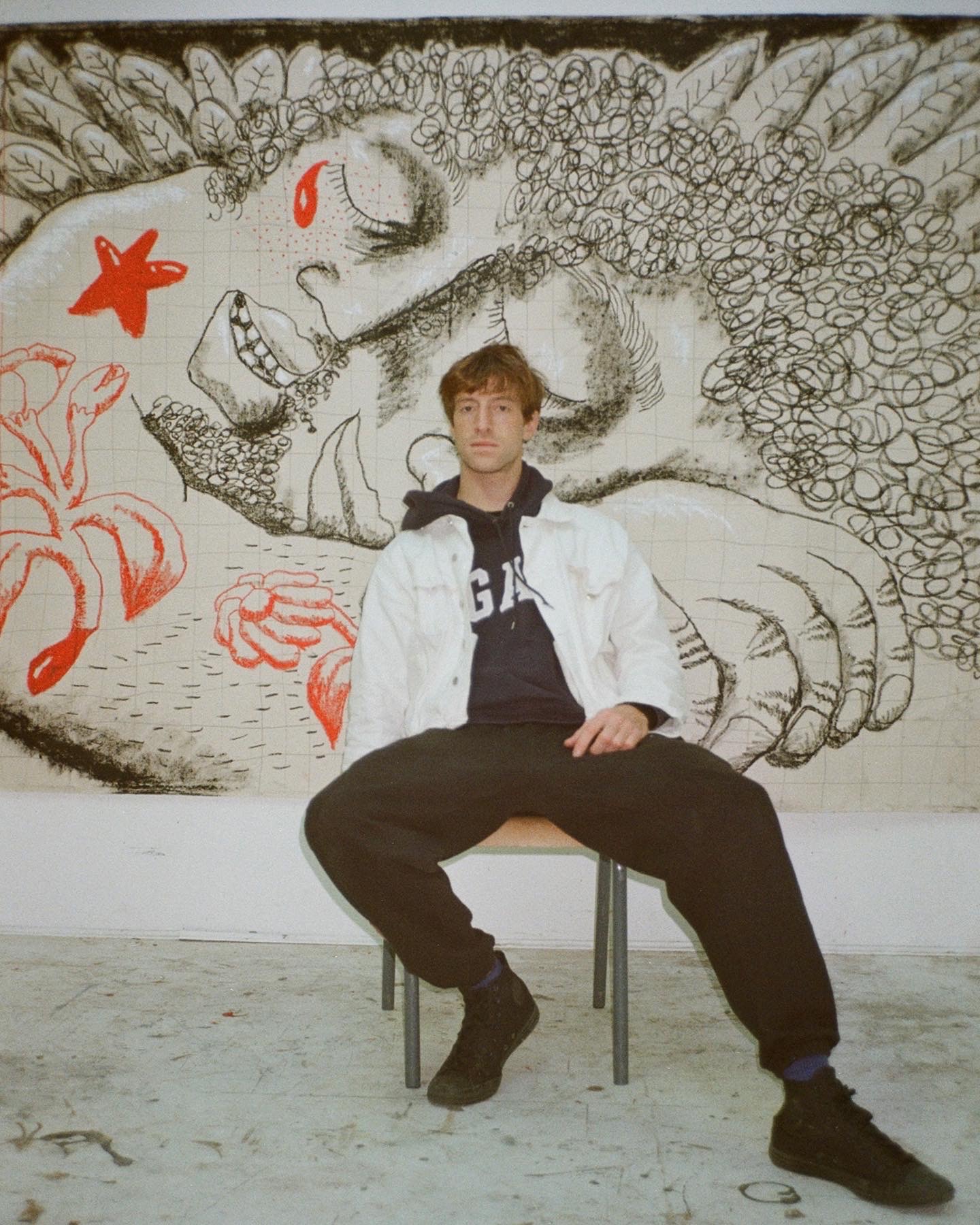
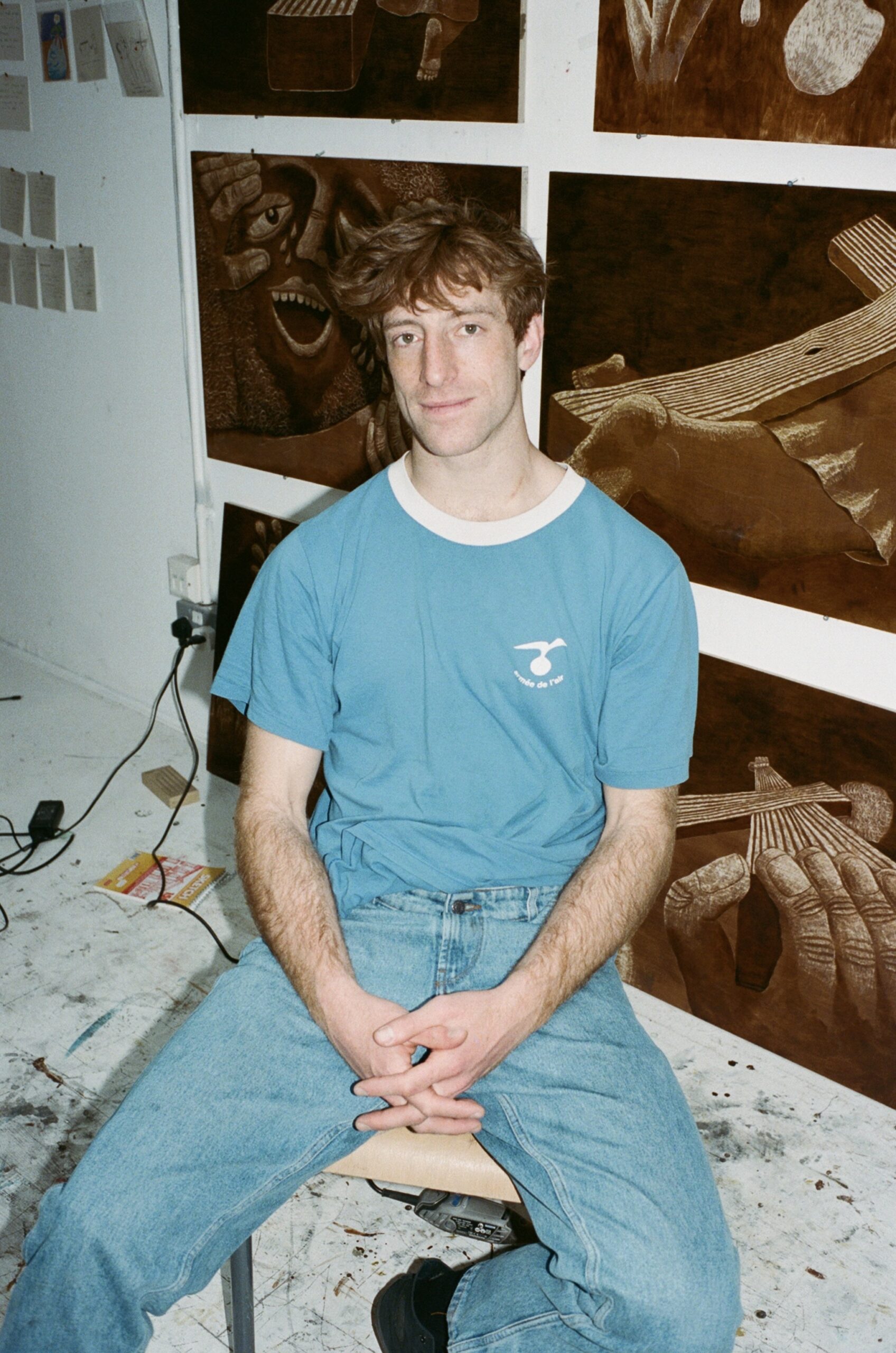
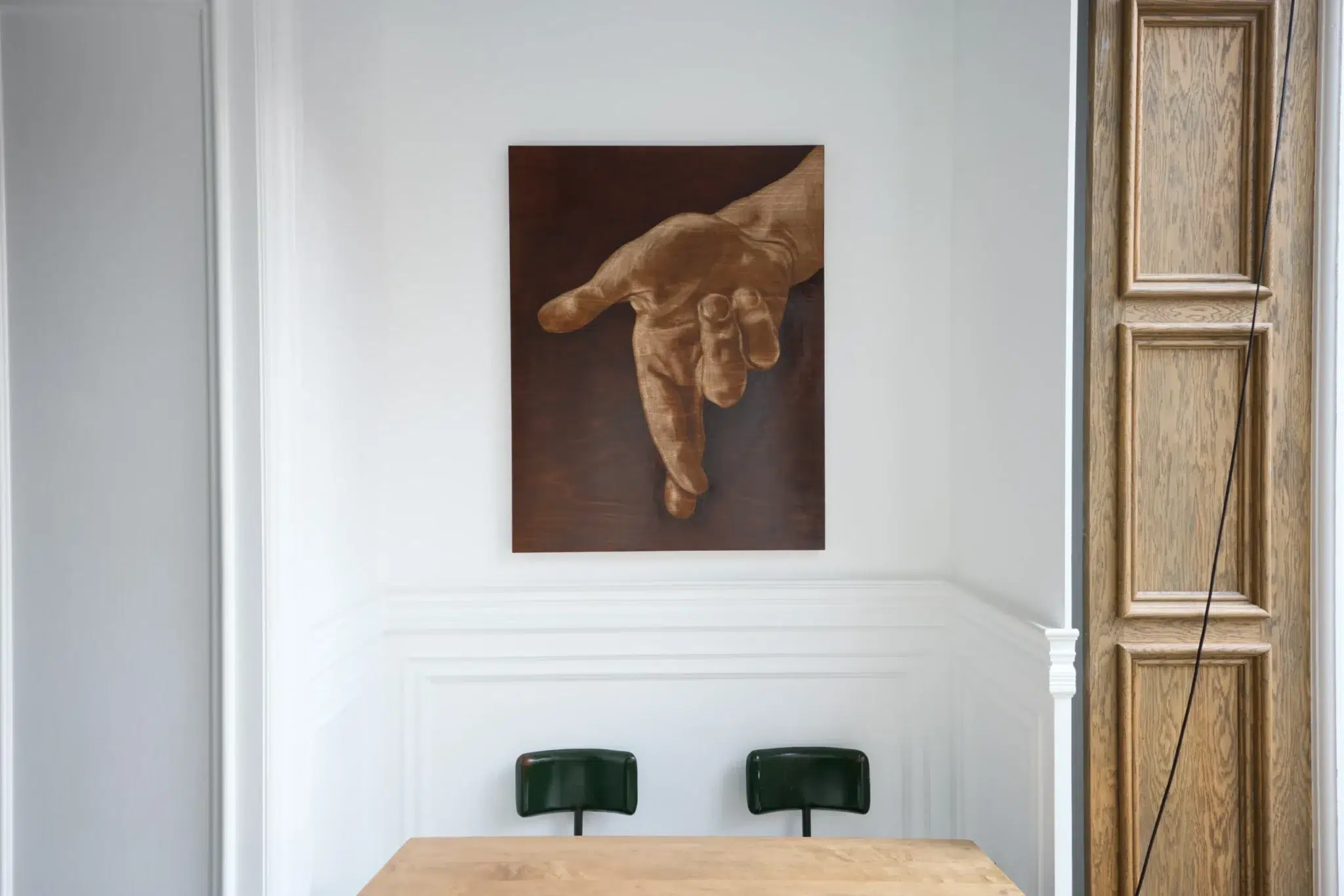
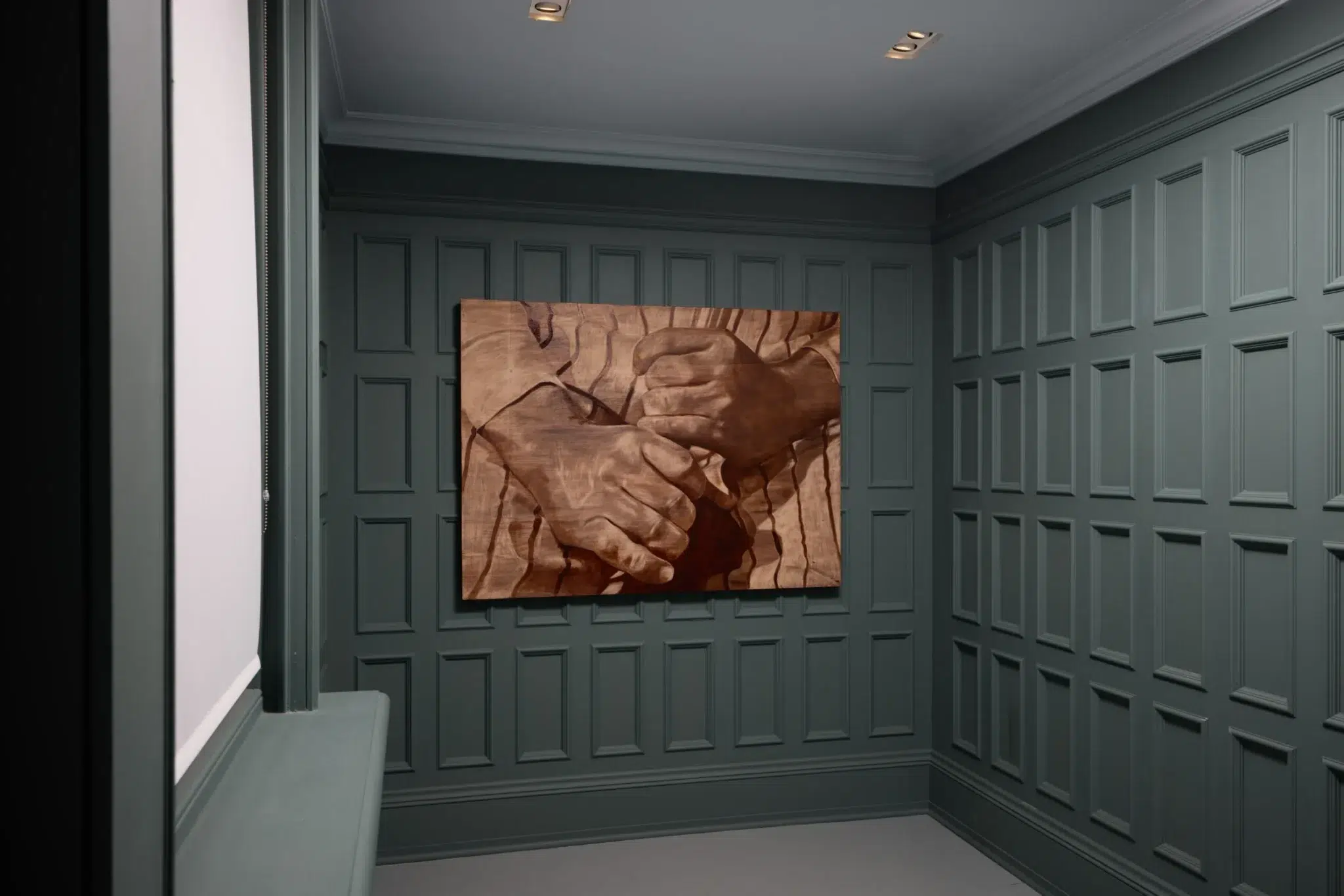
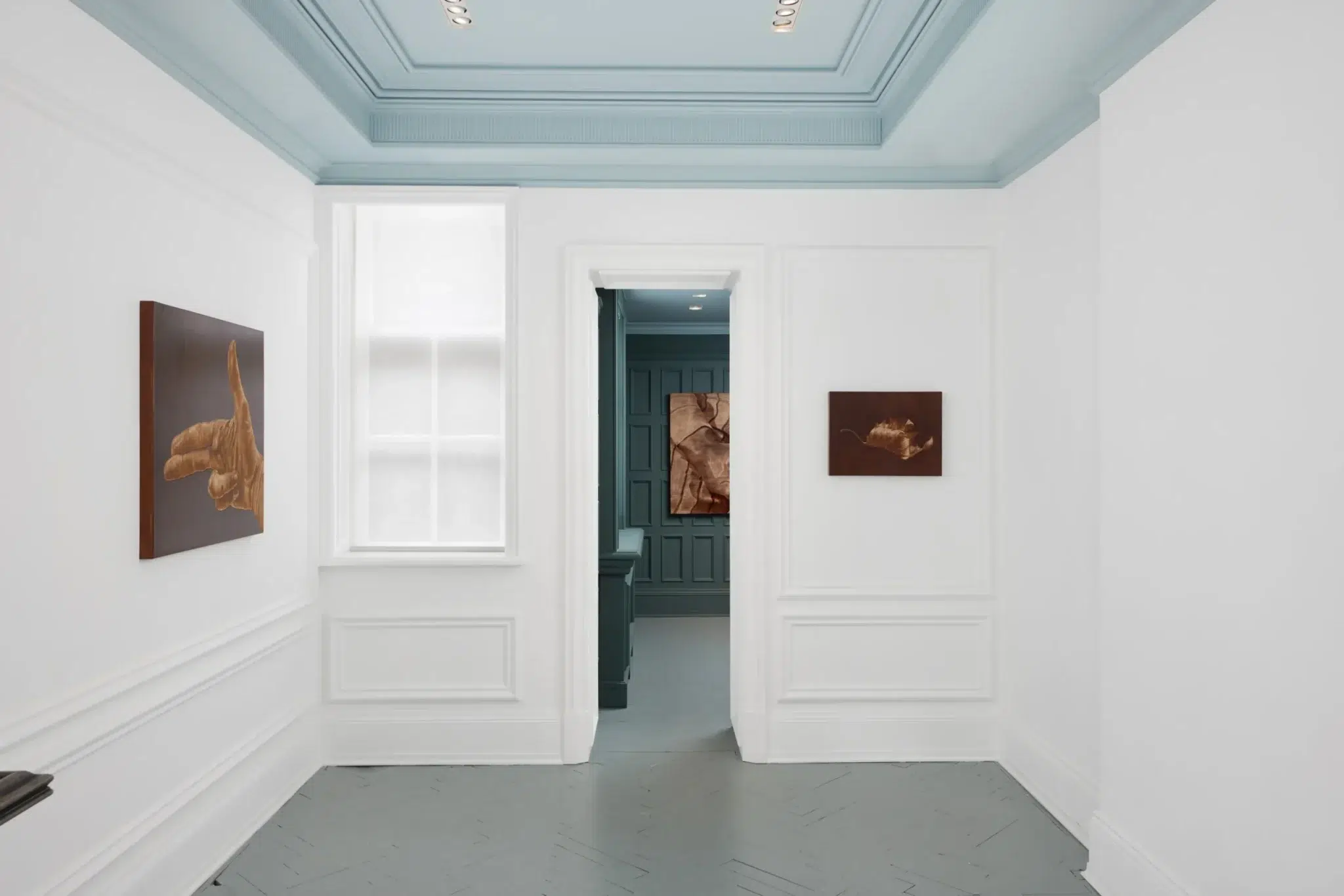
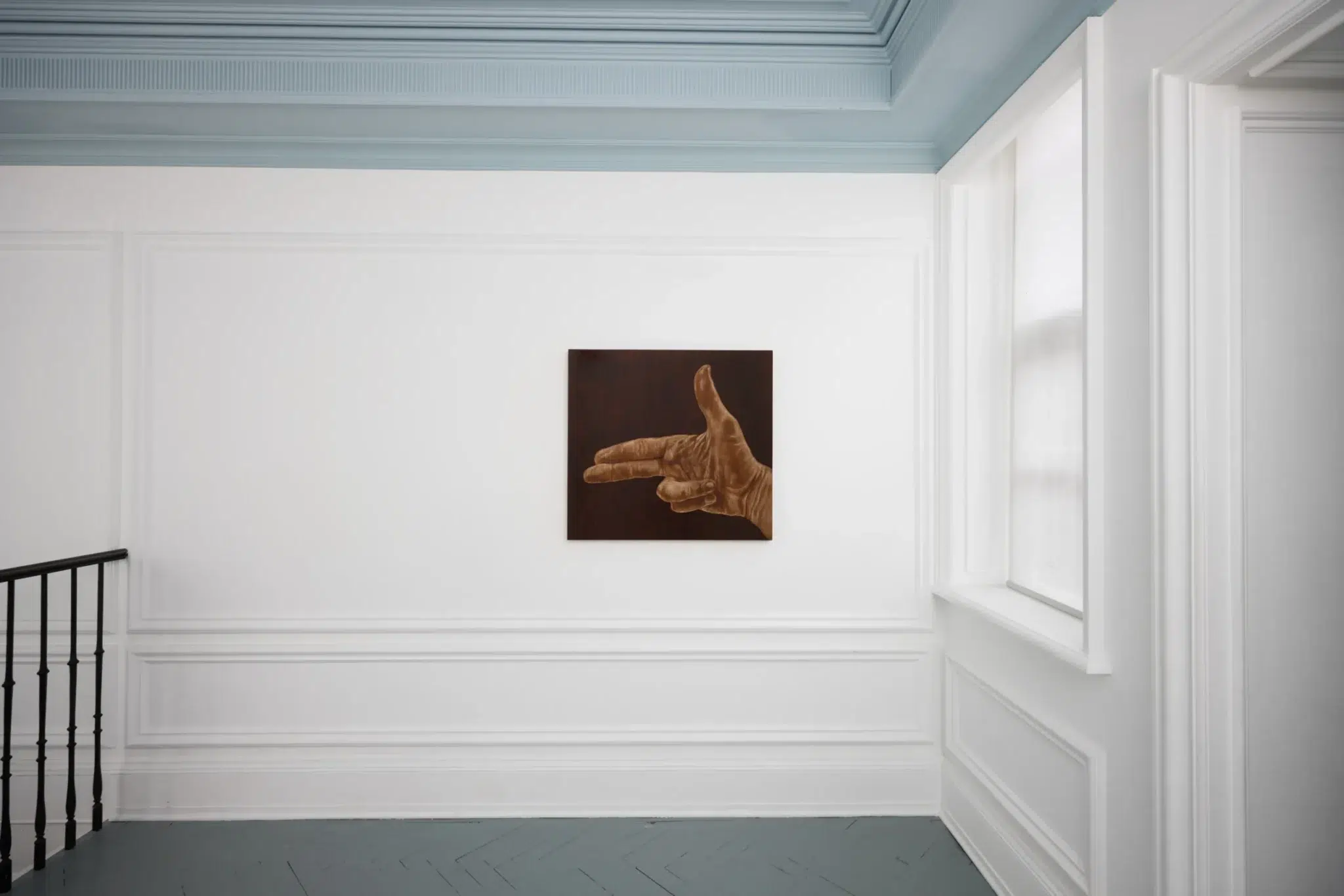
Orfeo Tagiuri (b. 1991) is an American artist and writer based in London. He works almost exclusively with wood stain, rarely using traditional paint. Each composition is built through layered applications of stain, with the depth and darkness of the image determined by the number of layers applied. Working on wooden panels, he allows the natural grain to remain visible, making it an active element in the work and inviting reflection on the nature of painting and the process by which it is normally created.
We talk about Orfeo Tagiuri’s new crowd painting for the Urban Dwellers exhibition, sparked by a 1943 photograph taken in Rome after the bombing of San Lorenzo, where the focus shifts from authority to the faces gathered in search of hope. Tagiuri explains why he works on wood, how staining and carving set the tempo of a piece, and how that began with a Slade project that turned school desks into surfaces for daydreaming.
LVH Art: We know you are still working on the painting that will be in the show, but could you
share a bit about the inspiration behind it?
Orfeo Tagiuri: It’s a large crowd scene, and I’m still in the process of bringing it together. It’s not a close-up like some of my previous works; instead, it’s a wide, complex composition. I was really inspired to make this particular work, and I always feel it’s important to follow that inspiration.
The inspiration for this piece comes from a black-and-white photograph taken in 1943, just after the bombing of the church San Lorenzo in Rome during World War II. In the original photo, there’s a huge crowd gathered, and at the front is Pope Pius XII, who was the pope at the time. What’s remarkable is that the Pope almost never left the Vatican, but on this day, because of the bombing, he came out to the site. The crowd is there both because of the destruction and because they’re searching for hope or guidance in a moment of crisis. In my version, I’ve cropped the image so that the Pope is almost entirely out of frame – only the back of his hand remains visible in the lower right corner. I wanted to shift the focus away from the figure of authority and instead highlight the faces and emotions of the people gathered. What drew me to this image was the intensity in the crowd – the sense that everyone is caught between something devastating and the possibility of hope.
What struck me was the importance of people’s connection to the architecture of a city. In this case, it’s a church, which of course carries a whole resonance. Even though the building isn’t depicted, you sense its presence in the way people have gathered, and their connection to the city and to this specific site.
Up to now, I’ve only really worked with single faces or couples in my images. This is the first time I’ve created a piece that brings together multiple portraits in a single space. That was exciting for me — it opens up a whole range of dynamics. You get these different senses of relationships forming, because when everyone is crowded together there’s almost a breakdown of social boundaries.
LVH Art: Have you looked at historical references before for your work?
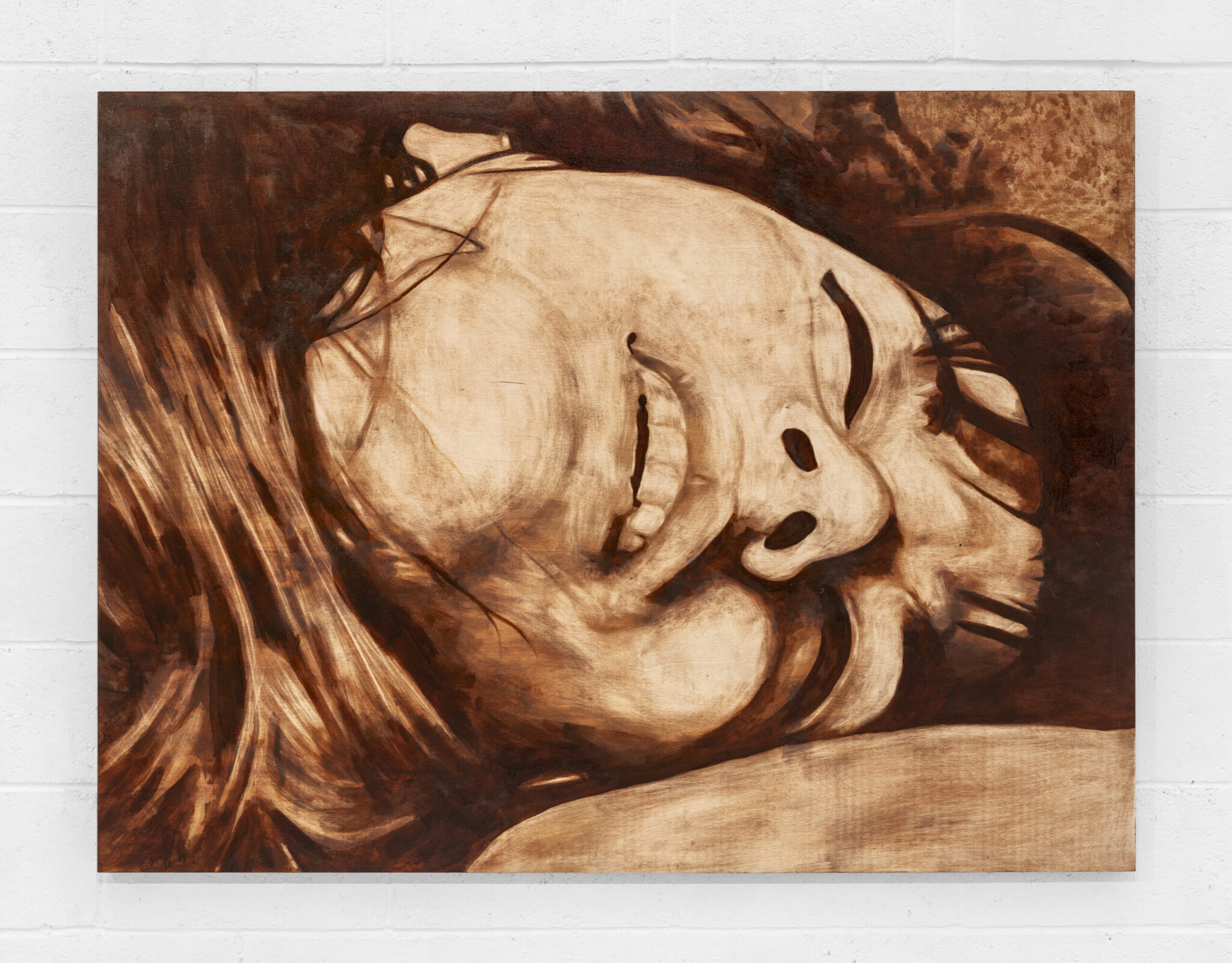
Orfeo Tagiuri: Yes, that’s often how I’ll start a lot of my works. For example, Beatnik Chaos (2024) takes inspiration from an image that comes from a newspaper feature where a woman and her partner were given LSD as part of a scientific study, and the photographs documented them becoming progressively more altered. What interests me with that moment was the way it sits at a crossroads. It was a time where there was both a violent political climate and, at the same moment, blossoming of spiritual and psychedelic experimentation. So again, you have this tension between a subject full of spiritual potential in a way and a backdrop of a potent political moment. I think my work often sits between those two poles.
LVH Art: Could you talk more about your colour choices? Most of your works are in a brownish palette, they feel like they come from the same ‘universe’.
Orfeo Tagiuri: All my works are on wood, so the tones are naturally wooden. The only thing changing the colour is wood stainer. I rarely use other materials, except for the occasional oil pastel.
LVH Art: How did you first discover wood as a medium, and what attracts you to working with
it?
Orfeo Tagiuri: When I was at the Slade, we had to write an essay choosing five of our favourite contemporary artworks. I picked five things that weren’t technically artworks at all — but I defined them as such. One was a woman who lived near a church I passed daily. Every week she would place a huge bouquet of fresh flowers at the church door. I thought of that as a kind of performance sculpture. Another came from my mother’s work: she was a child psychiatrist, and one of her patients, during recovery from addiction, had been given a box of sweets. Each day she allowed herself only one sweet and then stuck the wrapper to her hospital window. Over time it became this stained-glass-like collage. When she finished her treatment, she peeled the wrappers off the window and gave them to my mother as a gift. To me, that was one of the most powerful artworks. I wrote my essay around gestures like these.
My professors pulled me aside and said, “You’ve critiqued the whole idea of institutions, as you haven’t mentioned a single artist, gallery, or museum.” I thought I was about to lose marks or be criticised, but instead they gave me a long list of artists who had done exactly this kind of work – blurring art and life, subverting and expanding the art world. That moment revealed to me a whole lineage I hadn’t known existed. For my degree show, I recreated a classroom with eight desks in the centre. On each desk, I carved into the wood as if a troublemaking student had been given endless time to leave their scratchings. That was the beginning of me working with wood — turning this institutional space into one that also allowed for daydreaming, and play.
LVH Art: You studied Creative Writing before. How did the shift toward art feel for you?
Orfeo Tagiuri: I studied Literature and Creative Writing at Stanford in California, and still do quite a lot of writing, especially when making paintings. I sometimes think of it as taking footsteps. One step might be making an image or working with a photograph, and the next step is writing; which becomes a way of analysing why I was drawn to that subject in the first place. What I like about doing both is that in making art, you don’t always need to know why you’re interested in something – you can just jump in. Then writing gives you a chance to reflect and understand what that interest was. That in turn becomes another step. So it becomes this cycle: not knowing, then curiosity, then research and knowing, and then back again to not knowing, curiosity, research, and knowing, etc.
LVH Art: The new works are quite different from your previous works. Could you tell us more
about the shift in style?
Orfeo Tagiuri: Yes, so before I used a lot of imagery I imagined myself. I was inventing subjects for things I was internally feeling, or narratives I was curious about, but now I am looking more at capturing these historical moments.
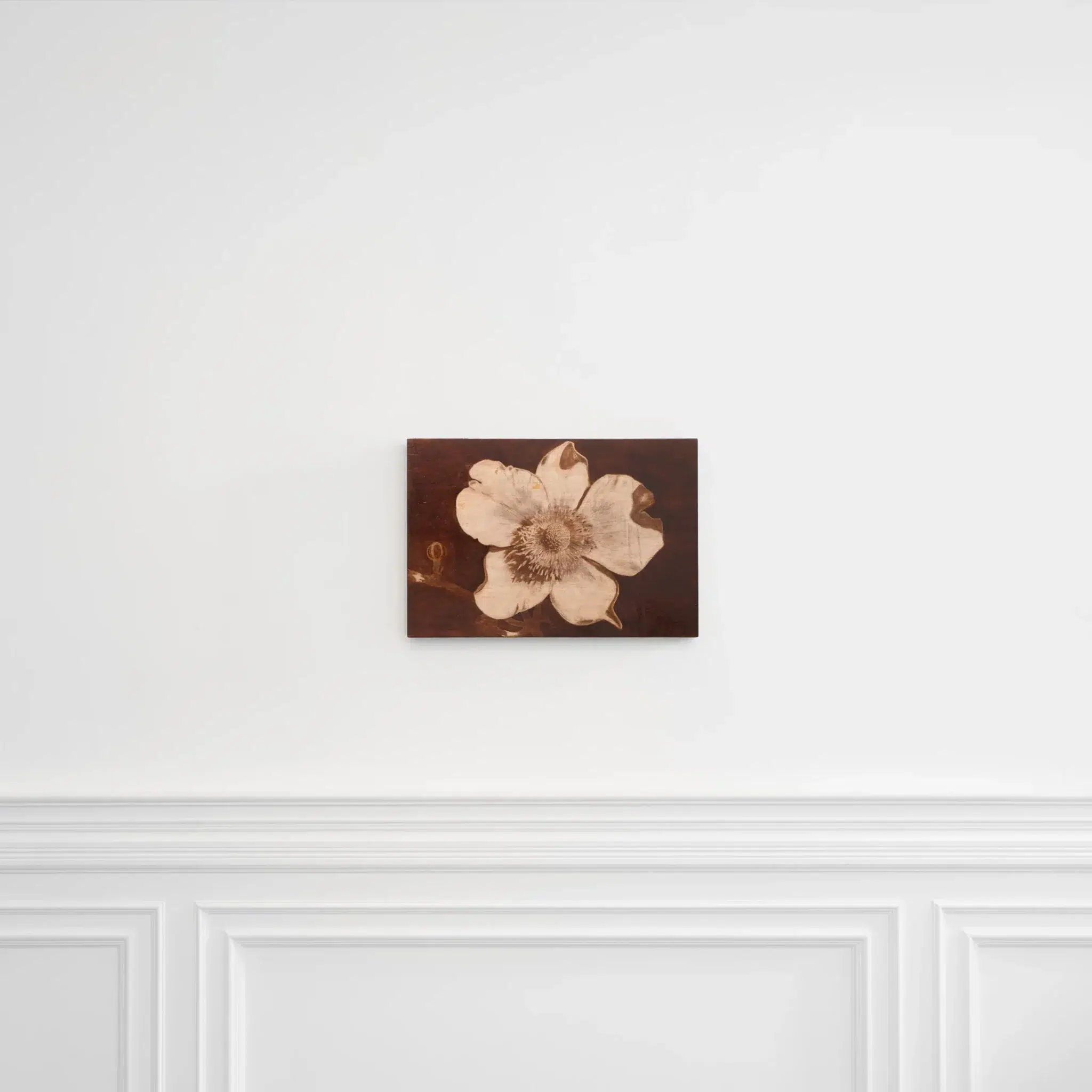
I think the turning point for me was during an artist residency called IM Residency in Worlingham, Suffolk in April last year. There were a lot of flowers that started to open while I was there, and by the time I left they were fully blossoming. In particular, the magnolias. I started drawing them just as an exercise, and then I learned that magnolias have both male and female parts, but they can switch them off and on. I think noticing how something as simple as a flower can hold that kind of narrative — the same kind of narratives I’m trying to tell through my own imagery — suddenly opened up a door. So, everything I’m curious about can tell a story, whether it comes from me or from the world.
LVH Art: Do you have any creative rituals or processes that help you get into the right mindset?
Orfeo Tagiuri: The nice thing about working on wood is that it has to be prepared, as I need to put down a base layer and then several layers of stain. There’s already a rhythm built into that process before I even start making deliberate marks, and I think that helps get me into the zone.
LVH Art: Are there any artists or writers who inspire you at the moment?
Orfeo Tagiuri: I’m always drawn to the poet James Tate. He describes very ordinary situations, but each one has a kind of twist to it. Another artist I admire is David Horvitz, an LA-based artist who interacts very poetically with the world around him. His work is quite conceptual, but also accessible, not alien or opaque the way some conceptual art can be. For example, he once made a project where every time he went to a café, he would steal a spoon and mail it to MoMA. Eventually, there was a drawer in one of the offices filled entirely with these stolen spoons, and he turned it into a book called Stolen Spoons. He also made a beautiful work where he collected sea glass — the broken bits of glass you find on the beach. He gathered so much that he was able to melt it down and make new vases.
LVH Art’s List: What to See in Paris during Art Basel this Year
LVH Art’s List: What to See in Paris during Art Basel this Year
In Conversation with Isabelle and Christine d’Ornano