In Conversation with Lucas Dupuy

For our upcoming exhibition Urban Dwellers, LVH Art sat down with London based artist Lucas Dupuy to discuss his process and inspirations.
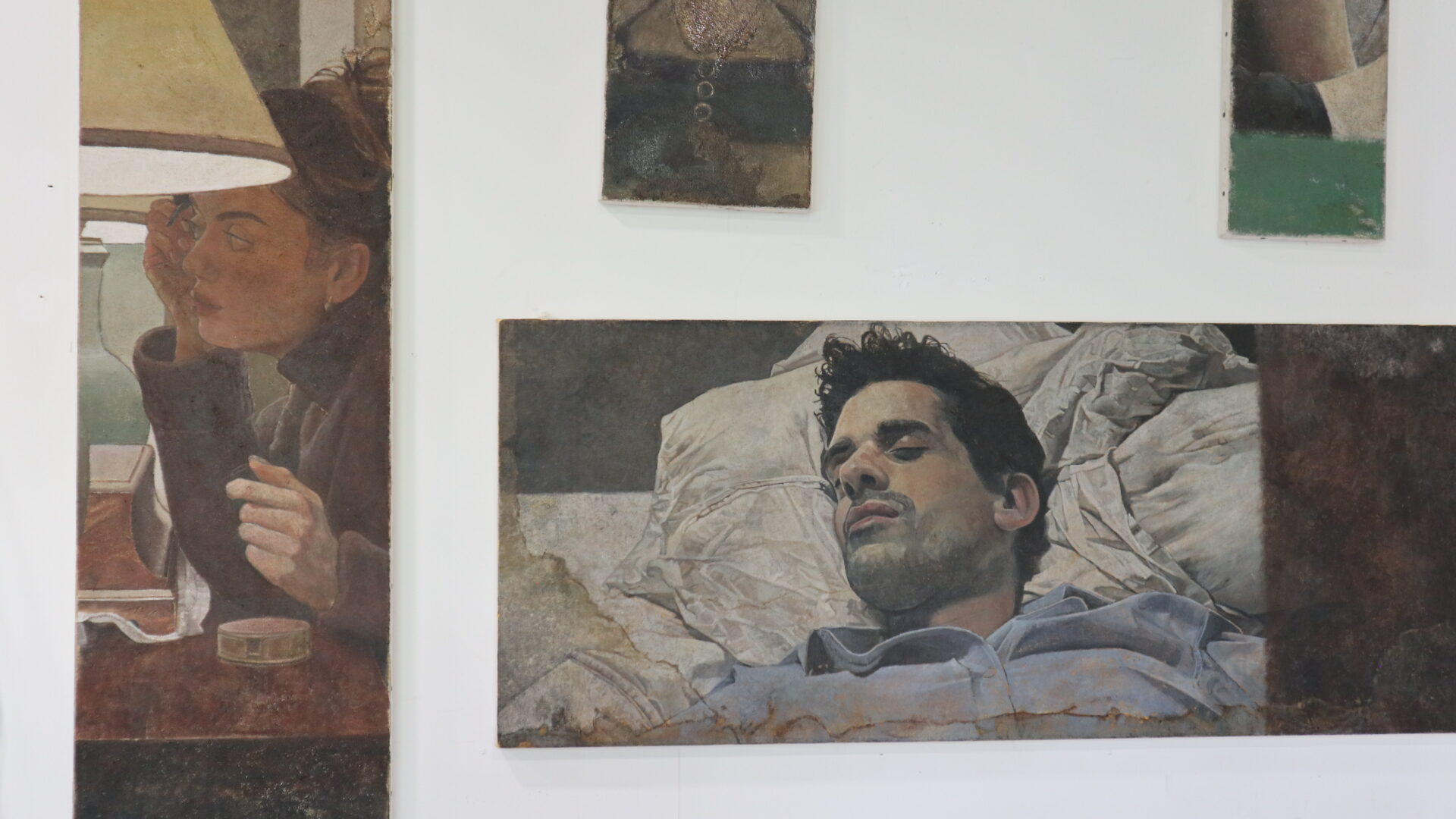
Lucas Dupuy (b. 1992) is a London-based artist whose work explores the intersection of language and form, inspired by the bold geometry of 20th-century Brutalist architecture. He plays with perspective, composition, and light, capturing fleeting moments as he builds, erases, and reworks surfaces. Using acrylic or gouache on raw materials like hessian or canvas, Dupuy layers paint intuitively to create subtle, elongated brushstrokes. For Urban Dwellers, we commissioned him to paint a wooden door in the main exhibition space as a response to the environment. He is also contributing an additional artwork to the show, and discusses both pieces in the interview.
LVH Art: Your work often sits at the edge of language and form. When you start a work, do you map a structure first, or let the composition emerge through layering, erasing, and return?
Lucas Dupuy: I work on many drawings in the studio, and these often evolve into larger paintings. The process is somewhat obsessive, I’ll crop, layer, and project parts of these smaller studies to arrive at a final composition. It’s rarely about mapping everything in advance; instead, it’s a process of discovery through repetition and alteration. Each new layer can shift the work’s direction entirely.

LVH Art: You’ve completed several commissions in the past, but was this the first door you’ve ever painted? What was the experience like working in the space? Were there any thoughts or inspirations going through your mind during the process? Did you approach this commission differently from your usual practice?
Lucas Dupuy: It’s the first door I’ve ever painted, yes! The space itself has a lot of history, and that immediately affected how I approached the work. The light moves through the room in such a beautiful, shifting way throughout the day. I found myself constantly taking photos of reflections and shadows. They became a kind of visual language that helped guide the painting process. James Turrell’s work kept coming to mind while I was painting, particularly the way he treats light: “For me it was important for people to come to value light. To value light as we value gold, silver, objects, paintings.” This quote has always resonated with me, and it returned to me strongly in this context. The space itself felt almost spiritual like a chapel or a concert hall, especially with the high ceilings and the way light moves around within it. I definitely approach commissions differently from my studio practice. When working in a specific location, I think a lot about how the piece will interact with its surroundings. For this project, I focused on creating a composition that felt as though it was meeting in the middle, radiating outward from a central point. It was about allowing the work to live within the space rather than simply occupy it.
LVH Art: You’ve spoken about dyslexia shaping how you see words as shapes and symbols. How does that experience guide your use of grids, fragments, and “unreadable” marks today?
Lucas Dupuy: That experience has definitely played a role in how I think about visual language. When I was younger, dyslexia made reading a very physical experience. Letters and words didn’t always appear as stable, fixed forms but as shifting shapes or abstract patterns. I used tinted overlays to help focus on sentences. That early experience informed a lot of my mark-making. I began to see language less as text and more as image.
Over time, that has evolved into a broader interest in abstraction, using fragments and marks that echo written forms but resist direct readability. These gestures still carry a sense of communication, but they move away from literal language toward something more open-ended, influenced now by both nature and architecture.

LVH Art: Brutalist architecture and city structures recur in your paintings. What aspects of those forms — their mass and rhythm — are you translating, and where do you allow them to dissolve into atmosphere?
Lucas Dupuy: I’ve always been drawn to Brutalist structures. There’s something fascinating about how these massive concrete forms can simultaneously feel monumental and fragile, depending on how light hits them or how they weather over time.
In my paintings, I try to translate that sense of rhythm and presence. I often begin with a clear grid or structural form, but as the painting develops, it becomes clear its moving between precision and ambiguity, just as the city itself does.
LVH Art: You frequently work with gouache and acrylic on raw supports like hessian. What about that material attracts you and your practice?
Lucas Dupuy: I’ve always been interested in the tension between fragility and durability. Hessian has this rough, open weave that absorbs paint in unpredictable ways. That unpredictability becomes part of the work’s energy. I like how the surface interacts with the medium and how areas of paint can sink in deeply or sit on top. It exposes the process, allowing you to see where decisions have been made. That tactile quality feels essential to my practice.
LVH Art: What was it about the theme of Urban Dwellers that first attracted you, and how do you feel your work connects to it?
Lucas Dupuy: The quote from Martin Wong used in the show’s text, his view of the city was incredibly inspiring (“Everything I paint is within four blocks of where I live, and the people are the people I know and see all the time.”-Martin Wong). His ability to see poetry and humanity within urban spaces has always been very important to me. Growing up in London, I’ve always found the city to be an endless source of inspiration — not just for its architecture but for its constant movement and energy. The city is a kind of living organism. I hope that’s reflected in my work, it’s moving, but it also attempts to hold qualities of stillness.

LVH Art: Can you speak in detail about the artwork that you created for Urban Dwellers? What were some of the ideas or themes you were exploring while creating it? How did the work evolve during the process? Did it change from your original idea?
Lucas Dupuy: For Urban Dwellers, I wanted to explore how architectural and organic forms could merge — how the language of the city could be reinterpreted as something softer. I reflected on the wall painting and how this work responded to the space, bringing some of that same energy into the studio, as I made both works during the same period. I was thinking about the scale of the space and felt this long, thin format would lend itself well to the building, this also helped inform the mark making.
LVH Art’s List: What to See in Paris during Art Basel this Year
LVH Art’s List: What to See in Paris during Art Basel this Year
In Conversation with Isabelle and Christine d’Ornano