In Conversation with Jameela Stenheden Gordon-King

For the upcoming exhibition Urban Dwellers, LVH Art sat down with London-based artist Jameela Stenheden Gordon-King to discuss how movement, rhythm and gesture animate her practice.
Jameela Stenheden Gordon-King (b. 1998) works primarily across painting and drawing, treating line as an active force whose speed, rhythm and intensity register the motion of her own body. Figures in motion recur throughout her canvases and works on paper, where gesture becomes inseparable from image. Combining charcoal, oil paint and distemper, often with pigments she grinds herself, Gordon-King tests the boundaries between drawing and painting, grounding her images in earthy tonalities while allowing sound and music to shape the scale and cadence of her compositions. This interplay of material, sound and motion underpins works such as Blue Note (2025), which will be included in the Urban Dwellers. Our conversation traced these concerns, exploring how Gordon-King translates internal and external rhythms into visual form and how presence and process converge in her studio.
LVH Art: Can you describe your creative process? Do you have any rituals or habits?
Jameela Stenheden Gordon-King: I wouldn’t really say I have any specific rituals. I do tend to listen to music while I work, usually it would be Jazz – lots of Nina Simone and Alice Coltrane. It ends up being part of my environment. I have also started to do collaborations with musicians, which stemmed from the listening of Jazz and interactions with live music.
LVH Art: How do these collaborations with musicians work, and what do they bring to your practice?
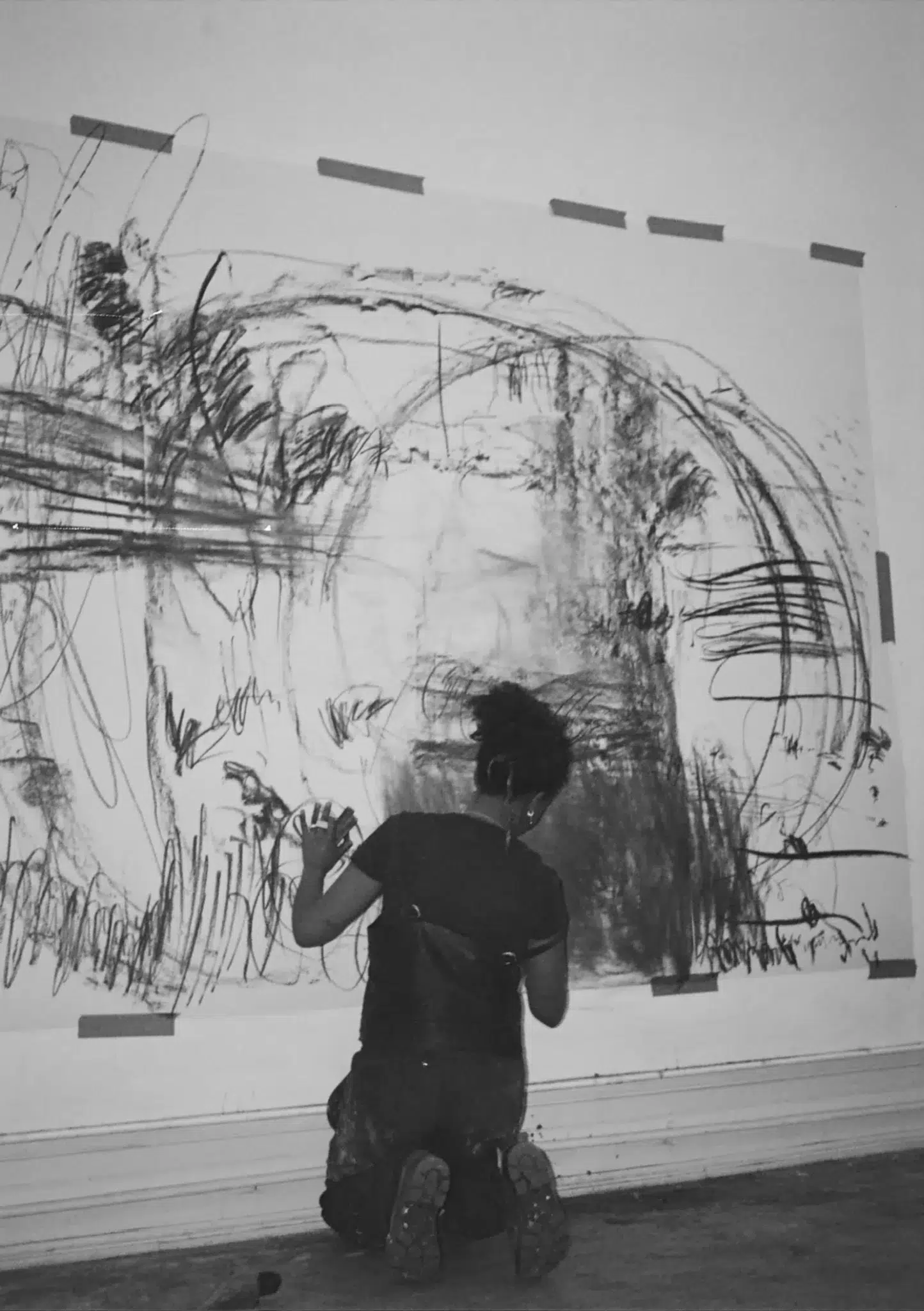
Jameela Stenheden Gordon-King: The collaborations are a conversation, a back and forth. The musicians that I have worked with most regularly are Arnold, who plays clarinet, and Avila who plays the drums amongst many other instruments. They respond to my drawing, and I to them playing. With the tapping of the charcoal and notes from their instruments informing each other. I record these sessions, then listen back to them when painting.
LVH Art: Are these collaborations mainly for drawing or painting? How do drawing and painting relate in your practice?
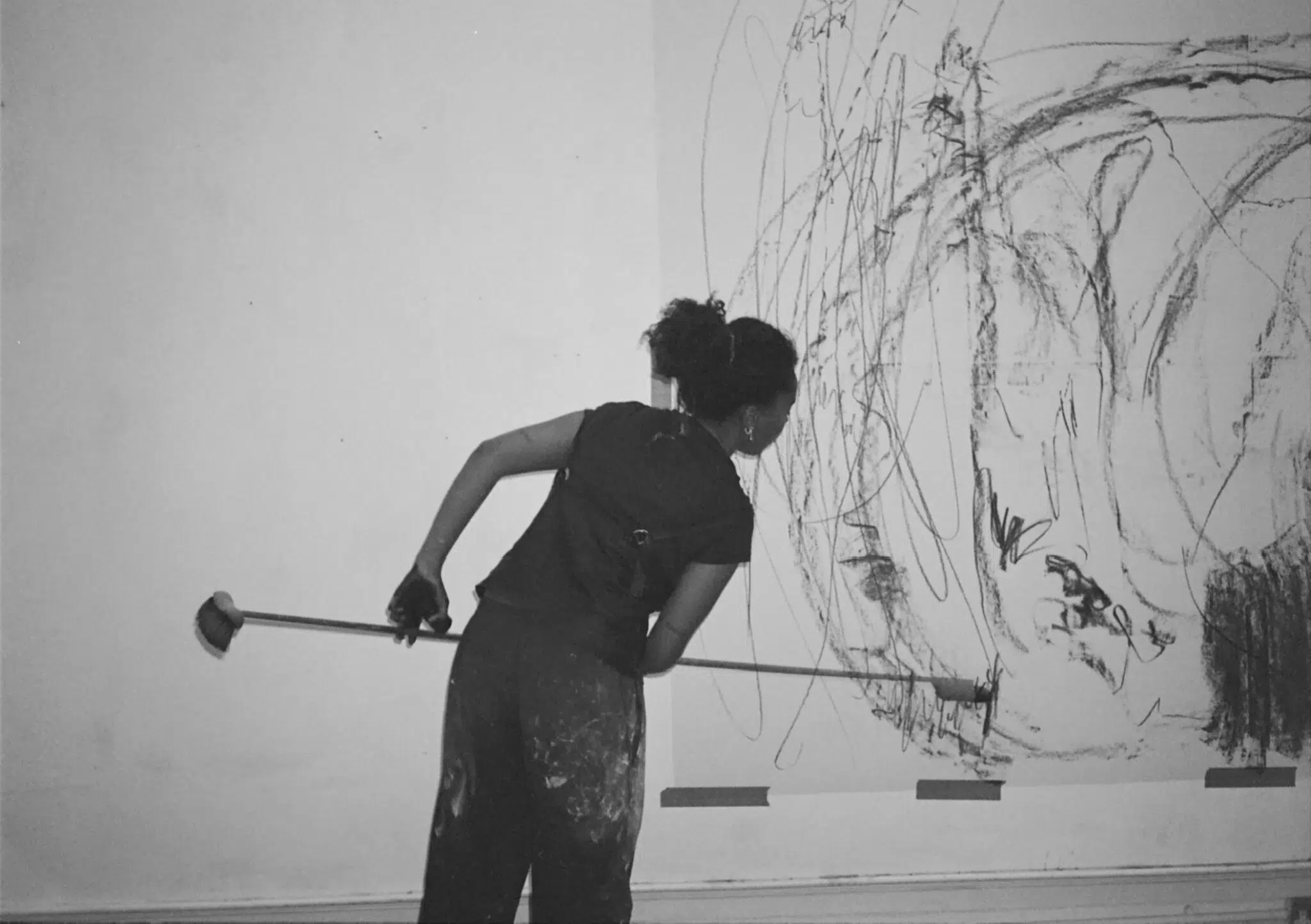
Jameela Stenheden Gordon-King: Most of the collaborations with musicians have been with charcoal drawings because the medium is immediate and doesn’t require a slowing down to think about colour. Drawing and painting have a cyclical relationship in my work. When I was living back home in Sussex, I’d go for walks by the river and fill a sketchbook with quick studies. Later, I’d take those sketches to the studio and develop them into larger ink or charcoal works. The paintings in my degree show were documentations of the act of drawing itself, of the body in motion as it makes mark. For me, drawing and painting are on equal footing; they inform each other.

LVH Art: Does music influence your painting as well?
Jameela Stenheden Gordon-King: Yes, it’s in everything I do, rhythm. For Blue Note I listened to a recording from a collaboration with Avila and Arnold while painting. But with painting, I sometimes need silence to focus, especially when I’m working with colour. Its bursts of energy followed by stillness. It really depends on the moment.
LVH Art: Can you tell us more about your work Blue Note which will be included in Urban Dwellers?
Jameela Stenheden Gordon-King: Blue Note started again as a documentation of the collaborations and of the body. I listened back to recordings from one specific session from earlier this year, and wanted to allow for the sound to come through into the painting: in parts writing a kind of musical language, dictionary of sound. The painting brings together different types of making marks and arranging of space, it feels it’s a culmination of all the knowledge I’ve gathered so far.
LVH Art: How does working with colour affect your process?
Jameela Stenheden Gordon-King: Colour adds another layer of complexity. I’m always thinking about how each colour or tone relates to the others. With Blue Note and similar works, I use oil, alongside distemper, which dries quickly and requires mixing each colour from pigment. You can’t just squeeze it from a tube, so you have to work in sections rather than layering everything at once. There’s a kind of time pressure, because the paint dries fast, and you have to be decisive. I like that it forces me to slow down and think, even as I’m working quickly. I remember listening to Andrew Cranston talk about the sectioning that distemper pushes you to adopt before I’d tried it, and it really rings true.

LVH Art: Why do you often return to charcoal as a medium?
Jameela Stenheden Gordon-King: I started using charcoal for quick drawings, I like the immediacy and the fact that it is a completely natural substance. Its relevance grew after being involved in the coppicing of trees for a charcoal company in Scotland. Their process is slow and sustainable, as they wait seven years for each plot of trees to grow before processing. The charcoal itself is uncompressed and comes in large sticks, sometimes half a meter long. I love the materiality of it: the way you can make big, physical marks, and even the smell of the fire in the charcoal. It’s a very direct, tactile medium, and I’m drawn to that.
LVH Art: Movement is a key part of your practice, both in the physical act of painting and in the figures, you depict. How do you think about movement in your work?
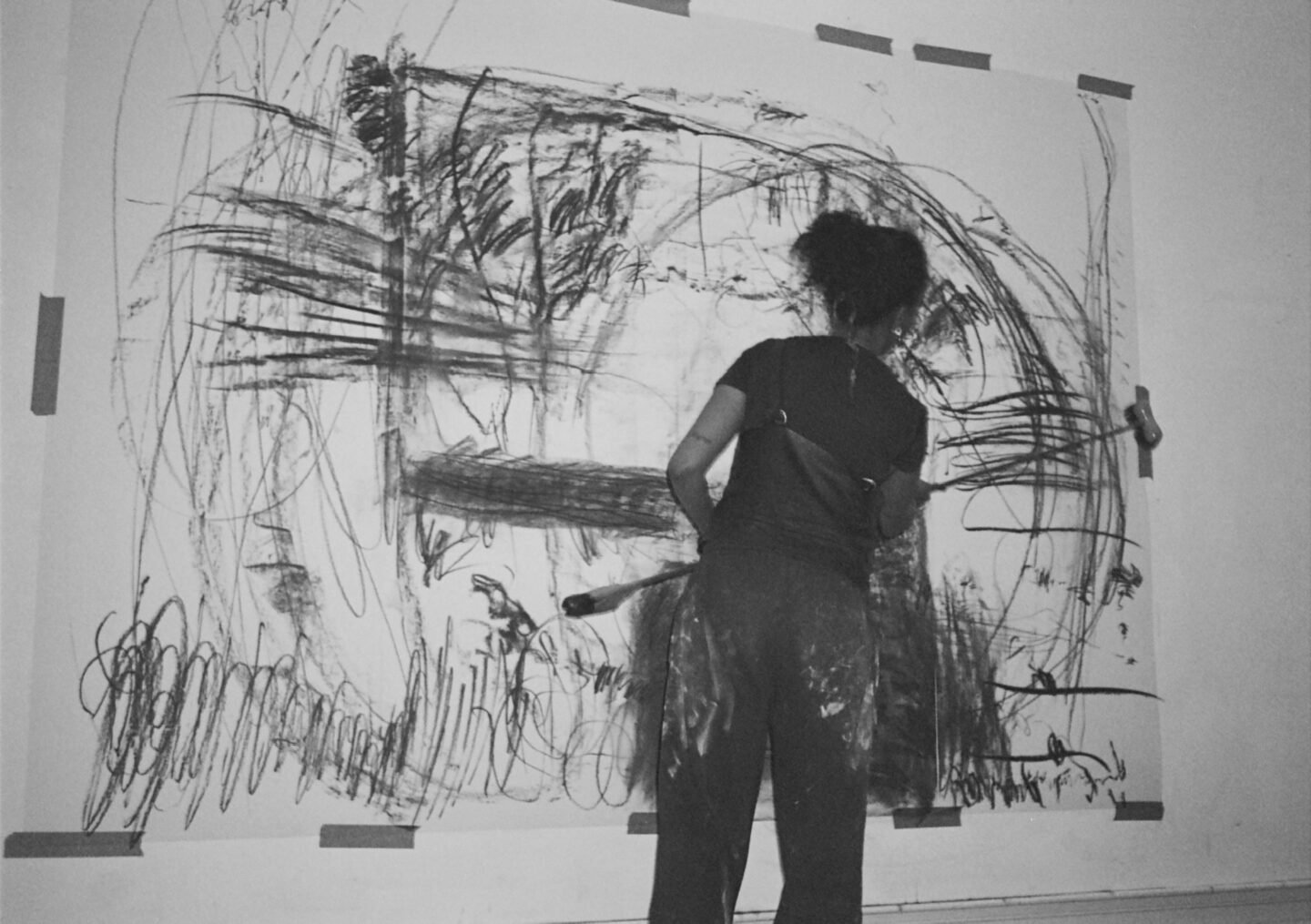
Jameela Stenheden Gordon-King: Movement is central, especially in large-scale works. I started making big circular marks with my whole body while listening to jazz, which led to more physical drawing that engages the whole body. I had the chance to use the Bloomsbury Theatre whilst ay Slade, a huge paint frame that’s about 10 meters long and almost as tall. The circles began as a way to loosen up and activate the composition. Sometimes I document these sessions to use as references for figures in my work. The act of moving, responding to music, and making marks becomes a kind of dance, and that energy is captured in the finished piece.
LVH Art: What tells you that a painting has reached its point of completion, and how do you recognise that moment in your process?
Jameela Stenheden Gordon-King: There’s just a moment when I feel it’s done. I don’t like to overwork pieces, but I am obsessed with the idea of concealing and working over, so if I do go too far theres usually a way to bring it back. The time it takes to finish a work can vary from a few days to a few months. Sometimes I’ll leave a painting in the studio for a long time and come back to it later, adding to it whilst working on other pieces so they are in dialogue with each other.
LVH Art: Are there any artists, writers, or other creatives who have inspired or influenced your practice? If so, what about their practice or ideas resonates with you?
Jameela Stenheden Gordon-King: Right now, Goya is a big inspiration, especially his Black Paintings and the way he depicts the weight and movement of bodies. I’ve spent a lot of time with his work here in Madrid, and I hope to see his drawings in the archives. I also look at Cy Twombly, for the way that he understands the materiality and substance of paint, you can feel the speed of his hand when looking at his paintings. But also, for his use of mythology, how he is able to distil stories into these compositions that don’t bear everything at first glance, you have to work to draw out knowledge. They’re like musical scores or notes.
LVH Art: How has your work evolved in the last years?
Jameela Stenheden Gordon-King: Collaborating with others has changed my practice, making it less singular and more dynamic. I used to think of painting as a solitary activity, but working with musicians and other artists has opened up new possibilities. Both are necessary, to be alone and to be in a conversation. Working more consciously with movement too, being aware of how it guides the body has also shifted things significantly.
Mexico City Now: Artists, Galleries, and the Pulse of a Global Art Capital
Mexico City Now: Artists, Galleries, and the Pulse of a Global Art Capital
From Tradition to Form: Mexico’s Design Landscape Today