In Conversation with Gabrielė Adomaitytė

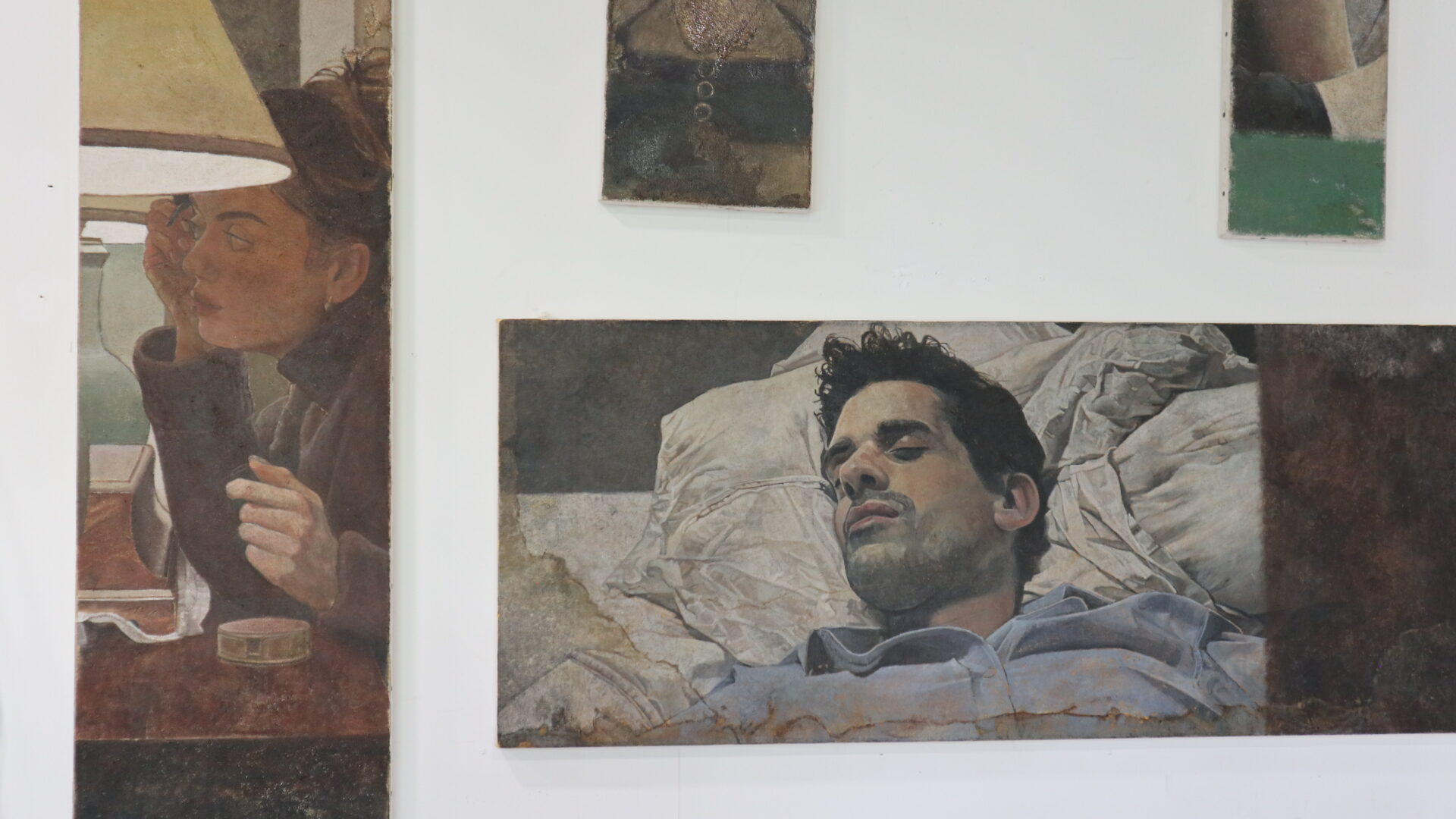
For our upcoming exhibition Urban Dwellers, LVH Art sat down with Lithuanian artist Gabrielė Adomaitytė to explore how she transforms archival material and digital fragments into gestural, painterly forms.
Gabrielė Adomaitytė (b. 1994) is a Lithuanian painter based in Brussels whose work explores how memory and material are stored, circulated and transformed in the digital age. She moves between archives, photography, writing and painting, treating each as a technology of remembrance and testing how traces fragment and re-form across different systems. Initially drawn to printed matter for its quiet material histories, she has shifted toward more direct and complex methods, transmitting networks of images, data and research into layered, gestural paintings. Patterns of repetition and sequence run through her practice, evoking loops, erosion and renewal rather than simple reproduction. In this way she situates painting within contemporary digital conditions, opening new frameworks for how personal, collective and planetary knowledge can be preserved, reframed and reimagined.
LVH Art: In your process, you move between archives, photography, writing, and painting. How do you connect these different knowledge frameworks?
Gabrielė Adomaitytė: I think of painting less as making images and more as building systems. Archives, photography, writing, and painting are all technologies of memory, and I move between them to test how information circulates, fragments, or collapses. For me, a painting is never singular, I see it as a repository.

LVH Art: In your earlier work, you engaged with printed matter such as photocopies or book pages, but over time your attention has noticeably shifted. What kinds of source material are most important for you today?
Gabrielė Adomaitytė: Printed matter first drew me in because its material subtleties already carry history without revealing any particular information. Although over time, I shifted towards more complex systems, choosing this direct interaction and transposition instead of copying the source material.
LVH Art: You often layer images, creating a dense grid or network. Why have you selected your specific subjects to clash, interweave?
Gabrielė Adomaitytė: My work is driven by accumulation. Images come broken up, indexed, or re-coded, like data in circulation. I let them coexist rather than creating painterly scenic views. The compositions are non-hierarchical. Everything happens all at once, so the body is decentralised. Painting evolves as a systematised totality.
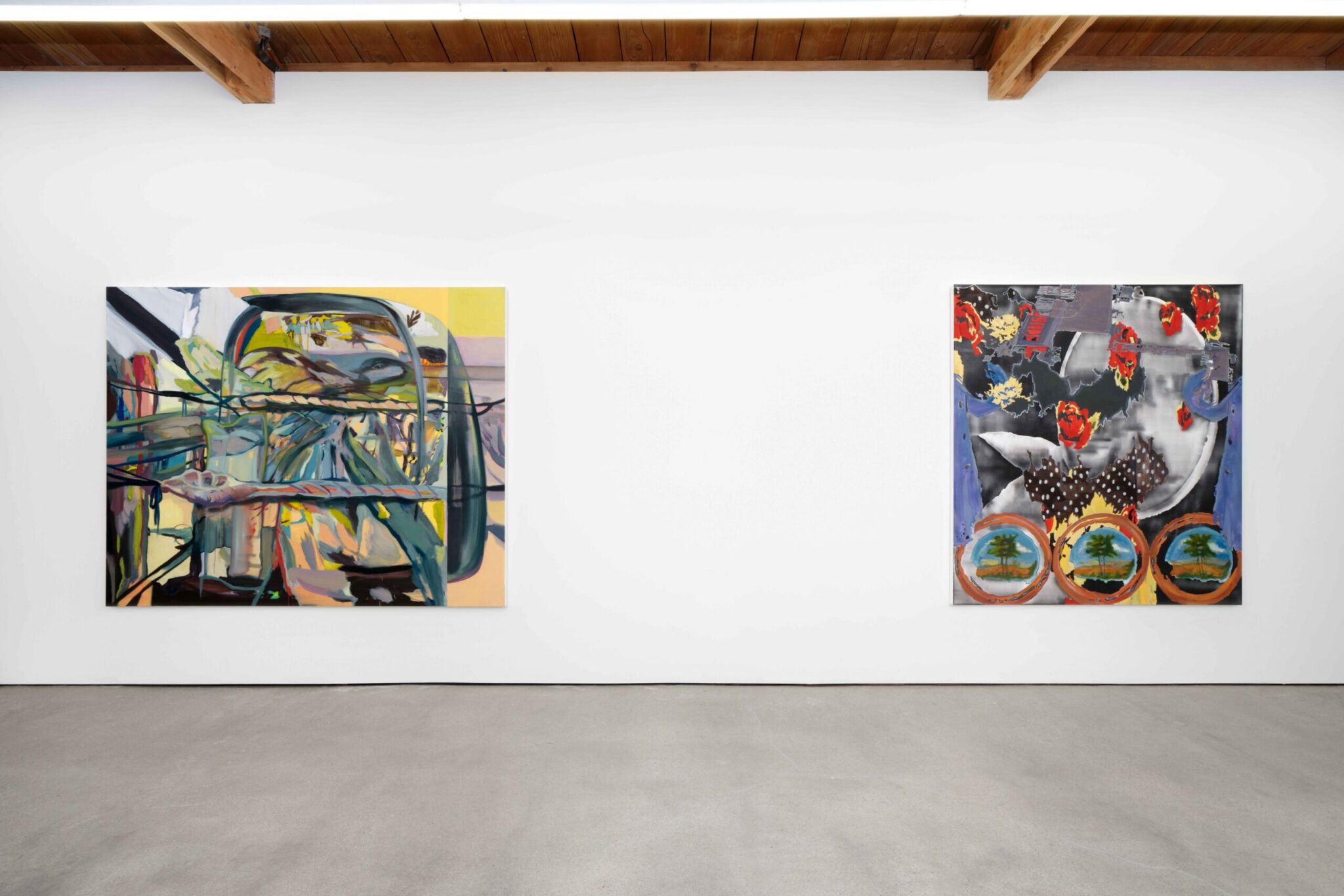
LVH Art: Can you talk about your source material in general and how your process of collecting and incorporating the photographic collection into your paintings evolved?
Gabrielė Adomaitytė: Collecting and categorising is at the core. If my earlier series dealt primarily with singular images, now I am drawn to constellations of knowledge infrastructures and archiving systems. The photographic collection is no longer just a resource bank, but a work in and of itself. My engagement with the vastness of data concedes to operating from a non-human-centric perspective.

LVH Art: Your paintings feel less like isolated images and more like networks. How would you describe them connecting across a room or within an exhibition?
Gabrielė Adomaitytė: I rarely think of paintings as closed objects. Each one is behaving in a system, and together they form networks. The exhibition space is an environment of relations sustained by its own logic, just as a collection does.
LVH Art: Technology, archives, and medicine intersect in your paintings. How do you see these systems converging?
Gabrielė Adomaitytė: I was always surrounded by medical iconography. With most of my family working as doctors and pharmacists, visiting hospitals was a big part of my daily life. Medical and diagnostic devices transform the human body into diagrams, scans, and language. What interested me early on was how the promise of technology, which appears so structural and aims for clarity, ultimately manifests as something incredibly fragile.

LVH Art: Can you speak in detail about the work you are showing in Urban Dwellers?
Gabrielė Adomaitytė: Automation (2025) began with my visit to the Abbey Library of Saint Gall in Switzerland. I often encounter terrestrial globe models in museums, which are symbols of science and, inevitably, its thresholds. That became the starting point. The work then evolved through fragments from medical imaging, echoscopy panels, and monitors appearing simultaneously. Today we are hyper-trained to absorb novel complexity, almost to the point of automation, yet our bodies impose hard boundaries. I am deeply invested in tracing what happens beyond these limits.
LVH Art’s List: What to See in London This October