From her Iconic Paintings Back to the Origin: Retracing Tracey Emin’s Journey

With her major retrospective now open at Tate Modern, we are spotlighting Tracey Emin, the fearless British artist renowned for her raw, provocative and deeply personal work. Emin rose to prominence in the 1990s as a key member of the Young British Artists movement. She established herself through a fearless willingness to place her own life at the centre of her art, developing a practice defined by a direct and unfiltered examination of love, loss, and self-discovery. Widely recognised today as one of the most significant living female artists, her major retrospective, Tracey Emin: A Second Life, further cements her enduring impact and relevance.
Tracey Emin, born in 1963 in Croydon, London, grew up in the seaside town of Margate. From the outset, her work has defied confinement to any single artistic medium. Her work moves fluidly across painting, sculpture, installation, neon, textile, and performance. Yet regardless of form, her work is unified by an unwavering commitment to emotional truth. For more than four decades, Emin has approached art-making as both a means of confronting trauma and a process of transformation, using creative expression to examine, endure, and transcend lived experience. As she herself described, “Making art lets me breathe, helps me to stop my mind from crashing in.”
In this article, we start with the paintings she embraced making later in her career. They convey a striking emotional depth shaped by lived experience and resilience. From there, we trace backward through her earlier career, examining the conceptual works and installations that established her practice and the themes she has remained true to from the very beginning.
Painting
Painting has occupied a complex place in Emin’s life. Although she trained as a painter, she abandoned the medium for a period following an abortion in her early twenties. To Emin, the smell of oil paint became intolerable, inseparable from trauma. For years, she turned instead to other forms, such as installation, textiles, and performance.
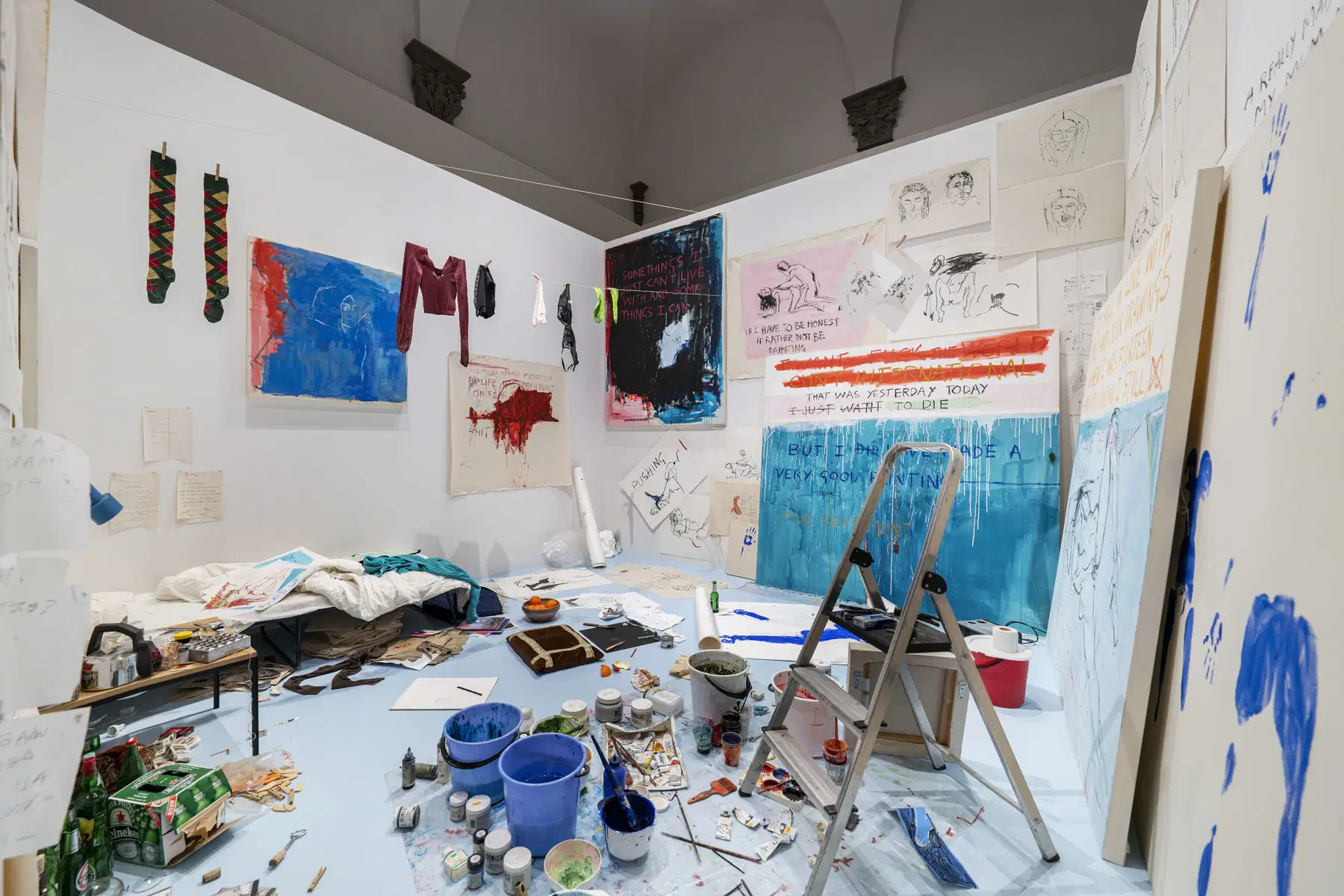
Her return to painting was itself a performative act. During Exorcism of the Last Painting I Ever Made, staged at Galleri Andreas Brändström in Sweden in 1996, she lived and worked inside the gallery for three weeks, transforming the space into both studio and installation. She painted openly and even slept on-site, allowing the entire process to unfold before the gallery visitors, blurring the boundaries between artwork and lived experience and between the private space of the artist’s studio and the public gallery.
Reflecting on her earlier decision to stop painting, she later remarked, “It’s like I needed to punish myself by stopping the thing I loved doing the most.” The statement reveals how intimately bound painting was to her identity. When it returned, it was no longer simply a medium. It had become a necessity.
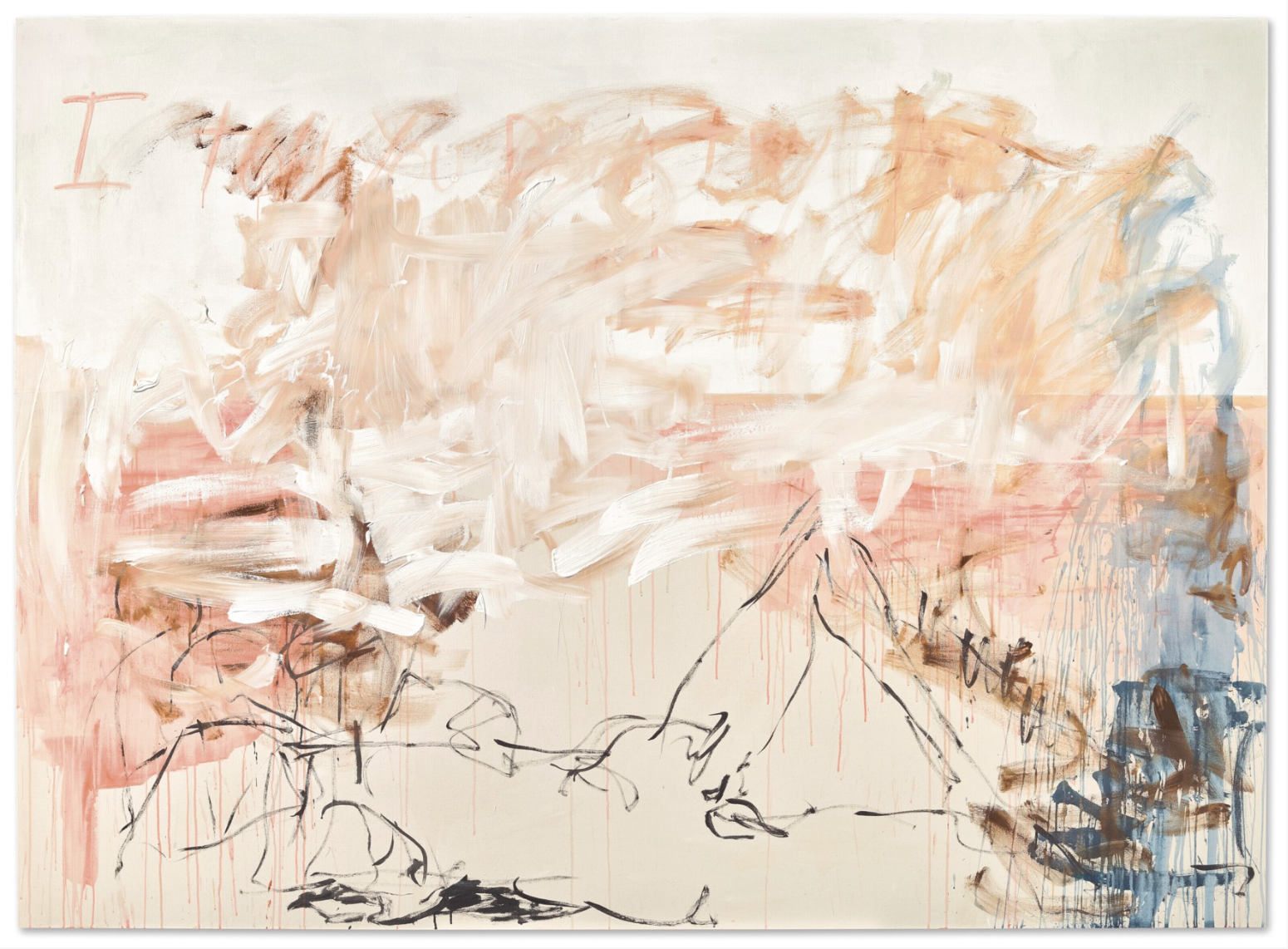
Painted in 2007, the year Emin represented Great Britain at the 52nd Venice Biennale, I Told You Don’t Try to Find Me belongs to a pivotal moment in the artist’s career. By this stage, painting had reasserted itself as a central medium in her practice, allowing her to translate the autobiographical intensity of her earlier works into a direct and physical painterly language.
In this work, the composition centres on a reclining female figure stretched across the canvas. The body is rendered with elongated limbs and fluid contours, defined through urgent, gestural lines. The sense of ground is mostly unclear, yet she may be suggesting that the figure rests directly on the canvas’s lower edge. Areas of exposed canvas remain visible, reinforcing the immediacy of the execution and the rawness of the surface. On the upper left of the canvas, a hint of text emerges, with the letter “I” clearly visible and the letter “t” partially buried beneath layers of paint. It’s evident that she originally wrote something, only to obscure it under thick, urgent brushstrokes. The beginning of the title is faintly visible in the text on the painting, suggesting it may reflect what was originally written but later covered. The title functions as both a declaration of withdrawal and an assertion of autonomy, while the painted figure remains fully exposed. The surface preserves the evidence of its making. Drips, revisions and thin washes of acrylic coexist with denser passages of pigment. This refusal of refinement heightens the emotional resonance of the work.
Emin approaches her work without a predetermined plan, letting intuition guide her entirely. In later interviews, she explained that she relies on what she calls “the thing” of painting — a force that animates the canvas. “I start to draw,” she said, “and then it starts telling me something I didn’t know before.”
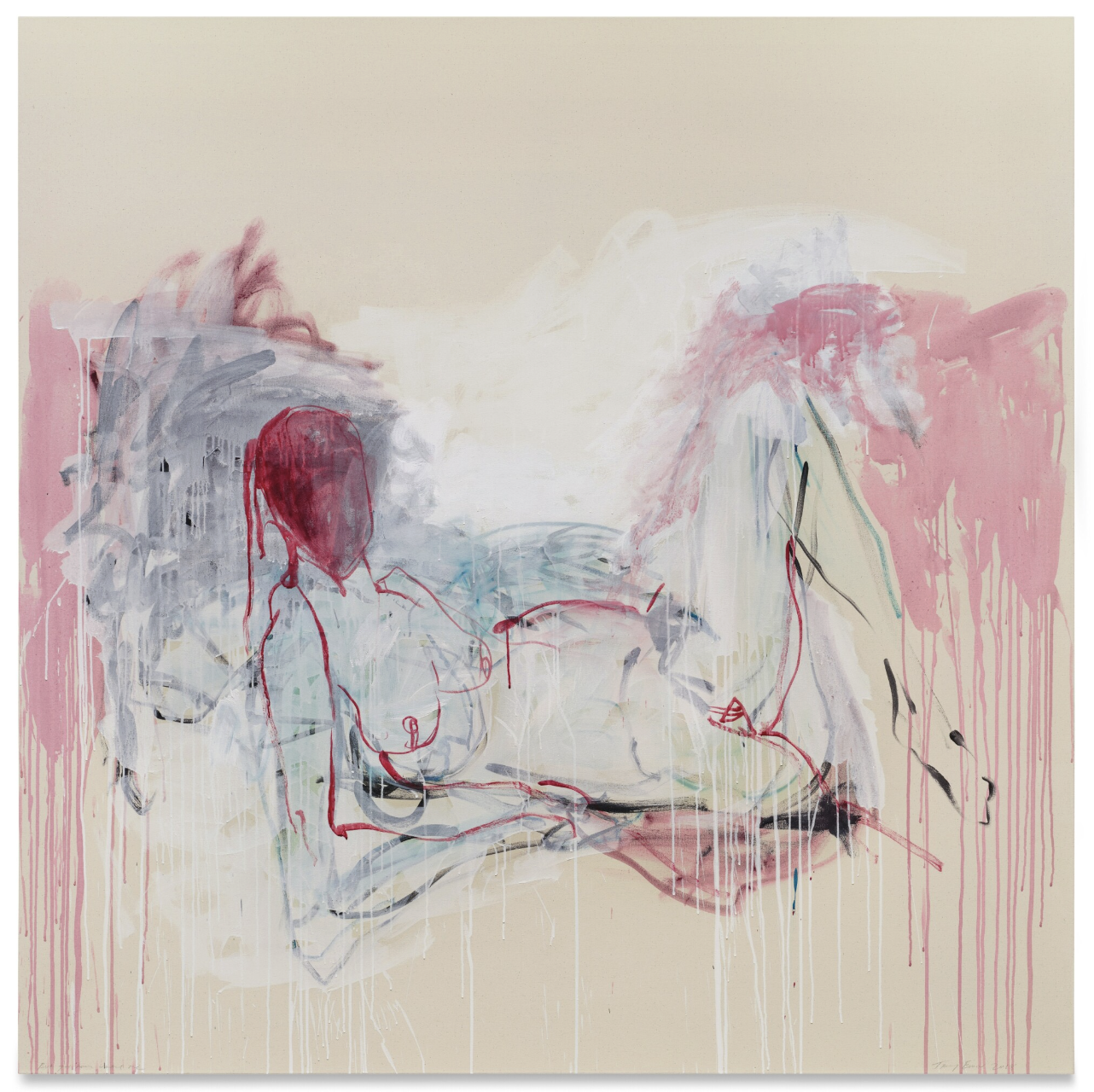
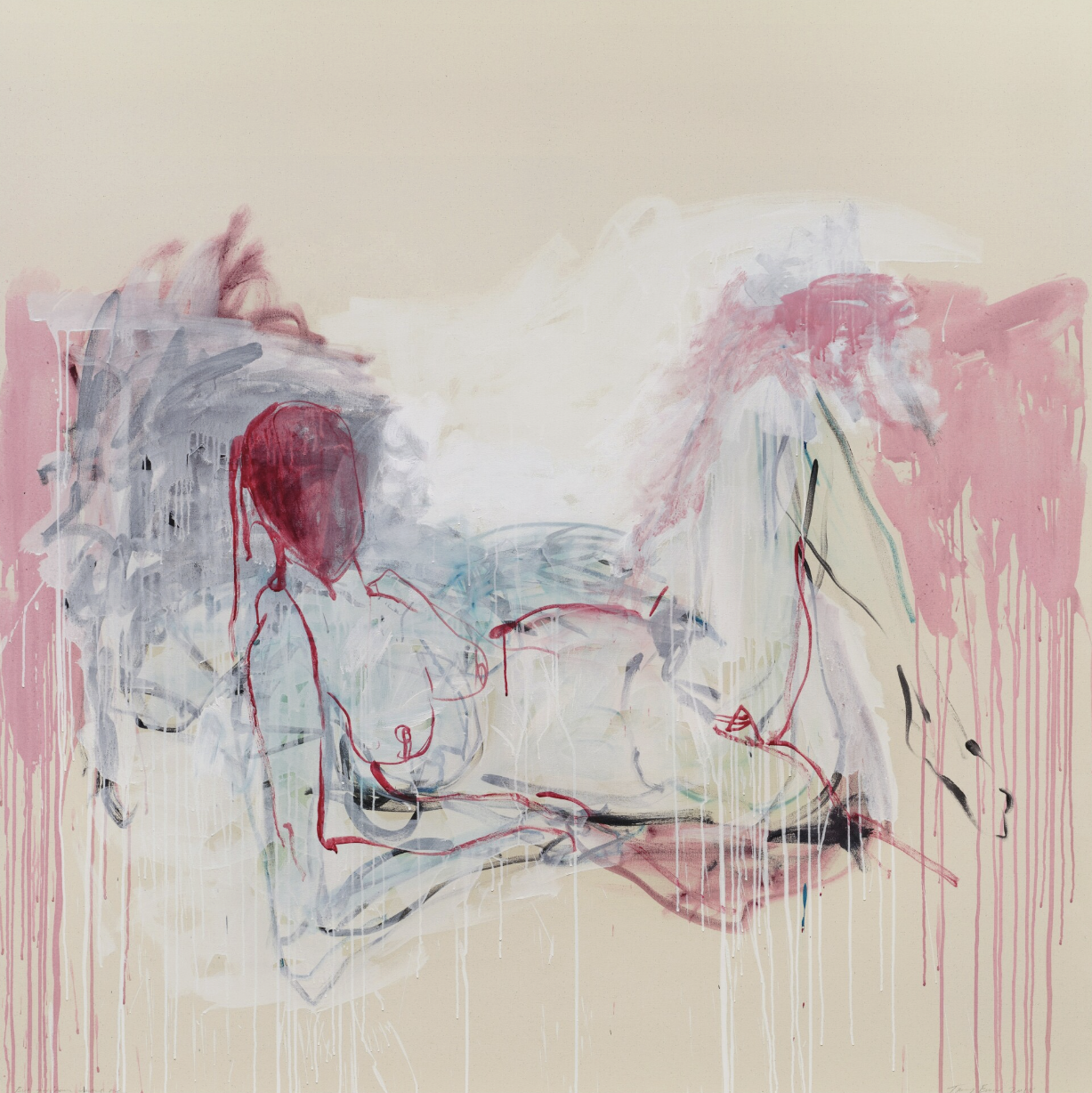
Painted more than a decade later in 2018, But You Never Wanted Me demonstrates the evolution and consolidation of Emin’s visual language. Here, her figures, often reclining or contorted, occupy ambiguous spaces rendered in vivid, emotionally charged colour. In Emin’s work, red functions as more than a chromatic choice. It evokes flesh, intimacy and emotional exposure, intensifying the psychological atmosphere of the painting.
The figure is delineated through fluid, searching lines that privilege emotion over anatomical precision. Limbs extend and curve with a sense of immediacy, suggesting movement and instability. The surface retains visible traces of the artist’s hand. Acrylic is applied in sweeping gestures, with translucent washes set against thicker areas of pigment. Notably, the face is obscured, submerged beneath a field of red. There are no discernible features, no gaze to meet the viewer. This absence is significant. By covering the face, Emin denies the conventional focal point of portraiture. Identity dissolves into colour. The red that envelops the head suggests flesh, evokes a wound, and conveys an overwhelming emotional charge all at once. It becomes a psychological mask rather than a literal one. Emin has remarked, “True art is very powerful; the greatest paintings have souls. They breathe and stare at us; we are looking through the artist’s eyes.” In this work, the “stare” does not originate from any depicted eyes but from the force of the body itself. The absence of a defined face intensifies this presence, inviting viewers to project their own emotional struggles onto the figure.
The title introduces a note of personal rejection, yet the scale and compositional dominance of the figure convey defiance rather than retreat. The body occupies the canvas with authority, transforming vulnerability into presence.
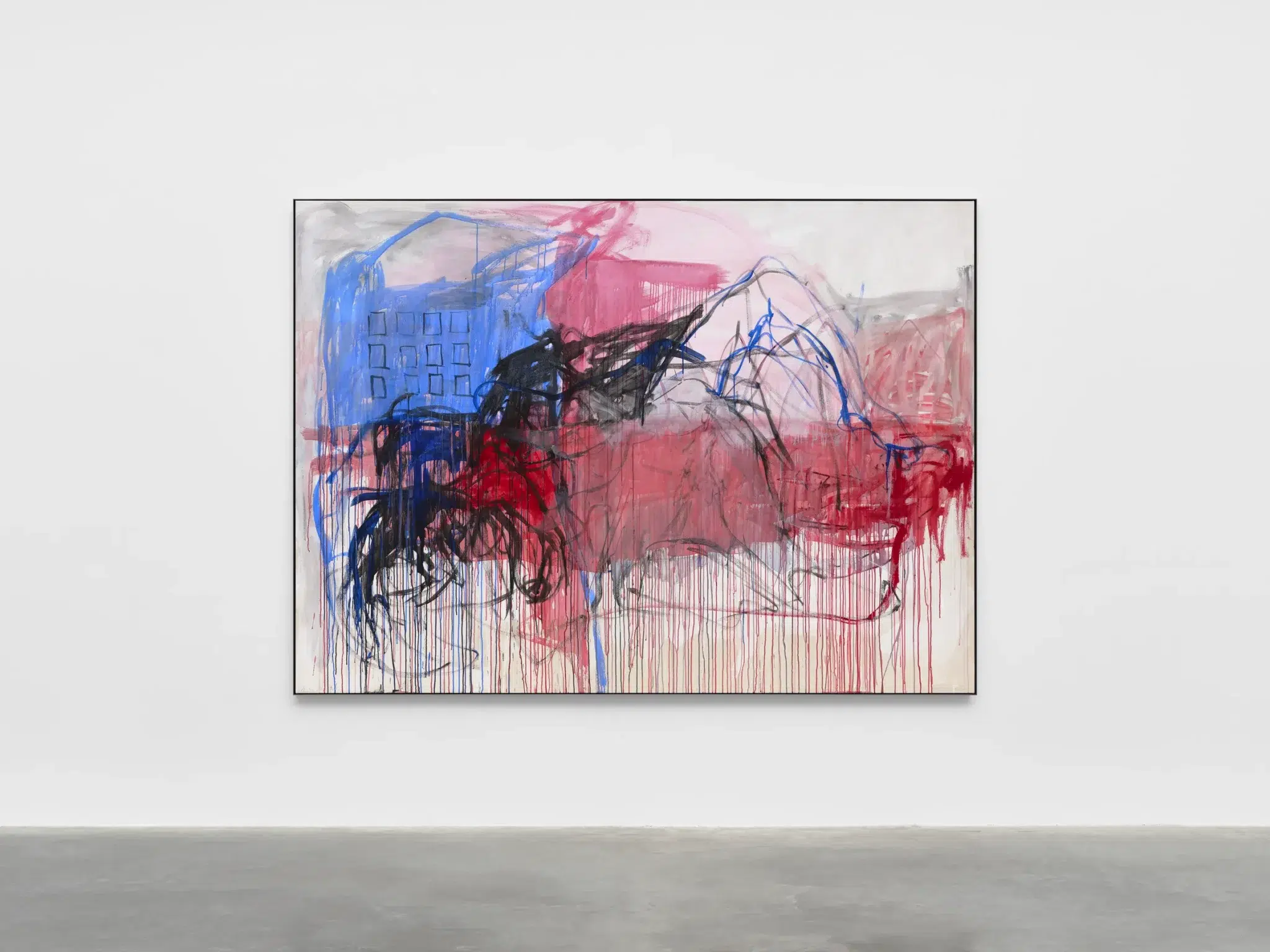
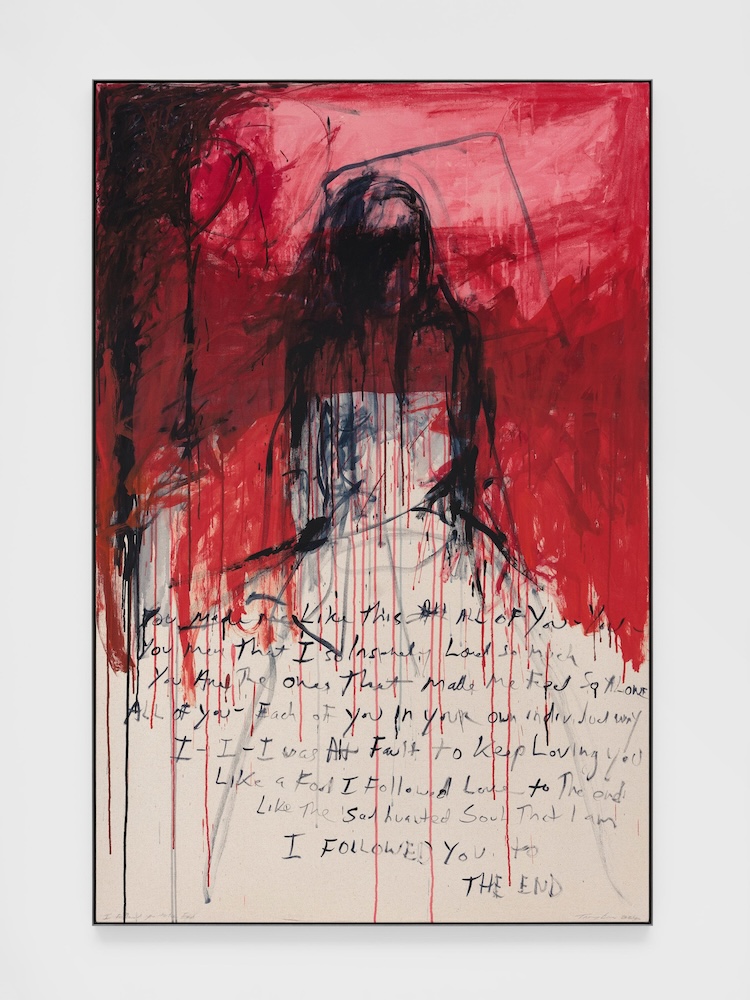
Painted in the aftermath of illness and major surgery, Another Place to Live (2024) occupies a pivotal position in the artist’s recent work. Created following her diagnosis with aggressive bladder cancer in 2020, the painting belongs to a body of work that confronts survival.
The composition feels more abstract than many of her earlier figurative canvases. While the female body remains central, it is partially entangled within a dynamic field of colour and line. A reclining form stretches across the surface, yet its contours dissolve into gestural sweeps of red, black and blue. The figure appears exposed, almost suspended within an indeterminate space, and space dissolves into fields of saturated pigment. In this work, Emin pushes the balance between figuration and abstraction further than in many of her earlier paintings. In the back left of the composition, she also introduces what appears to be a building, suggested through geometric forms. This structure may allude to the idea that, as human beings, we inhabit only one body, one place of shelter to care for and endure within; even through illness, there is no possibility of finding a new “home.” Exhibited as part of I Followed You to the End at White Cube Bermondsey in 2024, the painting signalled a new phase in Emin’s practice. The exhibition was widely understood as marking her reemergence following illness.
Sculpture
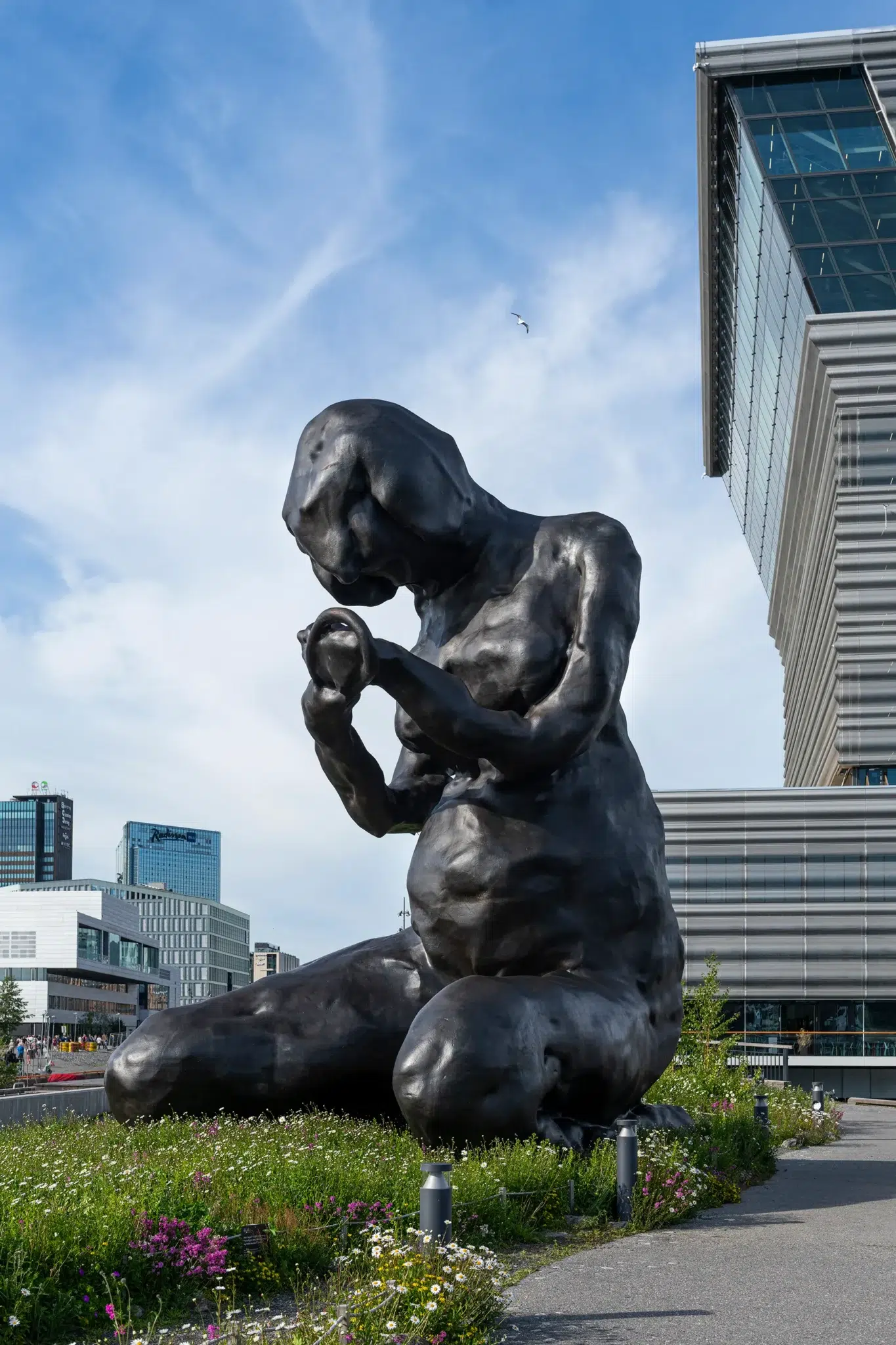
The Mother (2022) is a monumental bronze permanent sculpture installed outside the Munch Museum in Oslo, which overlooks the harbour. Positioned at the threshold of a museum dedicated to Edvard Munch, the work establishes a direct dialogue between Emin and one of her most formative influences. It marks her first permanent public sculpture in Norway and situates her within a lineage of artists concerned with psychological intensity and the expressive potential of the human figure.
“Munch’s mother died when he was very young,” says Tracey Emin. “So I want to give him a mother.” The statement is both personal and symbolic. By installing a maternal figure outside the museum, Emin offers a counter image to the absence that shaped Munch’s early life and haunted much of his work. From a young age, Emin was drawn to German and Austrian Expressionism, particularly the works of Egon Schiele and Edvard Munch. Their uncompromising treatment of psychological states and their distortion of the human figure shaped her own artistic sensibility. Her admiration for Munch was so profound that she dedicated her dissertation, titled My Man Munch, to his work. She later described the text as feeling like an intimate letter, a personal dialogue with an artist whose emotional honesty she deeply admired.
The sculpture itself depicts a nine-metre nude woman kneeling, her body slightly hunched as though bending protectively over an unseen child. The child is not physically present, yet the void beneath her torso becomes charged with implication. The posture conveys protection, grief and endurance simultaneously. The figure is elongated and subtly distorted, recalling Expressionist traditions, yet the surface retains the tactile immediacy of its clay origins. The Mother began as a small handmade maquette. “It started off with me playing with clay,” Emin explained. The decision to enlarge it was deliberate. “One reason is being close to Louise Bourgeois and seeing how she could go from small to giant.”
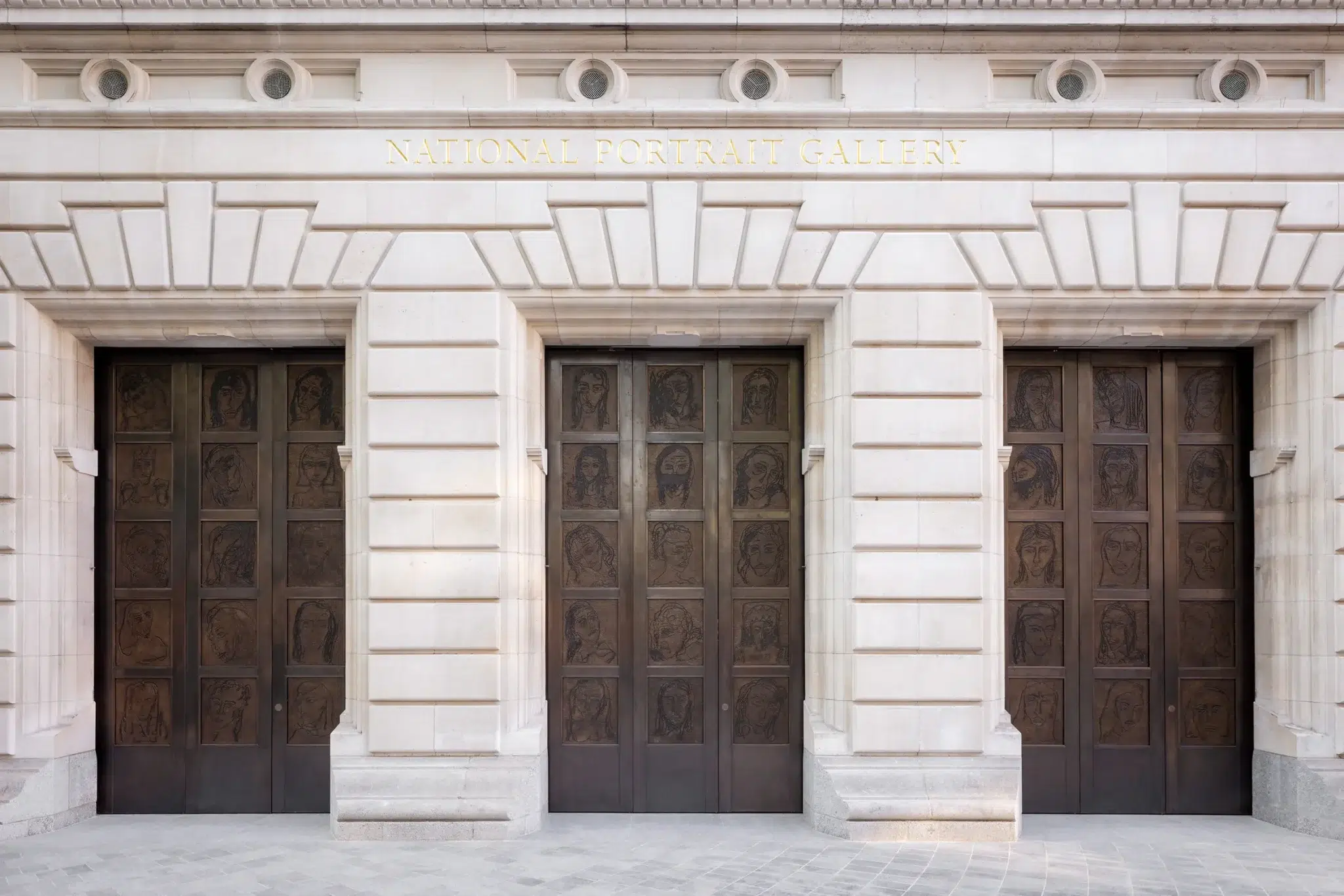
Emin’s commissioned work The Doors (2023), for the National Portrait Gallery in London, represents a landmark in her engagement with public space and institutional history. The project comprises ten bronze relief portraits cast from the monumental doors she designed for the gallery’s renovation. Originally painted in acrylic on paper, the portraits were meticulously transcribed into bronze panels. Each relief depicts a woman. Together they form a collective meditation on female presence and absence within art history. Emin articulated her intention: “Women in history are greatly underrepresented… I felt like the doors of the National Portrait Gallery should represent every woman, every age and every culture throughout time. I used myself as a mental template, but the end result is many different women, some that exist in my mind and some that perhaps exist in reality here and now, as well as from the past.”
The doors operate symbolically as thresholds. They mark entry into a space newly attentive to representation. Following the gallery’s renovation, the proportion of women displayed in the twentieth and twenty-first century galleries rose from 35 percent to 48 percent. Emin’s commission stands as a powerful statement on visibility, access, and the reconsideration of who is represented in institutions.
Neon
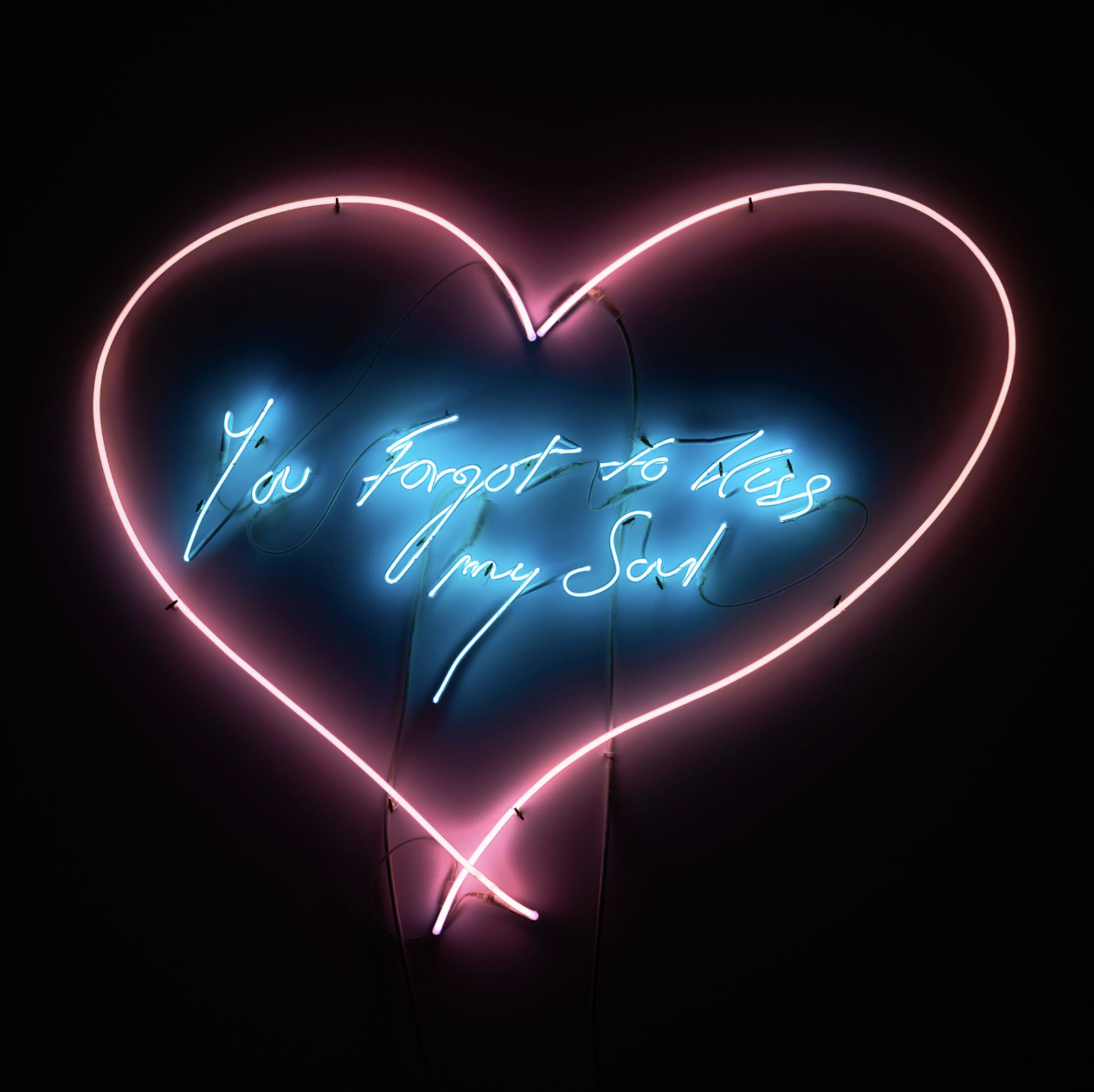
Neon occupies a central and consistent position in Emin’s practice. For more than three decades, she has worked with hand-blown neon tubing, transforming her distinctive, scrawling handwriting into bright light. By employing neon, a medium historically linked to industrial and commercial signage rather than traditional “high art,” she questions established artistic hierarchies and reveals how everyday materials can possess equal significance and impact. Exhibited in international museums and public spaces, her neons combine text and image to articulate complex, intimate narratives with disarming directness. If painting allows her to distort the body, neon allows her to expose the voice.
Tracey Emin’s You Forgot to Kiss My Soul (2001) is exemplary of her ability to distil emotional experience into a single charged phrase. The work consists of hand-formed neon tubing shaped into her unmistakable penmanship, often framed by an organically drawn heart. The letters slope and stretch as though lifted directly from a diary page. The effect is diaristic, immediate and unguarded. Emin has spoken of the emotional charge inherent in the medium itself. “Neon is emotional for everybody… That’s why neon is at fun fairs, casinos, red light districts and bars. It’s also to do with the way it electronically pulsates around the glass, it creates a feel-good factor.”
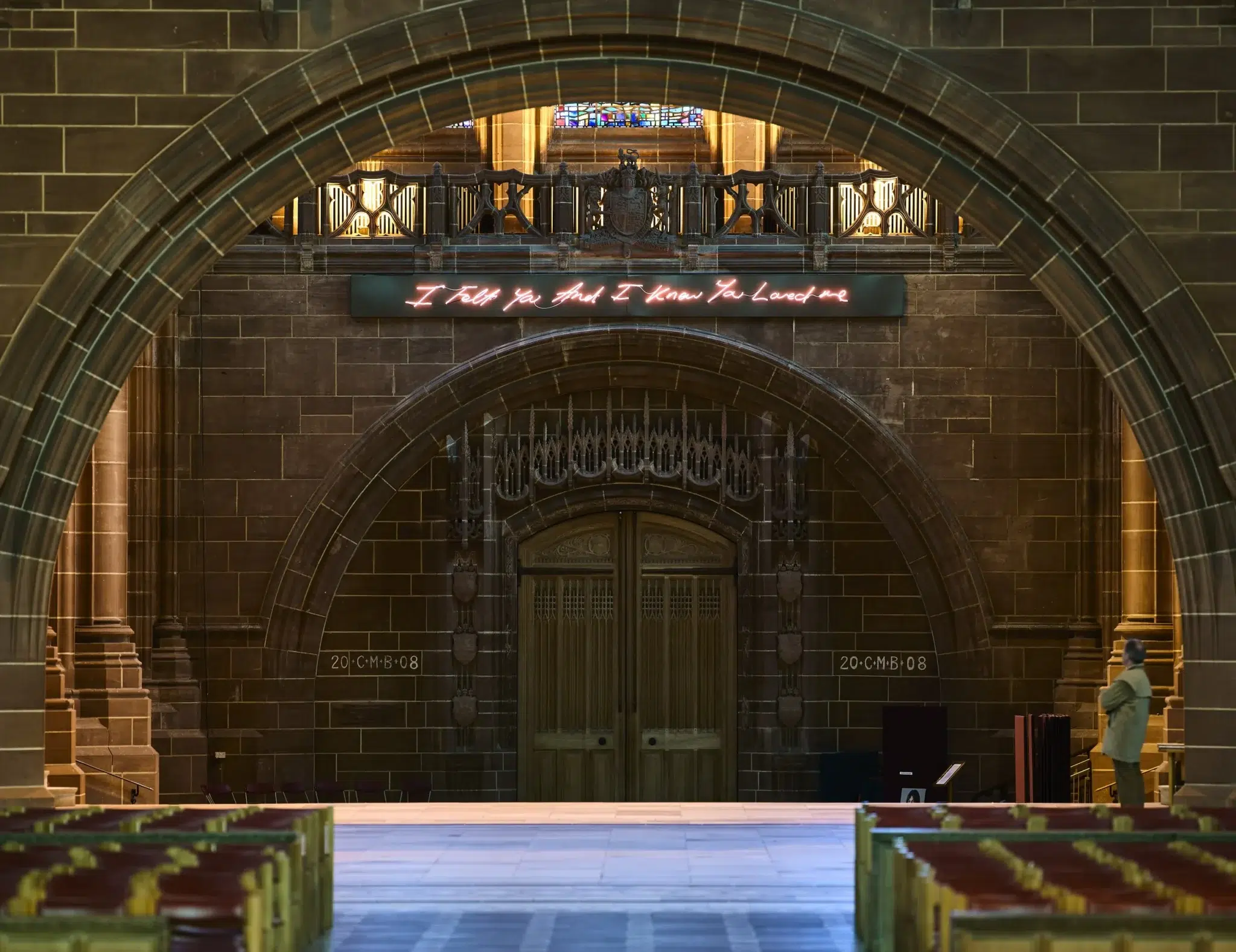
Emin frequently situates her neon works within public and architectural settings, extending personal declaration into communal space. A significant example is For You (2008), installed in the West Window of Liverpool Cathedral. The work reads, “I Felt You And I Knew You Loved Me,” its glowing script suspended within the vast Gothic architecture of the Church of England’s cathedral. The placement is striking. Neon, a medium associated with urban nightlife and commercial signage, inhabits sacred space.
Installation and Textile Work
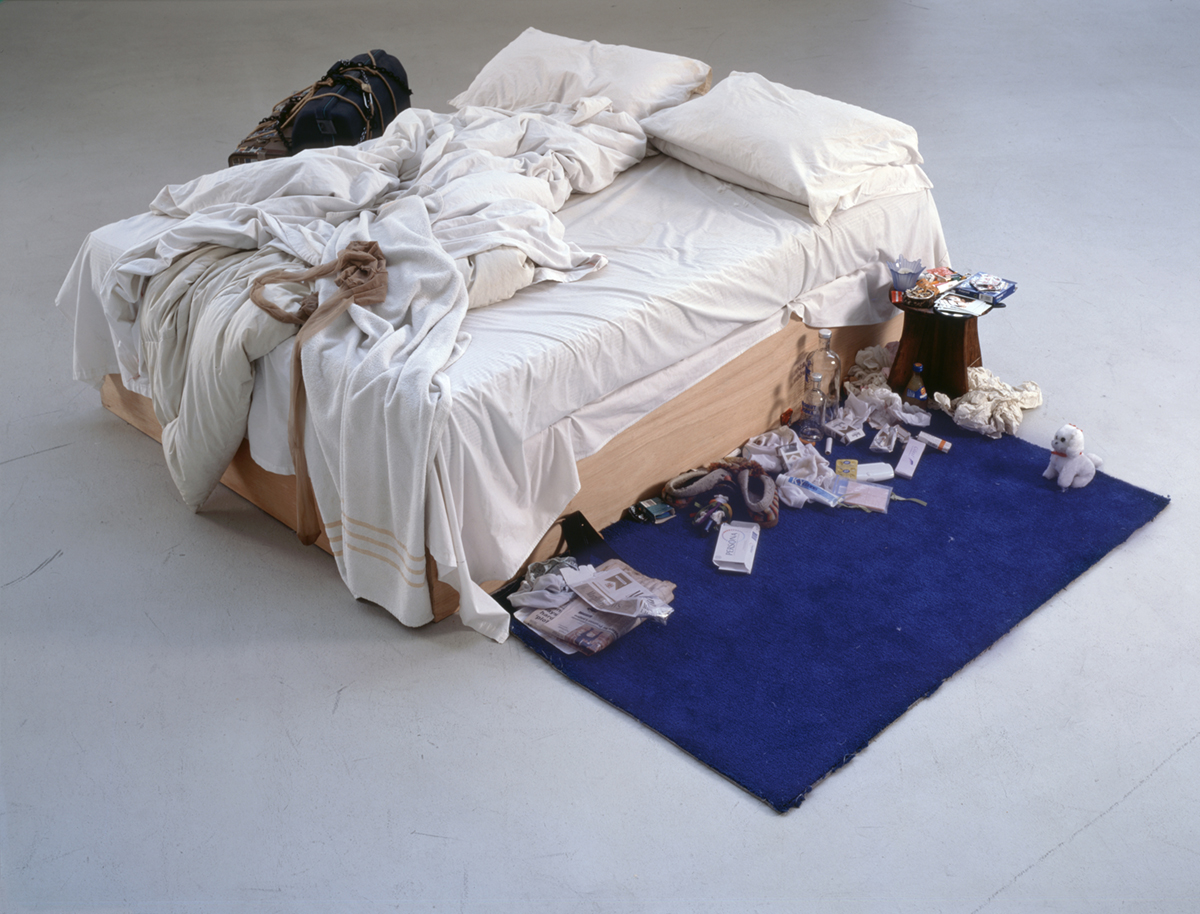
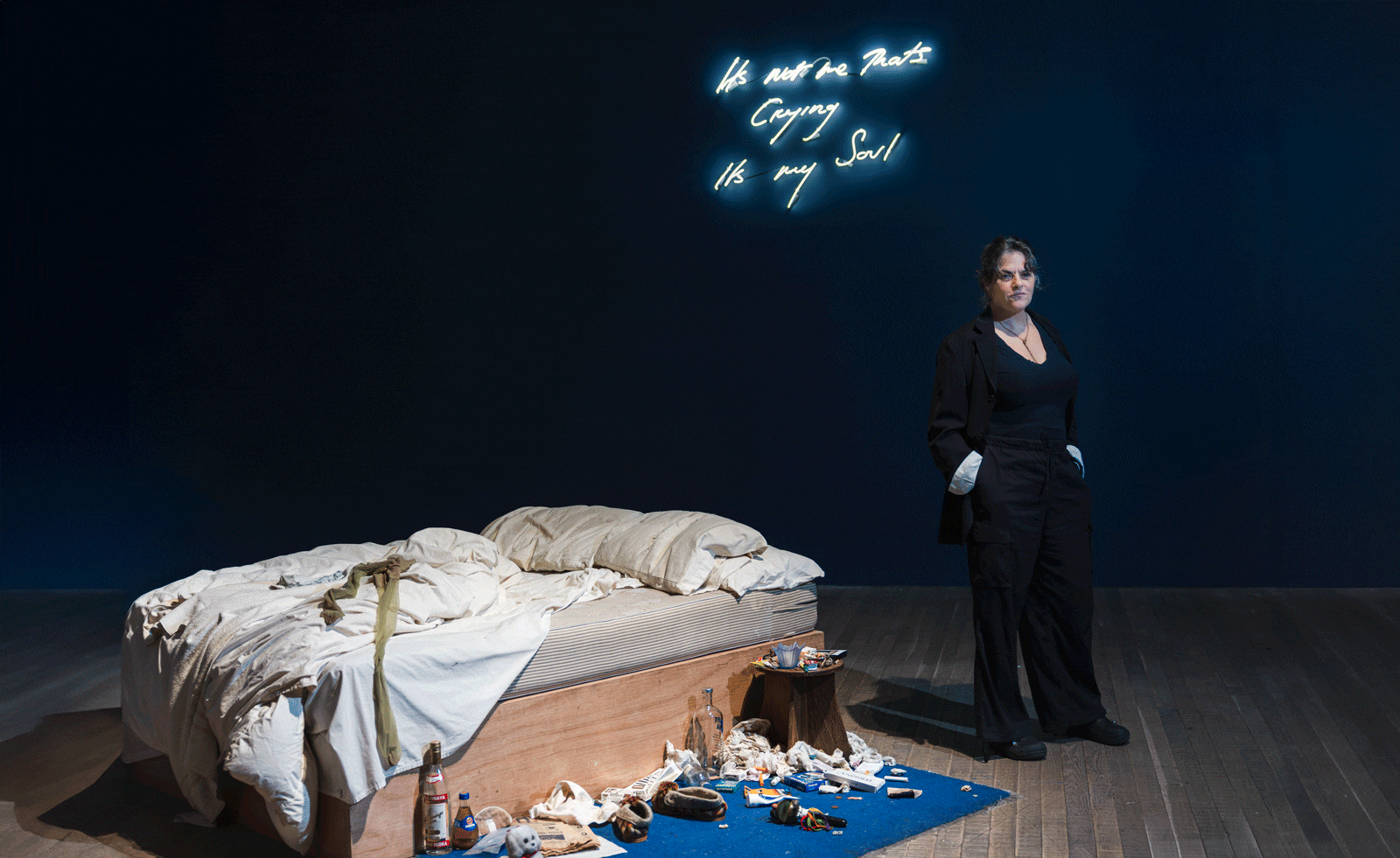
Produced in the wake of a personal breakdown after the end of a relationship, the installation turns the intensely private space of a bedroom into a strikingly public display. Emin spent several days in bed, immobilised by depression. When she finally rose to get water and returned to the room, she saw the deteriorating and chaotic scene with a new clarity. At that moment, she recognised it as an artwork. The installation consists of her unmade bed surrounded by the detritus of lived experience. Stained sheets, discarded bottles, cigarettes and personal objects remain exactly as they were. The bed is presented as evidence. In Emin’s hands, the bed becomes more than furniture. It is a recurring motif in her practice, a metaphor for passion and pain, isolation and communion, mourning and dreaming. It is where love begins and where despair settles.
My Bed was first exhibited in Japan in 1998, where it was originally accompanied by a noose suspended above the bed. The presence of the noose introduced a stark reference to self-destruction. When the work was later shown at the Turner Prize exhibition in 1999, Emin removed this element. Even without it, the installation retained its raw intensity. She later reflected that the time she spent in that bed felt like the end. The work embodies that sensation without theatrical embellishment. The installation is currently on view in Tracey Emin: A Second Life at Tate Modern, the artist’s major retrospective, reaffirming its enduring status as one of the defining works of late twentieth-century art.
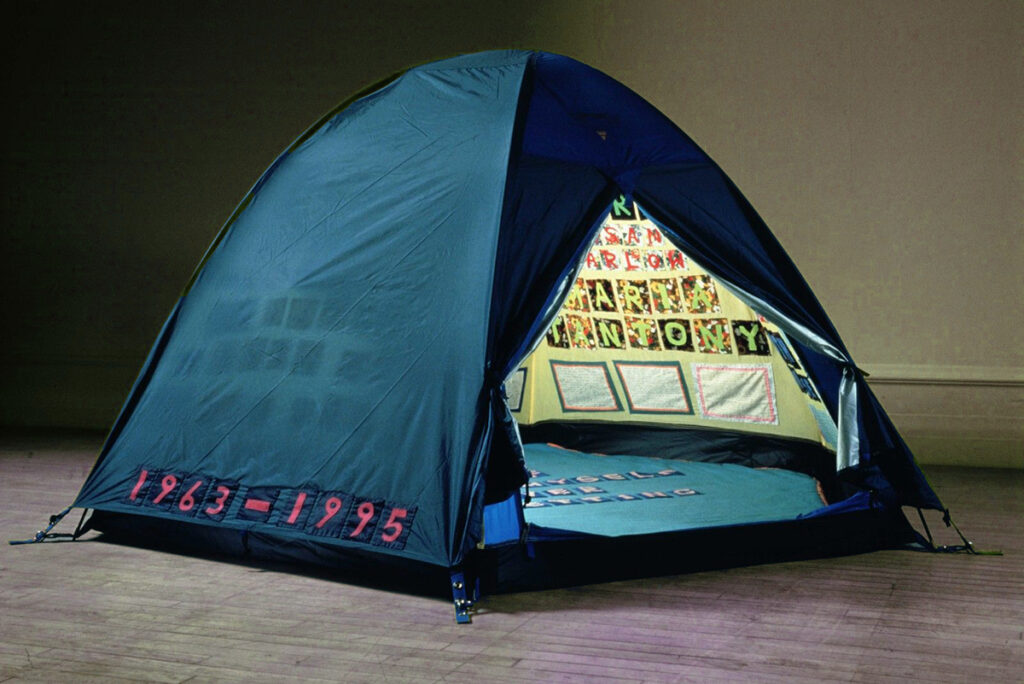
Everyone I Have Ever Slept With 1963–1995 (1995) is one of Emin’s most emotionally charged early works, created at a time when she was still forging her distinctive, confessional voice. The work takes the form of an actual, functional tent, incorporating ready-made materials into its construction. The tent is appliquéd with the names of everyone she had ever shared a bed with, including lovers, family, and close friends, transforming her personal history into a public display. By using this everyday object, Emin merges the ordinary with the intensely intimate, creating a literal and symbolic space that shelters her memories while exposing them to the viewer. The immersive scale and emotional directness invite viewers to confront the complexities of human relationships, while the use of familiar materials challenges traditional notions of what constitutes art. The work was destroyed in the 2004 Momart warehouse fire.
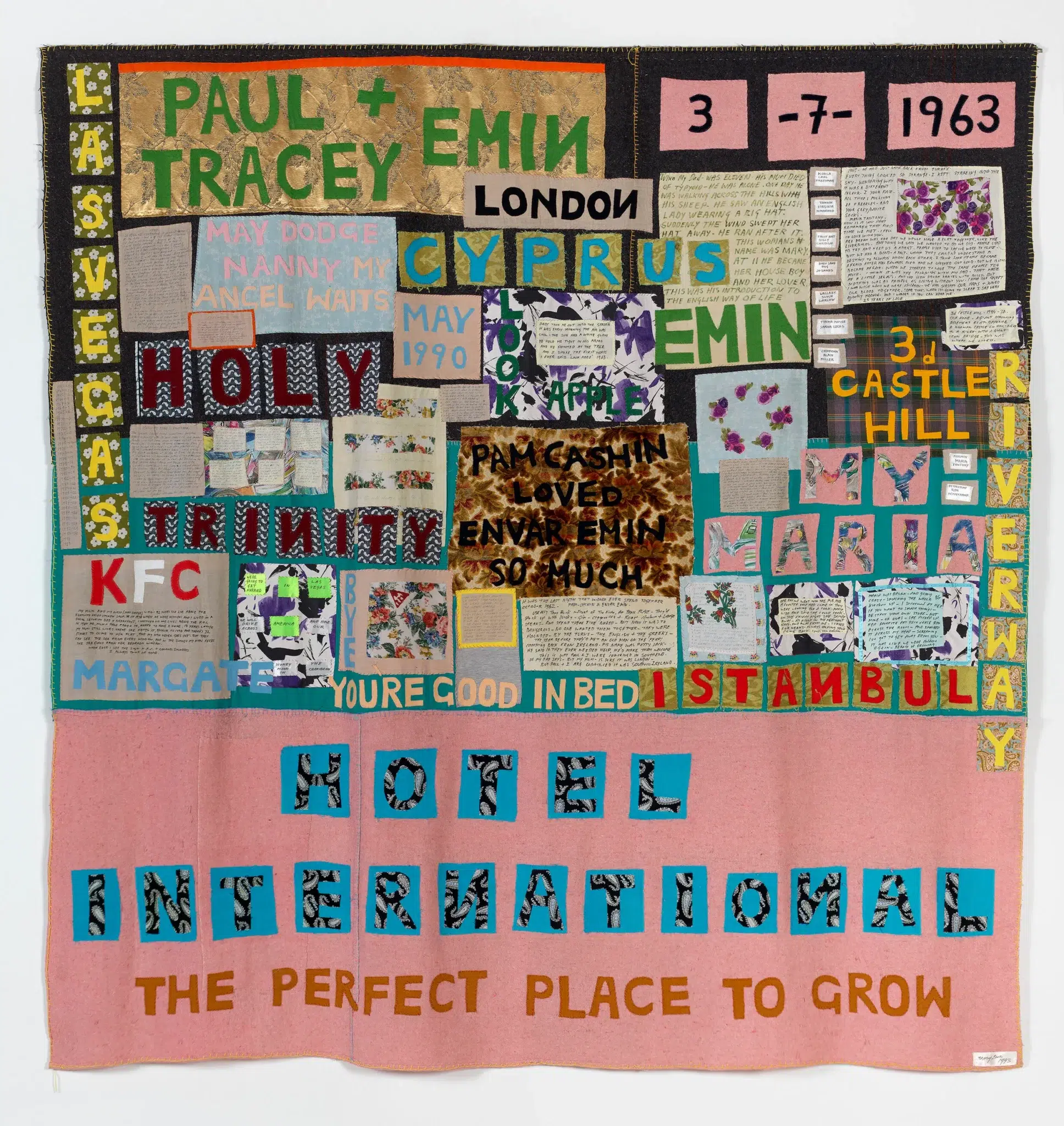
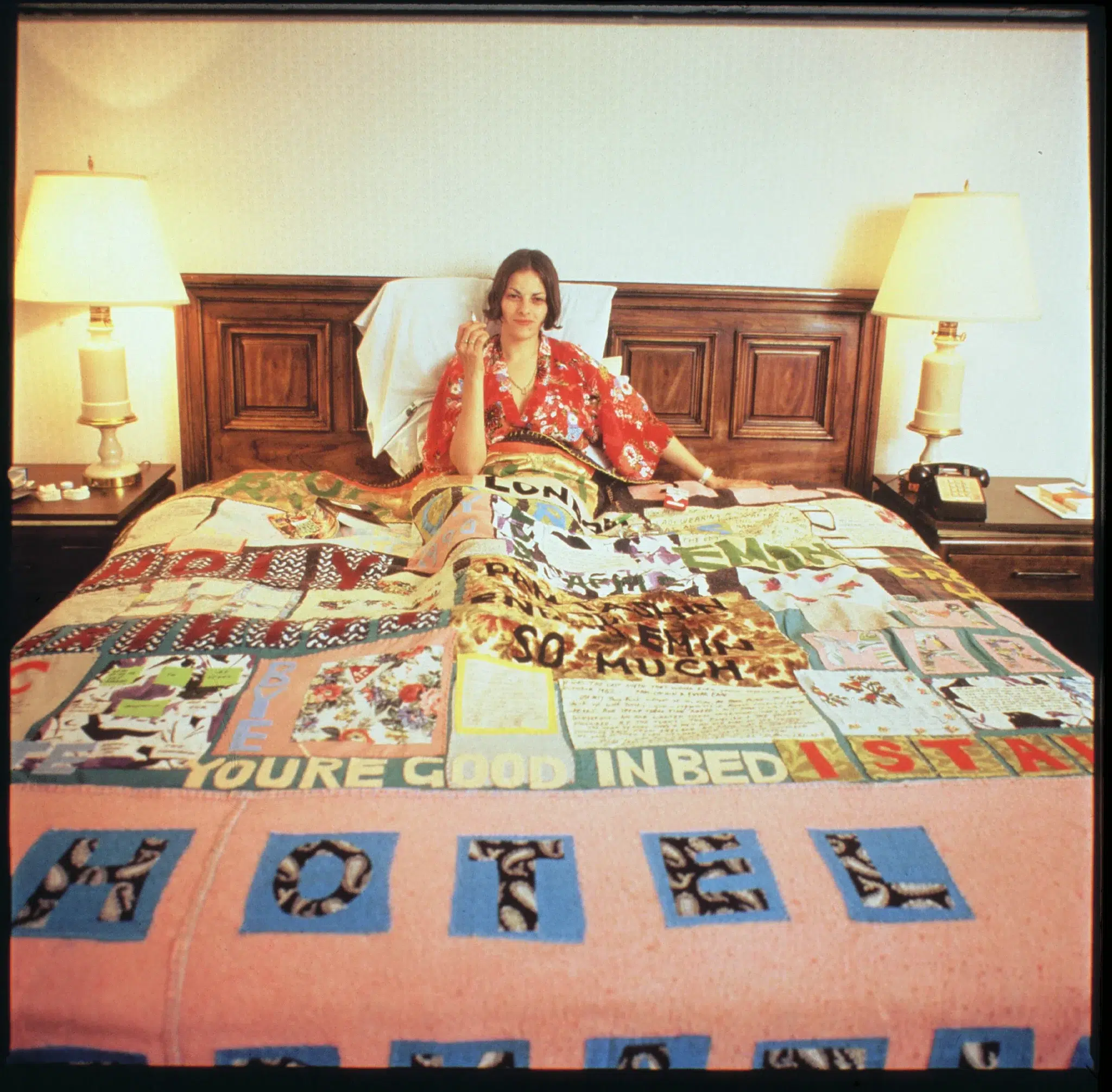
Hotel International (1993) marks a foundational moment in the artist’s career. It was not only her first quilt, but also a central work in her first solo exhibition at White Cube Gallery in 1993. With this work, Emin established the autobiographical language that would define her practice for decades to come.
The quilt takes its title from the hotel Emin’s mother ran in Margate during her childhood. Her early life was difficult, and she experienced sexual assault, an experience she later reflected on in her memoir Exploration of the Soul. The work does not recount these events directly; rather, it weaves them into fabric, text, and fragments. Names of family members are stitched across the surface, while smaller panels recall episodes from her early life.
Emin initially conceived the piece as a kind of curriculum vitae, a “CV.” With no prior exhibitions, she aimed to construct her own history and make a definitive statement. Rather than charting professional achievements, she presented the emotional and biographical experiences that shaped her. The choice of materials is central. Fabrics carry deep personal significance, some sourced from a sofa her family had owned since her childhood, others cut from her own clothing, embedding lived memory directly into the work. By using textiles and quilting, mediums traditionally categorized as “craft” and associated with women’s domestic labor, Emin plays with hierarchies in the art world, transforming a form often considered decorative into a vehicle for text, narrative, and personal history.
Tracey Emin’s work, from her early installations and textile pieces to her more recent paintings, reveals a fearless commitment to honesty and self-exploration. Across media, she consistently blurs the boundaries between private experience and public expression, challenging conventions and redefining the possibilities of contemporary art. Her practice stands as a testament to the power of personal narrative, showing how intimacy, vulnerability, and emotional truth can resonate universally.
From her Iconic Paintings Back to the Origin: Retracing Tracey Emin’s Journey
From her Iconic Paintings Back to the Origin: Retracing Tracey Emin’s Journey
The Top Contemporary Artists Reimagining Textile Traditions