The Artists Redefining the Language of Abstraction

This month, LVH Art presents Beyond Form, a new exhibition on view at Gallery Rooshad Shroff in Mumbai from 9 to 15 November. Bringing together artists from diverse generations and backgrounds, the exhibition examines what it means to move beyond representation, engaging with visual languages grounded in material, process, and perception. In this article, we take a closer look at the artists featured in Beyond Form, tracing the ideas, gestures, and experiments that inform their unique approaches to abstraction.
Discover all the works from the exhibition by clicking below
Private View of Beyond Form
Beyond Form highlights artists who move away from dominant figurative imagery, focusing instead on abstraction and the limits of figuration. The exhibition prioritises formal qualities like colour, form, process, and materiality over fixed narratives.
Many artists explore unconventional materials and processes. For example, Salvatore Emblema unweaves his jute canvases to reveal light and structure through absence. Peppi Bottrop combines industrial and organic materials, while Poppy Jones uses suede to emphasize texture. Rita Ackermann’s chalkboard paintings layer gesture and erasure. Sam Gilliam blends painting, sculpture, and architecture through improvisation and material exploration. Ha Chong-Hyun pushes paint through canvas to create sculptural textures. Anish Kapoor engages with material and void to create immersive experiences. Donna Huanca uses paint and texture to evoke transformation rooted in the body. For other artists in the exhibition, moving “beyond form” happens within the composition. Kylie Manning’s works hover between abstraction and figuration, while Marina Perez Simão evokes surreal landscapes through colour and shape. Sean Scully and Stanley Whitney focus on rhythm, structure, and colour’s expressive power. Abstraction here offers an open-ended, introspective mode of expression, accessing inner consciousness and the intangible aspects of human experience.
Artist List
Rita Ackermann, Peppi Bottrop, Salvatore Emblema, Sam Gilliam, Brice Guilbert, Ha Chong-Hyun, Camille Henrot, Donna Huanca, Poppy Jones, Anish Kapoor, Kristy Luck, Kylie Manning, Marina Perez Simão, Sean Scully, Ryan Sullivan, Stanley Whitney.
Rita Ackermann

Rita Ackermann (b. 1968) is known for a practice that oscillates between figuration and abstraction, memory and erasure. Having relocated to New York from Budapest in the early 1990s, she became a central figure in the downtown art scene, drawing on influences from graffiti, film, and underground culture. Over the past three decades, her work has evolved from raw figurative compositions depicting adolescent energy and chaos to complex abstractions that explore the instability of image, gesture, and recollection. Ackermann’s paintings often carry traces of what has been covered, wiped away, or transformed. Working with layered compositions of oil, chalk, and pigment on canvas or board, she constructs and deconstructs images in a continual process of making and unmaking. Figures emerge only to dissolve into the surrounding surface, as if memory itself were collapsing under the pressure of time and gesture.
Ackermann’s work included in Beyond Form is from her Chalkboard Paintings series, which she began in the early 2010s, marking a pivotal shift in her artistic practice. Using chalkboard paint as both surface and metaphor, she created works that evoke the classroom as a site of learning, repetition, and erasure. Onto these dark, matte grounds, Ackermann draws and scrapes with oil, chalk, and pastel, layering gestures that recall the spontaneity of drawing while maintaining the density and depth of painting. In her process, Ackermann transforms the language of drawing into a meditation on impermanence. Her work resists closure, remaining perpetually open to revision and reinterpretation.
Peppi Bottrop

Peppi Bottrop (b. 1986) is from a generation of artists whose work engages deeply with the changing landscape of post-industrial Europe. He graduated as Meisterschüler from the Kunstakademie Düsseldorf in 2014, where he studied under Albert Oehlen, Andreas Schulze, and Jutta Koether. He comes from Germany’s Ruhrgebiet, the country’s industrial heartland. Once a center of coal mining and steel production, the region has since been transformed as the mines closed and nature gradually reclaimed the landscape. The coexistence of human industry and natural regeneration lies at the core of Bottrop’s work.
Bottrop’s compositions often recall the spatial logic of maps, architectural plans, and urban grids, yet they remain open and intuitive. In the work included in the Beyond Form exhibition, he employs graphite, charcoal, and metal pigments to create layered networks of lines that oscillate between meticulous precision and expressive spontaneity. The visual language that emerges in his works moves between construction and dissolution, figuration and abstraction, suggesting a psychological landscape as much as a physical one. This rhythm of building, erasing, and rebuilding becomes a reflection of the historical and emotional cycles that define Germany’s Ruhrgebiet, the region in which he grew up.
Salvatore Emblema

Salvatore Emblema (b. 1929, d. 2006) was born in Terzigno, at the foot of Mount Vesuvius. He forged an artistic language inseparable from the landscape of southern Italy. The eruption of 1944, which covered his town in volcanic ash, left a lasting impression on the young artist, instilling a lifelong sensitivity to how light, matter, and time shape perception. The materials he used in his works such as raw jute, oxidised metals, volcanic sand, leaves, and earth pigments were taken directly from his environment. As Emblema explained, “My main concern was to have a direct relationship with truth.. Leaves and sackcloth were truth to me.” A central focus of Emblema’s career was exploring transparency, absence, space, and light. As art historian Giulio Carlo Argan observed, his work is “space which serves no purpose other than to be space.” From the late 1960s onward, he explored these ideas through the meticulous technique of detessitura, removing threads from the woven jute to let light pass through the canvas. By subtracting material, he paradoxically generated new forms, turning absence into a creative force that shaped the work.
Working in relative isolation in the Neapolitan countryside, Emblema remained distinct from the dominant currents of postwar Italian and American art. Yet his work resonates with a wider exploration of perception and materiality that characterised the period. While Arte Povera artists pursued dematerialisation and Minimalists explored serial form, Emblema discovered his own language of reduction: one rooted in the Mediterranean landscape, in its heat, luminosity, and tactile earth.
Sam Gilliam

Sam Gilliam (b. 1933, d. 2022) was a leading artist in postwar American abstraction. Emerging in Washington, D.C. in the mid-1960s, he was associated with the Washington Color School yet soon expanded beyond its compositional and chromatic restraint. By adopting a process-oriented and improvisational approach, Gilliam challenged the conventions of traditional painting. His radical Drape paintings of the late 1960s, made by suspending unstretched, paint-soaked canvases from walls or ceilings, redefined the relationship between painting, sculpture, and architecture. For Gilliam, the physical liberation of the canvas mirrored a broader pursuit of creative and personal freedom at a time of social and political transformation in the United States.
Throughout his career, Gilliam’s work remained in constant evolution. He treated colour as a living substance, shaped by gravity, gesture, and material chance. Inspired by the improvisatory energy of jazz, his paintings and works on paper evoke rhythm and movement through layered chromatic harmonies. Even as his methods changed from staining to folding, draping, and later collage, his art consistently sought to reconcile spontaneity with structure.
Brice Guilbert
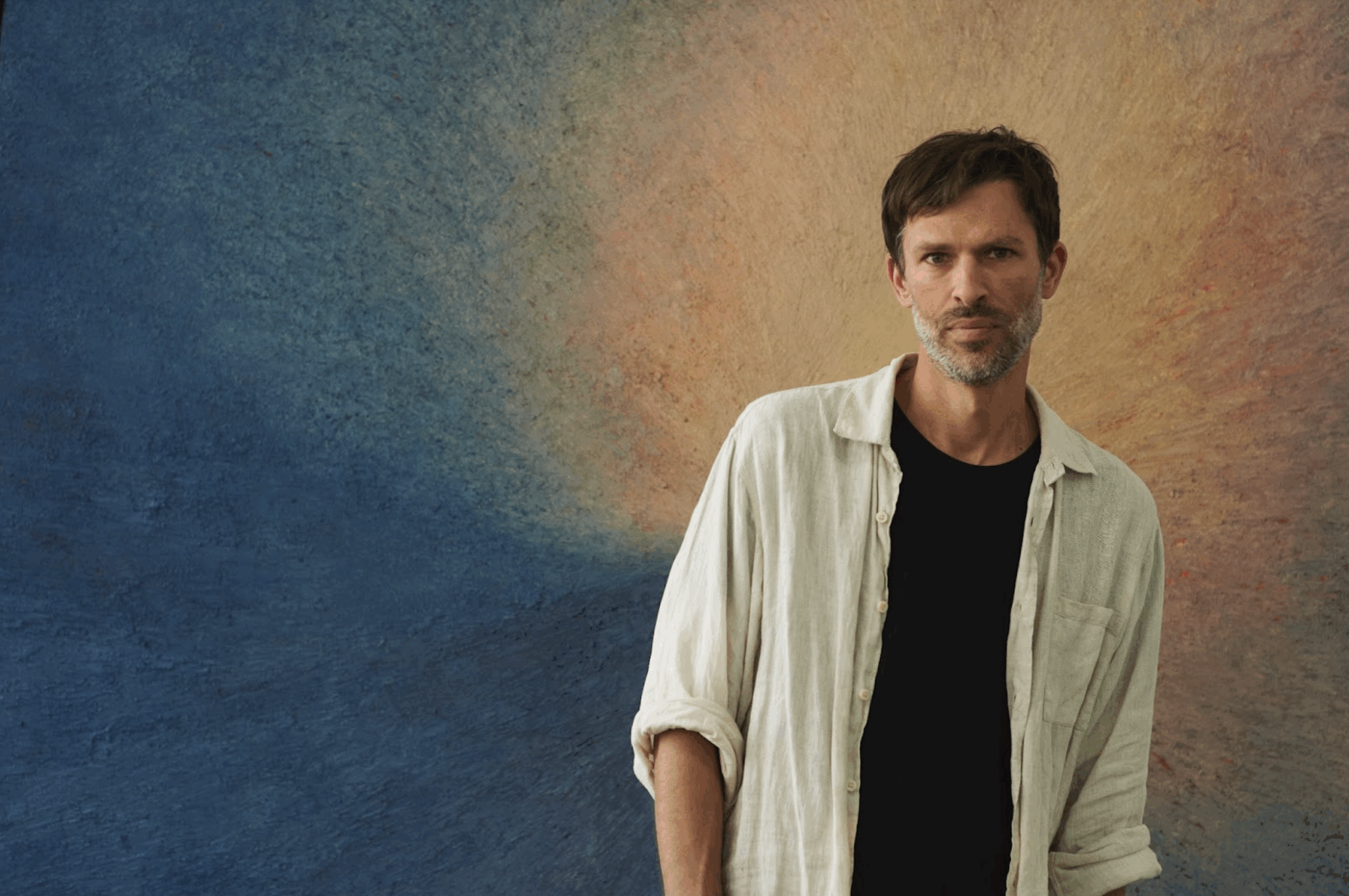
Brice Guilbert (b. 1979) combines figuration and abstraction in a practice that explores landscapes, particularly the volcano motif. Guilbert’s compositions often evoke elemental forces, light, air, and temperature, through colour and movement rather than clear figuration. The materiality of the oil stick, which he often employs, plays a crucial role in Guilbert’s process: its dense, waxy texture gives his works a physical presence that feels at once drawn and painted. By using oil stick on paper or canvas, he achieves a balance between immediacy and reflection: beneath the apparent simplicity of his marks lies a quiet intensity shaped by rhythm and repetition.
His work is deeply rooted in personal and lived experience, drawing inspiration from his Creole heritage and childhood on Réunion Island. The work included in the show is titled Fournez after the local pronunciation of Piton de la Fournaise, the volcano located on Réunion Island, which the artist recalls from his childhood. He has created countless works featuring this title and motif. As Guilbert noted, “The volcano is part of an unconscious, a space I lived and grew up in. The subject represented is an eruption, a projection, a sensation projected to the surface of every painting. Every work of art is the projection of an effect and of an idea.”
Ha Chong-Hyun

Ha Chong-Hyun (b. 1935) is one of the most significant figures in post-war Korean art and a central member of the Dansaekhwa movement, which redefined painting in Korea during the 1970s. His practice developed in the decades following the Korean War, a period marked by rapid reconstruction and cultural change. Ha sought to redefine a language of painting grounded in process, discipline, and the inherent qualities of his chosen materials. While in the 1950s he was still exploring Art Informel and geometric abstraction, by the 1960s he had shifted toward a more physical and meditative approach, in which process became the central focus of his practice.
In 1974, Ha began his Conjunction series, a lifelong body of work that would come to define his career. The series is based on the artist’s unique technique known as bae-ap-bub, or the “back pressure method,” in which thick layers of oil paint are pushed from the reverse side of hemp cloth so that they permeate and emerge on the surface. Through this process, Ha transforms painting into a physical act of negotiation between the visible and the hidden. The pigment fuses with the weave of the hemp, creating a field that is at once tactile and meditative. The result is not an image placed upon the canvas but a surface that embodies the tension between control and release.
Camille Henrot

Camille Henrot (b. 1978) is a New York based artist whose work draws on sources ranging from anthropology and mythology, to literature and psychology. Henrot explores how individuals navigate the overwhelming accumulation of information, emotion, and cultural narrative in contemporary life. A graduate of the École Nationale Supérieure des Arts Décoratifs, Henrot began her career in animation and video, before expanding into an interdisciplinary practice that merges research and intuition. Her projects often begin with a process of collection and comparison, bringing together ideas, images, and materials from disparate contexts. As the artist has remarked, she approaches knowledge “with the curiosity of the amateur,” transforming research into a poetic and at times contradictory visual language.
The meaning in Henrot’s paintings are not always obvious; however, there is always a deeper layer informed by her prior research. Notably, the title of the work included in the show reveals the conceptual nature of Henrot’s practice. Anguille sous roche, literally translates to “eel under the rock,” a French idiom meaning “something hidden beneath the surface.” This also reflects Henrot’s interest in the instability of perception.
Donna Huanca

Donna Huanca (b. 1980) is a multidisciplinary artist whose practice explores the intersections of the body, nature, and material transformation. Huanca’s practice often incorporates live performance and the human body as a living canvas. Models covered in layers of pigment, clay, and natural materials that she applies to their bodies perform among her paintings, becoming extensions of the surrounding works. This performative element underscores her interest in impermanence and transformation and the body.
Huanca’s process typically begins with images of her painted performers, which she then enlarges and prints onto canvas. Over this frozen snapshot, she applies successive layers of paint or other materials, allowing time to accumulate within the surface of the work. “Everything always goes back to the body, ” Huanca says. “And that’s such an important part for me to start, because I feel like everything I do is collage work. It’s based on taking something and combining things that don’t necessarily belong together. The paintings wouldn’t exist without the live body. I’m not really interested in painting on something that has no history or is just blank.”
Poppy Jones
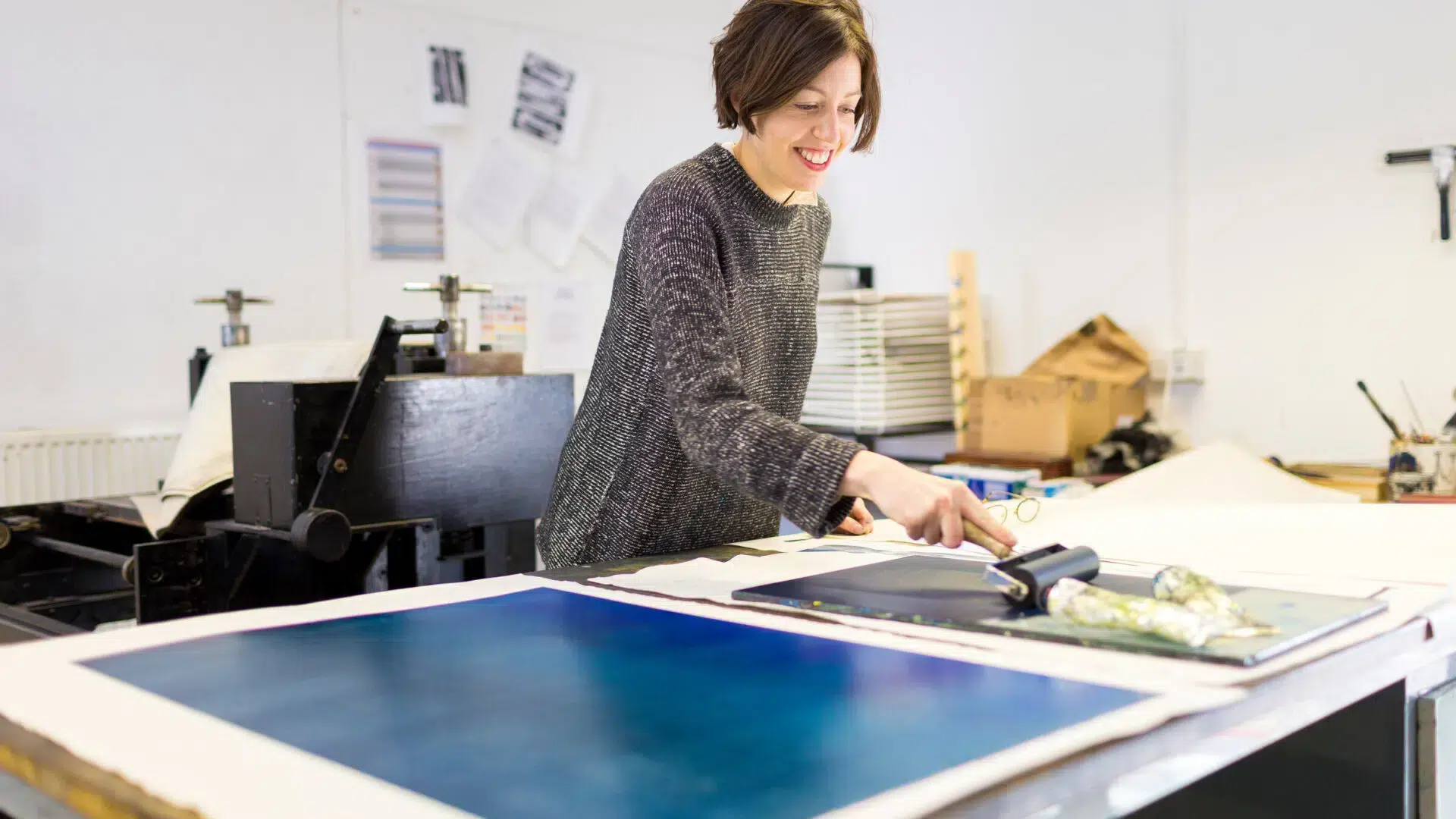
Poppy Jones (b. 1993) creates paintings that distil the fleeting impressions of daily life into moments of quiet intensity. Her work often begins with her own photographs, capturing interiors, and still objects, that often focus on the play of light and shadow. These images act as repositories of mood and memory from which Jones constructs a visual language that balances figuration and abstraction, and transforms something familiar into something poetic and elusive. Jones’ process is guided by intuition. Her compositions evolve through slow observation and material experimentation, revealing a deep sensitivity to surface and light. She works on silk, suede, or cotton, often repurposing garments or fabrics she has collected herself. The texture and absorbency of each support influence the final image, mirroring the tactile qualities of the scenes she depicts and reflecting her interest in the relationship between image and object. Although her practice is often grounded in figuration, her work in the exhibition gravitates towards abstraction, capturing atmosphere and emotion through subtle shifts in tone, texture, and light.
Anish Kapoor

Anish Kapoor (b. 1954) is internationally acclaimed for a practice that investigates perception, materiality, and the metaphysical dimensions of form. Although best known for his monumental sculptures and mirrored installations, Kapoor’s works on paper reveal a more intimate aspect of his exploration into colour, space, and the void. These pieces distil his sculptural concerns into concentrated meditations on presence and absence, inviting reflection on how the material world can contain the immaterial. Kapoor’s gouaches are not preparatory studies but self-contained inquiries into the tension between surface and depth. Using dense layers of pigment, he creates fields that appear to hover between expansion and collapse, emergence and absorption. The act of painting becomes both a physical and philosophical gesture.
Kristy Luck

Kristy Luck (b. 1985) creates paintings that inhabit the space between the figurative and the abstract, where organic forms and psychological landscapes intertwine. Her practice is rooted in an intuitive process that translates emotion and memory into layered compositions. Her paintings often suggest fragments of flora, anatomy, or interior architecture, yet resist fixed interpretation. Each composition develops through a balance of precision and spontaneity and is often executed in a style influenced by surrealism. Luck’s works feel elusive and dreamlike, as if they exist in a space between memory and imagination, inviting viewers to explore their own interpretations. Through her handling of paint, Luck transforms natural motifs into psychological symbols, using forms as a means of expressing feeling rather than depicting motifs accurately.
Kylie Manning

Kylie Manning (b. 1983) works are built from layers of gestural energy that evoke the natural world and the human condition. Working primarily in oil on linen, Manning constructs visual fields that feel atmospheric and corporeal, where figures and landscapes dissolve into one another. Her practice is deeply informed by the dramatic environments of her upbringing between Alaska and Mexico, places that both feature unique light and terrain. These early experiences fostered a sensitivity to the rhythms of weather, water, and shifting horizons that continues to shape her visual language.
Marina Perez Simão

Marina Perez Simão (b. 1981) is a Brazilian artist whose compositions emerge through layered washes of colour, fluid transitions, and rhythmic curves that suggest horizons, rivers, and skies without ever resolving into representational form. Working primarily with oil and watercolour, Perez Simão builds her compositions through a process of accumulation and erasure. Transparent layers overlap to create depth and luminosity, allowing colour to become the primary vehicle of expression. The artist’s use of fluid, gestural forms conveys an inner rhythm that recalls the natural world. In her work, landscape becomes a site of imagination rather than direct observation.
Perez Simão’s work embodies a distinctly Brazilian sensibility, attuned to the interplay between light, nature, and emotion. Her landscapes are not literal depictions but poetic meditations on perception and place. For Perez Simão, painting is a process of discovery rather than representation. Her colours appear to vibrate and merge, creating an illusion of movement and dreamscapes. Each work exists as part of a larger constellation, what the artist describes as “a dance between paintings”: individual yet interconnected, open to change and dialogue.
Sean Skully

Sean Scully (b. 1945) is one of the most significant painters of his generation, known for his rigorous exploration of abstraction through rhythm, structure, and colour. His work bridges the geometric clarity of Minimalism with the emotional depth of painterly gesture, creating compositions that feel architectural and at the same time human made. Throughout his career, Scully has worked across painting, printmaking, sculpture, and works on paper, using each medium to investigate how structure can convey emotion. Known for his stripes, blocks, and grid works, he uses these repeated forms not to impose order but to create a language of tactile resonance. They evoke a sense of stability intertwined with fragility, capturing the tension between control and imperfection inherent in his work.
Ryan Sullivan

Ryan Sullivan (b. 1983) is a New York based artist whose practice centres on a continuously evolving language of abstraction. Each work becomes a trace of its own creation, recording the forces and conditions that shaped it. Rather than applying paint in a conventional manner, Sullivan manipulates chemical reactions, temperature, and gravity, allowing his materials to determine their final form. How works are made from a constant dialogue between control and chance, structure and entropy.
Working with industrial materials such as resin, fiberglass, and epoxy, Sullivan captures processes that are usually invisible or fleeting. His surfaces appear simultaneously geological and gestural, evoking natural phenomena like erosion or sedimentation while also reflecting the artist’s deliberate manipulation. Through these material explorations, Sullivan reimagines abstraction as an act of transformation, revealing painting as a living process rather than a fixed image.
Stanley Whitney

Stanley Whitney (b. 1946) is celebrated for a lifelong engagement with colour and rhythm. Rooted in abstraction yet deeply influenced by the improvisational structure of jazz, his paintings construct visual harmonies through the repetition and variation of chromatic blocks. Since the 1990s, Whitney has refined a distinctive compositional format composed of vibrant squares and rectangles arranged in rhythmic balance that serves as both structure and improvisational score. In his works, the surface’s geometric grid like structures are softened by fact that you can clearly see the artist’s hand, where slight imperfections animate the forms and imbue them with human touch.
Working without preliminary sketches, he builds each composition colour by colour, responding to the energy and resonance of the previous hue. The spaces between blocks, often defined by thin lines or shifts in tone, act like intervals in music, allowing the eye to move and rest in turn. His work draws equally on the legacies of Colour Field painting and African American cultural traditions. Whitney demonstrates how colour can serve as both subject and structure, emotion and intellect. His art transforms the grid into a field of rhythm, turning painting into a temporal experience, a visual music of light, movement, and freedom.
LVH Art’s List: What to See in Paris during Art Basel this Year
LVH Art’s List: What to See in Paris during Art Basel this Year
In Conversation with Isabelle and Christine d’Ornano