

(index.php)
A Return To Nature And Landscape Painting In The Work Of 5 Contemporary Artists
For our latest line up of exceptional artists to watch, we are shedding a light on a new collecting trend that we witnessed emerge in 2020: a longing for open air landscapes and the natural world. As a result of the COVID-19 pandemic, and the subsequent lockdown, people around the world escaped the ceaseless anxieties of crowded cities to discover refugee in the great outdoors.
This urge to seek comfort and spiritual reverie in nature can be seen in the work of 5 contemporary artists whose depiction of meditative natural scenes somehow mirrors this collective impulse, offering a calming antidote to the tumultuous unpredictability of the times whilst adding a contemporary spin to the centuries old tradition of landscape painting.
Each of these five artists has earned critical recognition over the last few years, with worldwide representation from galleries, institutions and dealers. In their own style, whether more figurative or abstract, they all share a deep desire to convey the beauty of the natural world in ways that provide the viewer with a liberating space for reflection; and we believe their works to be prime examples of what we expect to be a growing trend in 2021.
Harold Ancart
B. 1980 in Belgium.
Lives and works in Brooklyn, New York.
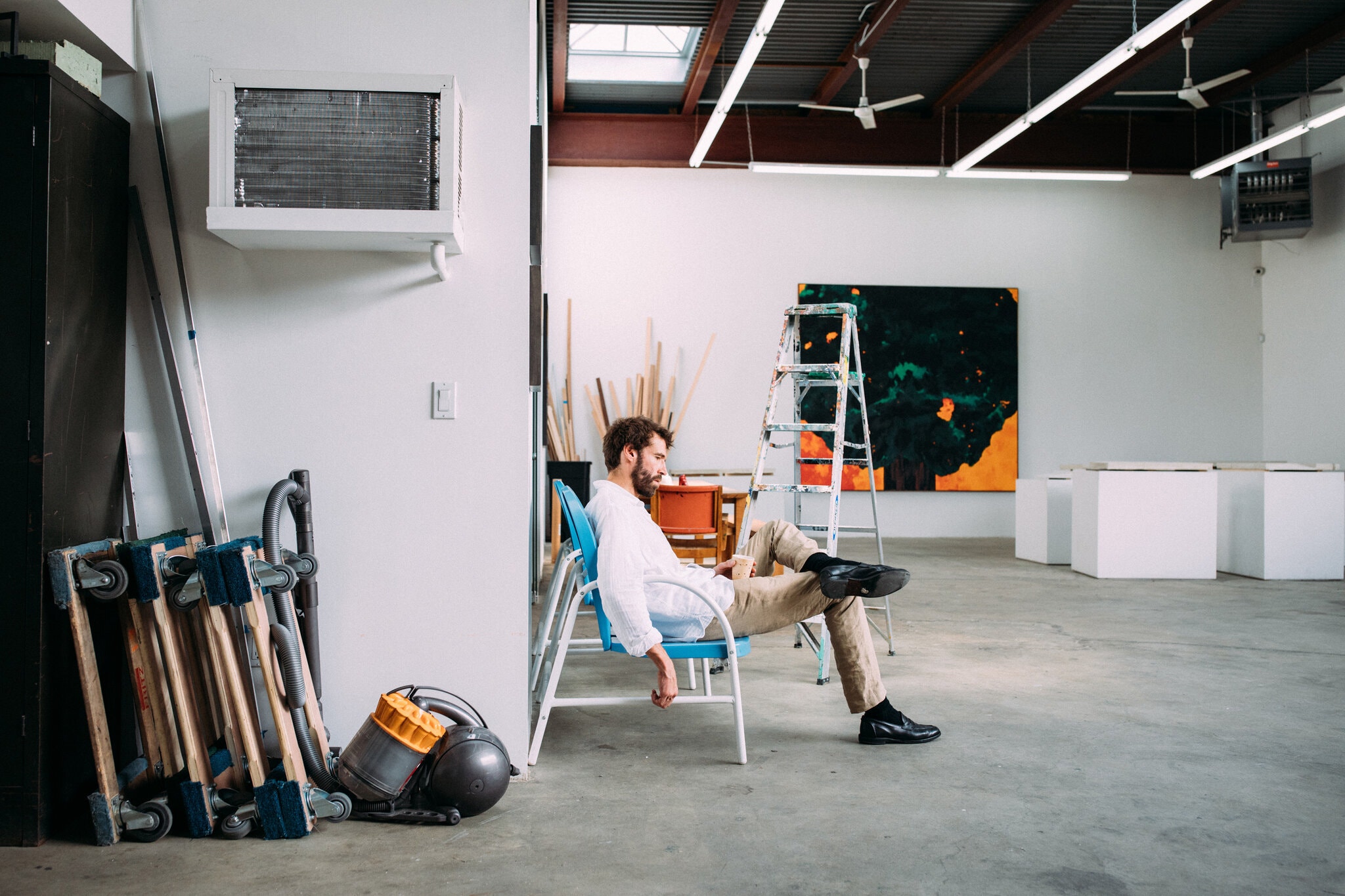
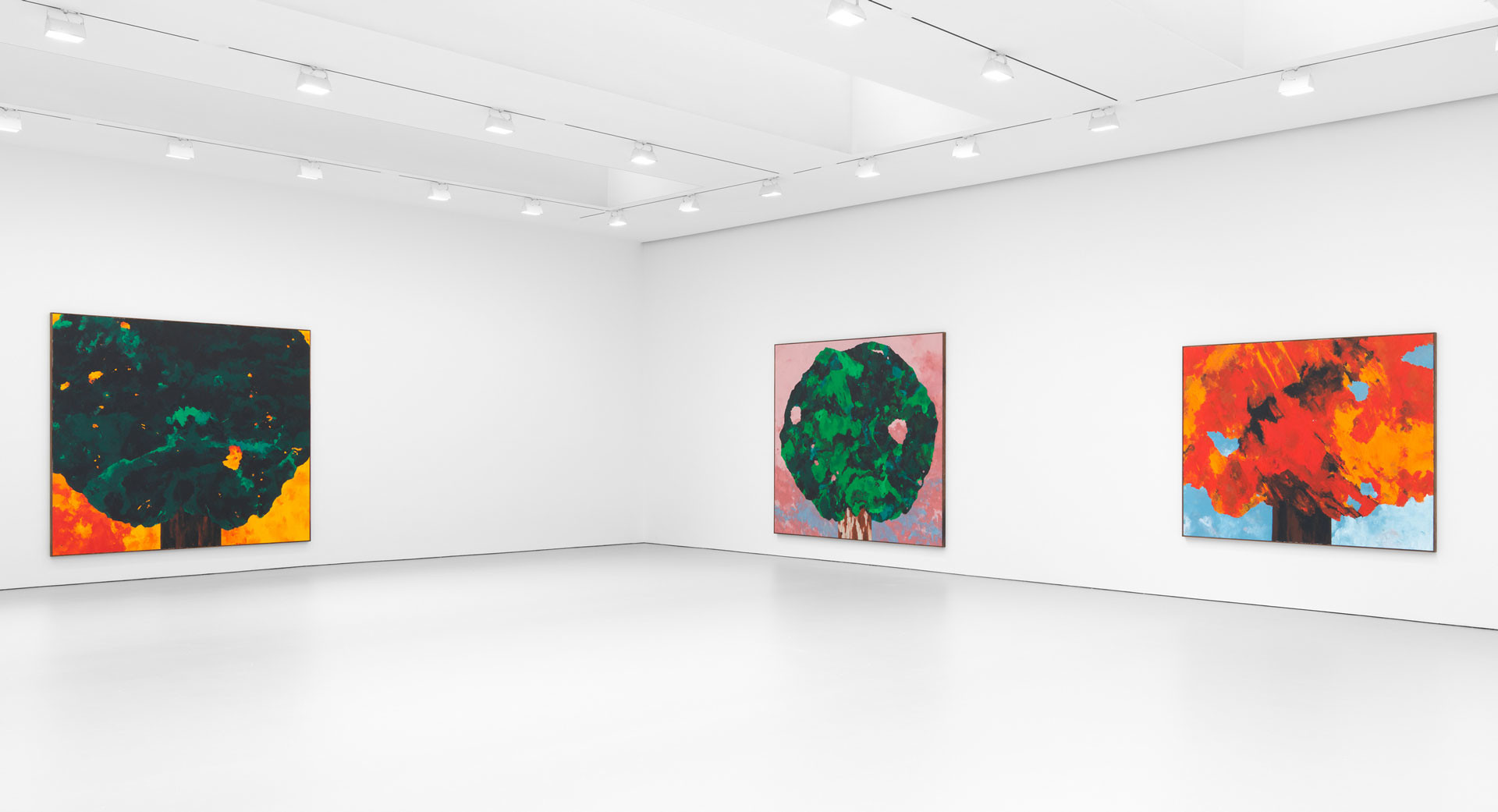
Clouds, fires, icebergs, and imposing flora are the identifiable shapes that the Belgian artist Harold Ancart uses to strip landscape painting down to its rudiments. The irreducible qualities of painting, and of drawing, have long been Ancart’s driving concern. He fuses the techniques of both, creating radiant compositions that recall the most animate works of the Color Field painters, while extending their delicate minimalism into an exuberant vision.
His horizon line is limitless, and it extends through numerous paintings, photographs, sculptures, and drawings. Ancart recognizes an unquenchable search for a kind of Eden, or escape, as a constant feature of our imaginations. This vast collective ideal is the setting for Harold’s new paintings, in which he discovers the possibilities for transformative experience are not just out “there”, but here, in the arena of painting. His paintings reveal a series of images that are connected to a delirious longing for escape, or connectivity to one’s place. In his latest exhibition at David Zwirner New York in 2020, the gallery described his body of work to offer an “immersive landscape experience”. Indeed, the works on the show were inspired by the artist’s encounter with the modernist landscape murals of the late American painter Gottardo Piazzoni, which are permanently displayed at the De Young Museum in San Francisco.
Lucas Arruda
B. 1983 in Brazil.
Lives and works in Sao Paulo, Brazil.
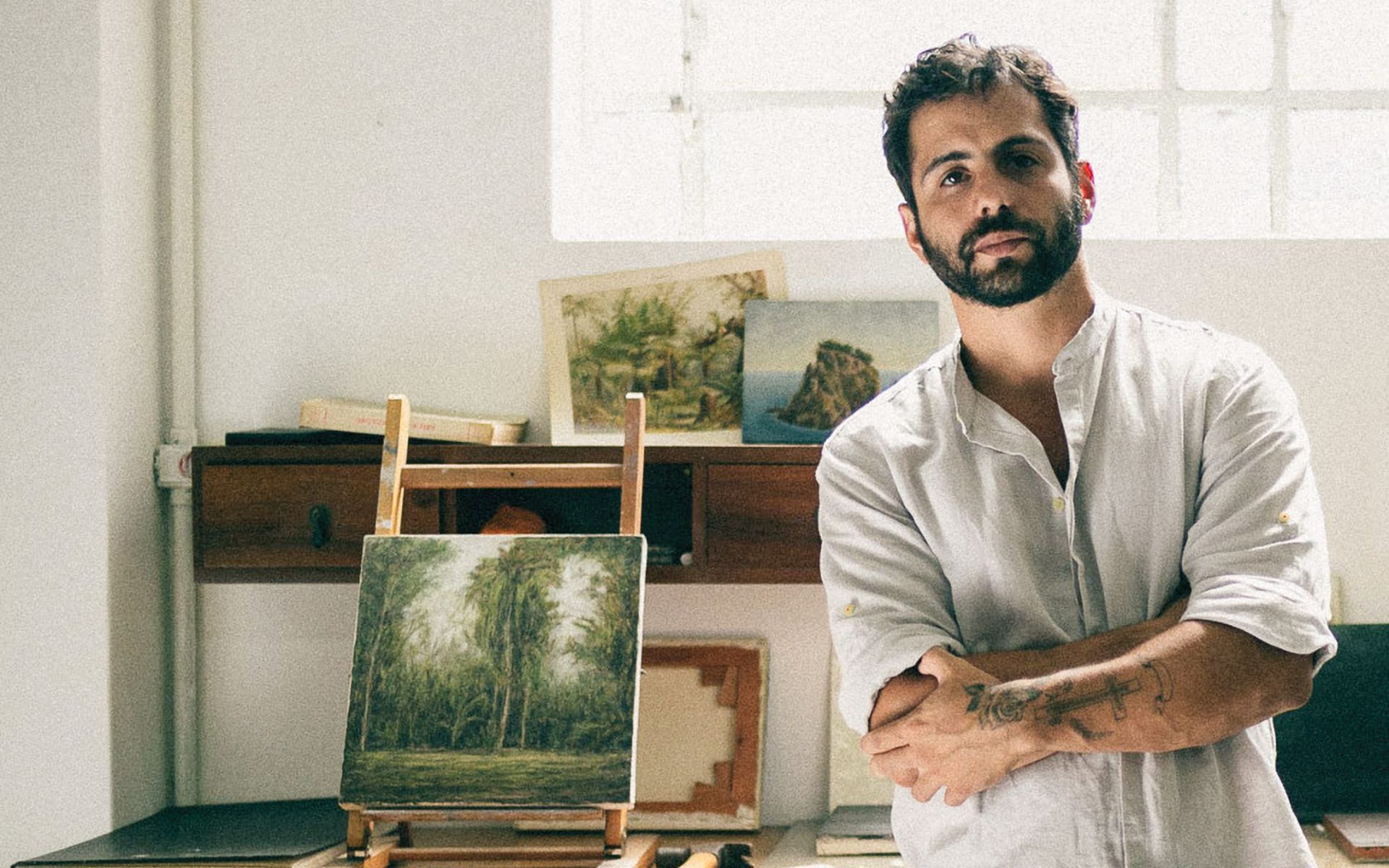
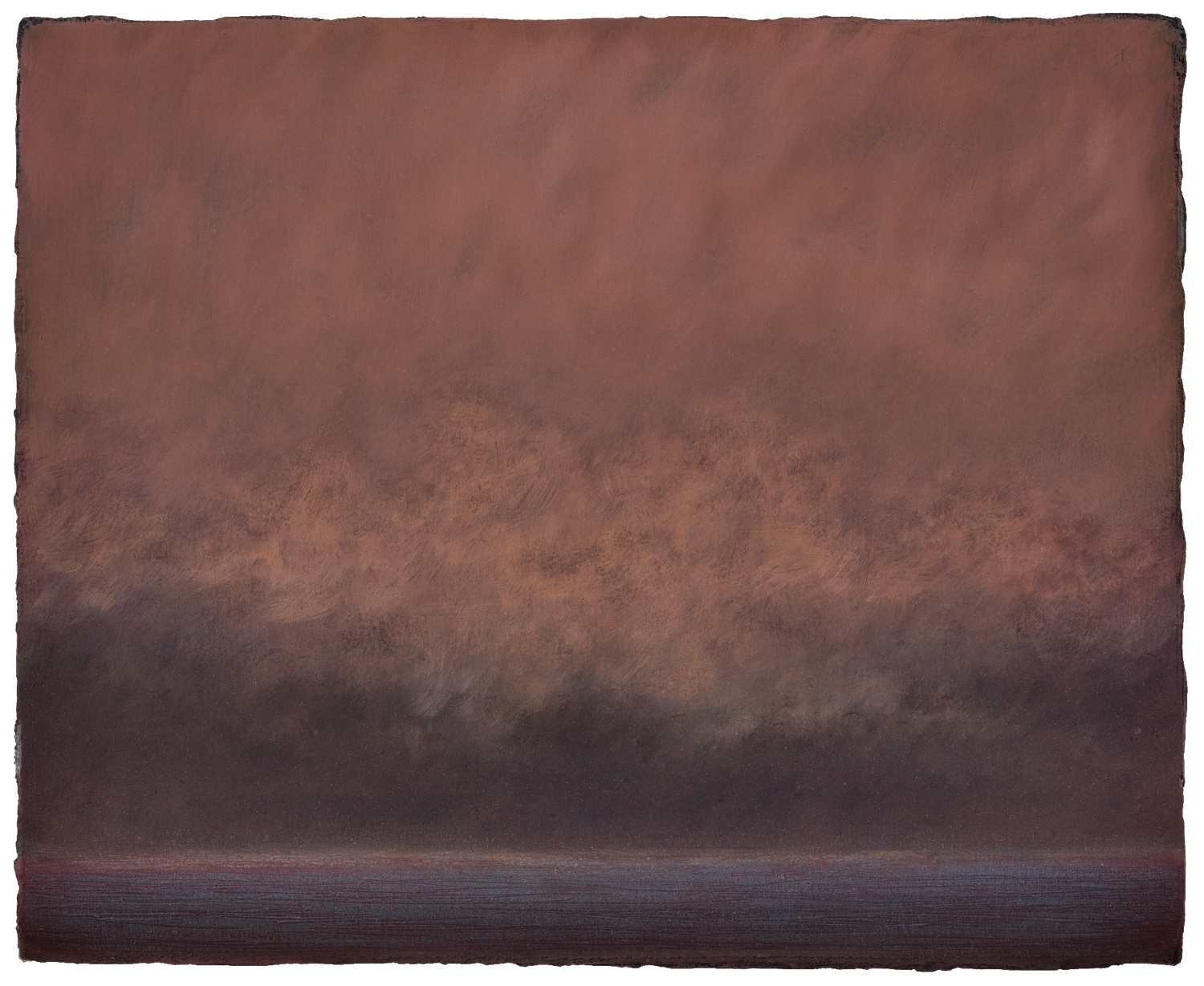
Through his intimately sized oil on canvases, São Paulo-based Lucas Arruda transports his viewers to another world. At first glance, one may think that the paintings by Lucas Arruda were created in the 19th century. Recalling the Romantic notion of the sublime, the striking landscapes and seascapes, often marked only by a faint horizon line, seem to radiate an intense, transcendent light from within. Painted from memory, they are devoid of specific reference points, achieving instead their variety through the depiction of atmospheric conditions. Verging on abstraction, the atmosphere hangs heavy over seas and in dense forests, and any perceived calm is only the signal of an approaching storm.
When asked about his work, Arruda says: “I identify more with Morandi, in the sense that I always use the same structure – a landscape with a horizon line. There’s a combination of mathematical and metaphysical impulses in my work. In a way, the only reason to call my works landscapes is cultural: it’s simply that viewers automatically register my format as a landscape, although none of the images can be traced to a geographic location. It’s the idea of a landscape rather than a real place, perhaps in that sense there’s a similarity with the late Turners.”
William Mackinnon
B. 1978 in Australia.
Lives and works between Ibiza, the UK and Australia.
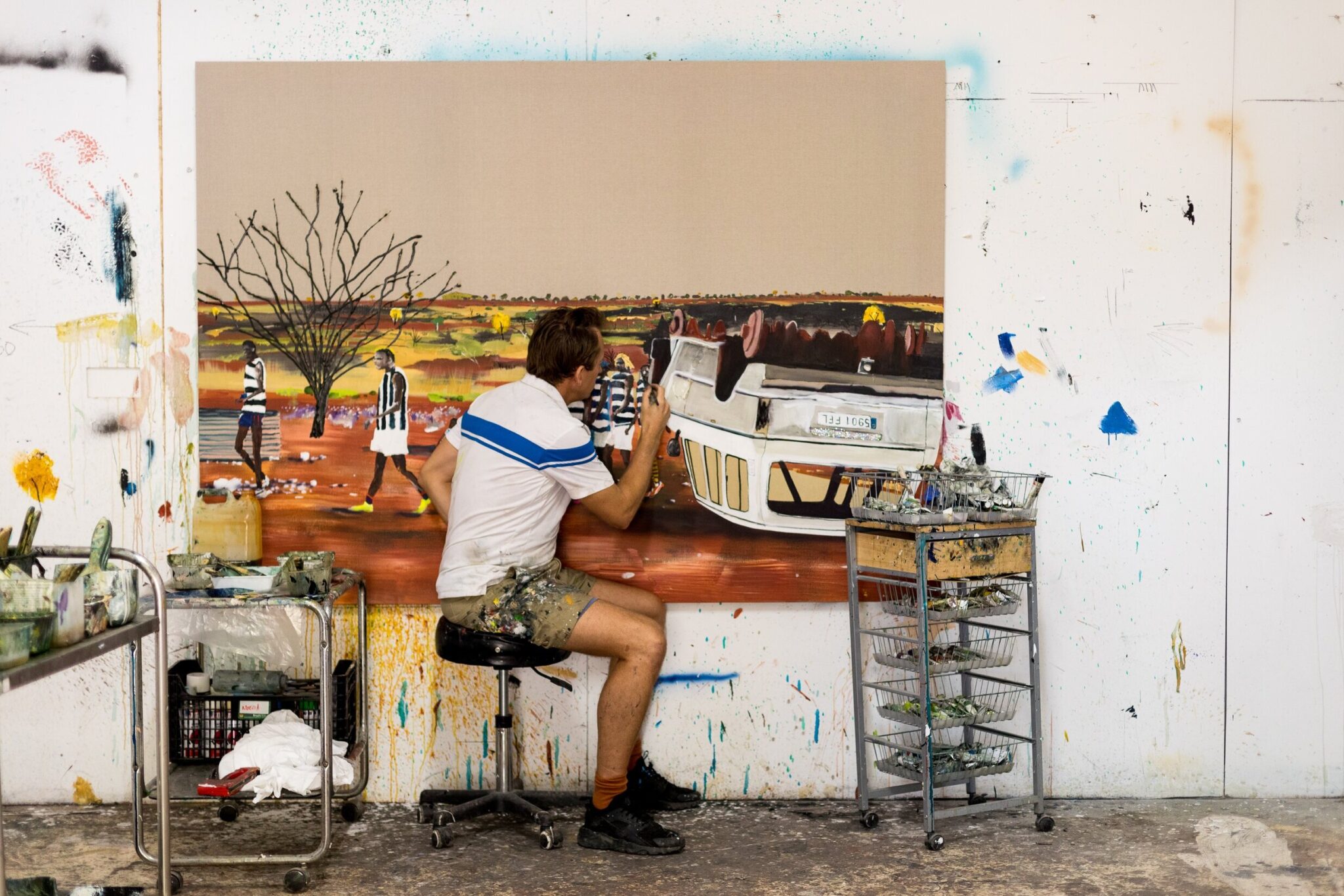
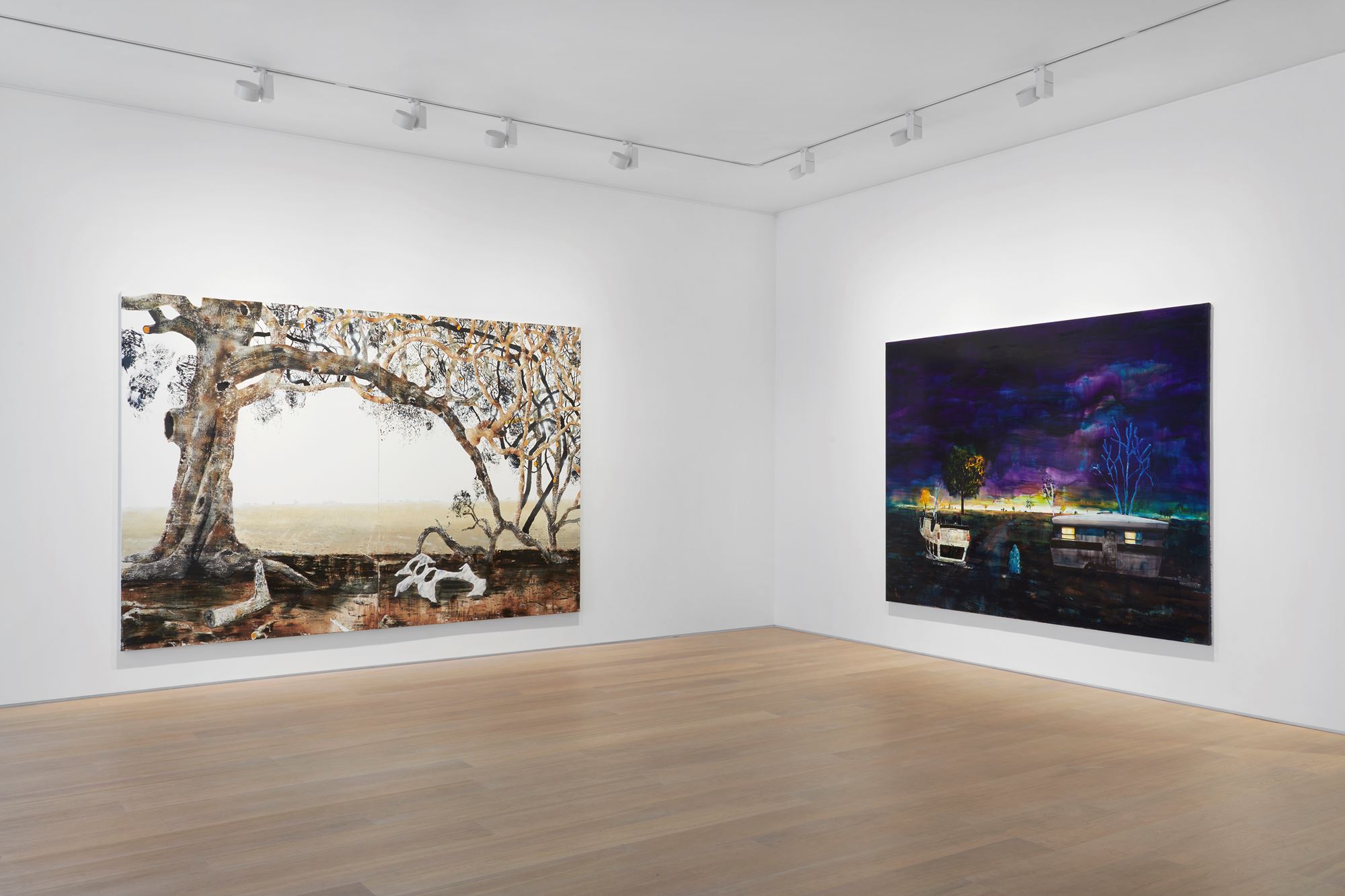
William Mackinnon’s landscape paintings portray the world he inhabits with ebullience, wonder and whispers, perhaps, of terror. Mackinnon’s vision captures the vastness of his domain in manners both terrestrial and emotional. Movement and displacement abound in his pictures too with dazzling painterly invention and compositional risk, Mackinnon suggests the notion that the extraordinary abounds in the mundane. Conflicting, loaded messages give Mackinnon’s landscapes charge and depth: is this a place to rest? Is this a place to die? Menace and welcome in equal measure; light and darkness showing and obscuring in equal measure.
When asked about his work, the artist says: “I call my work psychological landscapes. In a way, the roads and houses are always something more than just roads and houses. The cracks, drains, shadows, rips and glitter are stand-ins for emotional states, or symbolic of greater themes of life.”
In his latest exhibition at Simon Lee gallery in London, “Strive for the light”, the artist presented his latest body of work, reflecting on memories of trees in and around his family farm in western Victoria, and on formative experiences living in remote indigenous communities in the Kimberley region. Painted during a period of prolonged isolation as a result of lockdown, the symbol of the tree is imbued with a deep sense of longing for home, family, regrowth and regeneration.
Jennifer Guidi
B. 1972 in Redondo Beach, CA.
Lives and works in Los Angeles, CA.
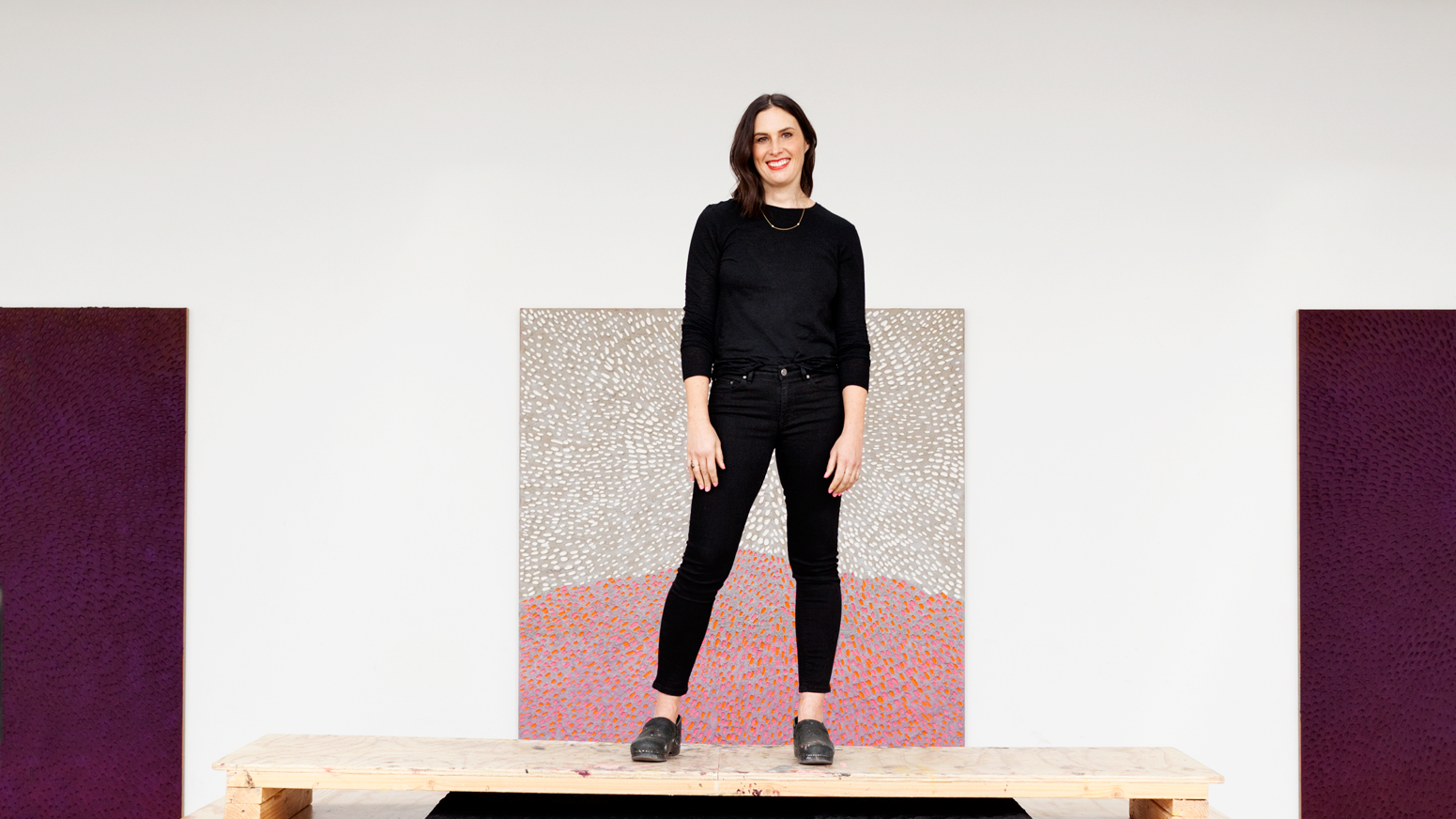
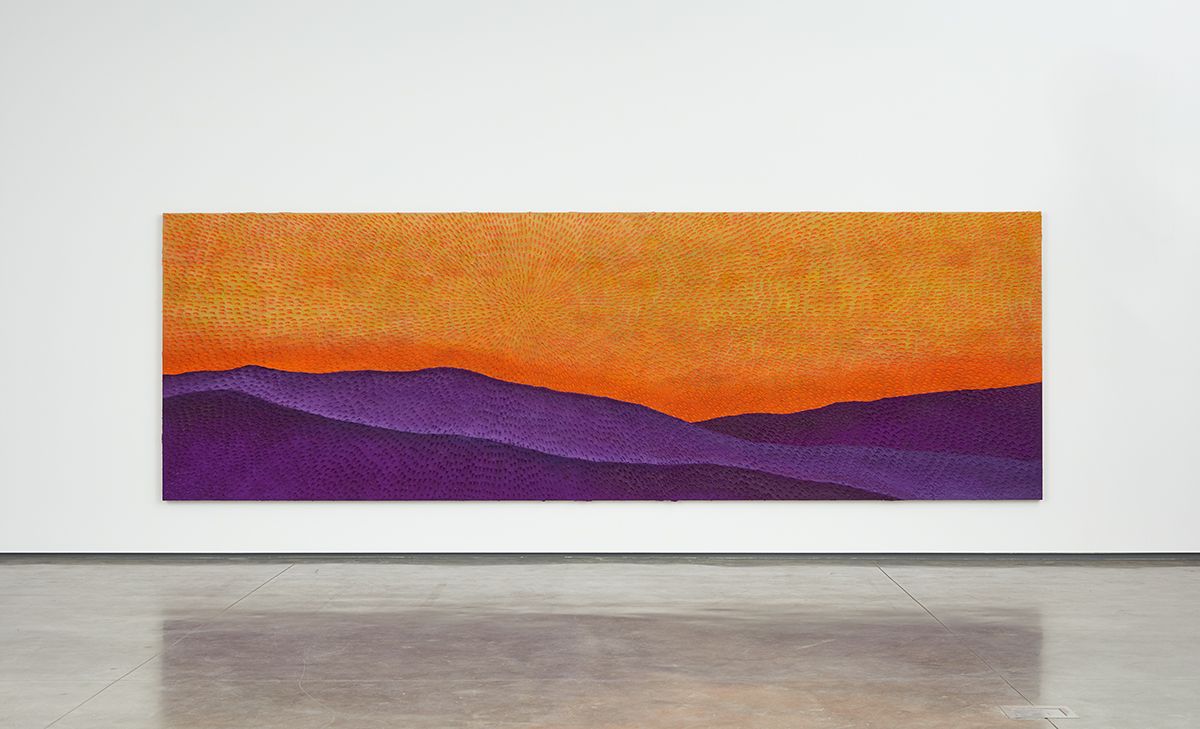
From a distance, Jennifer Guidi’s mandala like paintings offer oblique references to natural phenomena—sunrises and sunsets, swirling wind and rippling water. Upon closer inspection, the pictures begin to breathe and pulse, drawing viewers into a realm of intensified sensory perception, distinguished by Turneresque washes of light through which the connection between landscape and abstraction is made directly tangible.
Many of Jennifer Guidi’s paintings, through their rich combination of colours, echo the atmosphere of something like a coastal Californian sunset. Kurt Mueller, a director at L.A.’s David Kordansky Gallery, which represents Guidi in her hometown, asserts. “You look at these paintings and you start thinking about the rigor of an Agnes Martin and the atmospheric, open-ended landscapes of Georgia O’Keeffe,” he says. “They represent both literal space and the spaces of the mind.”
Each element of Guidi’s pictorial vocabulary–foreground, background, representation, and abstraction–is completely porous to the others, just as the external world one sees is inseparable from the internal structures of the eye that translate light to the brain. She engenders an altogether contemporary version of the sublime, one in which the tiniest details are of no less consequence than the overarching totality of the big picture.
Friedrich Kunath
B. 1974 in Germany.
Lives and works in Los Angeles, CA.
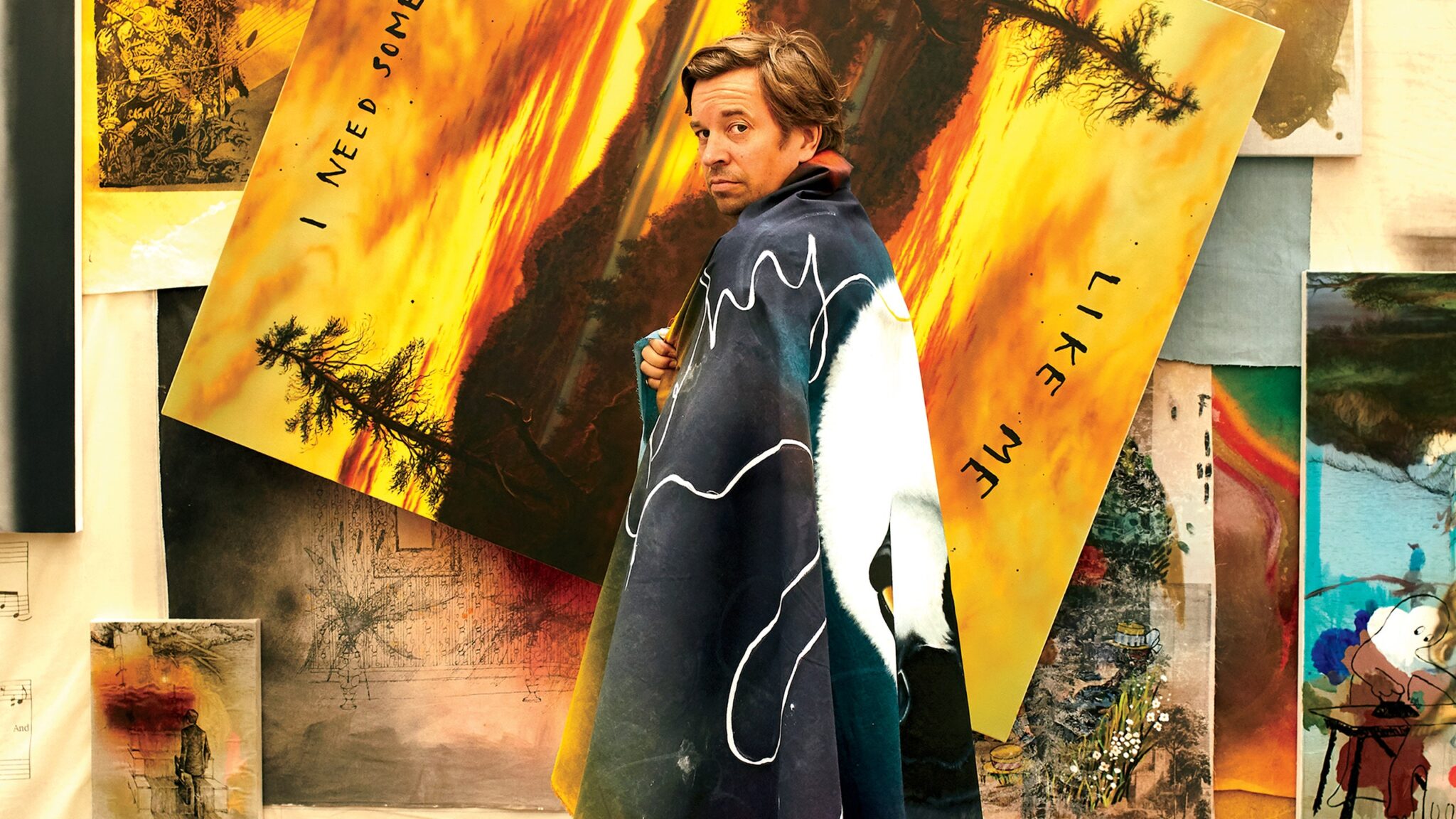
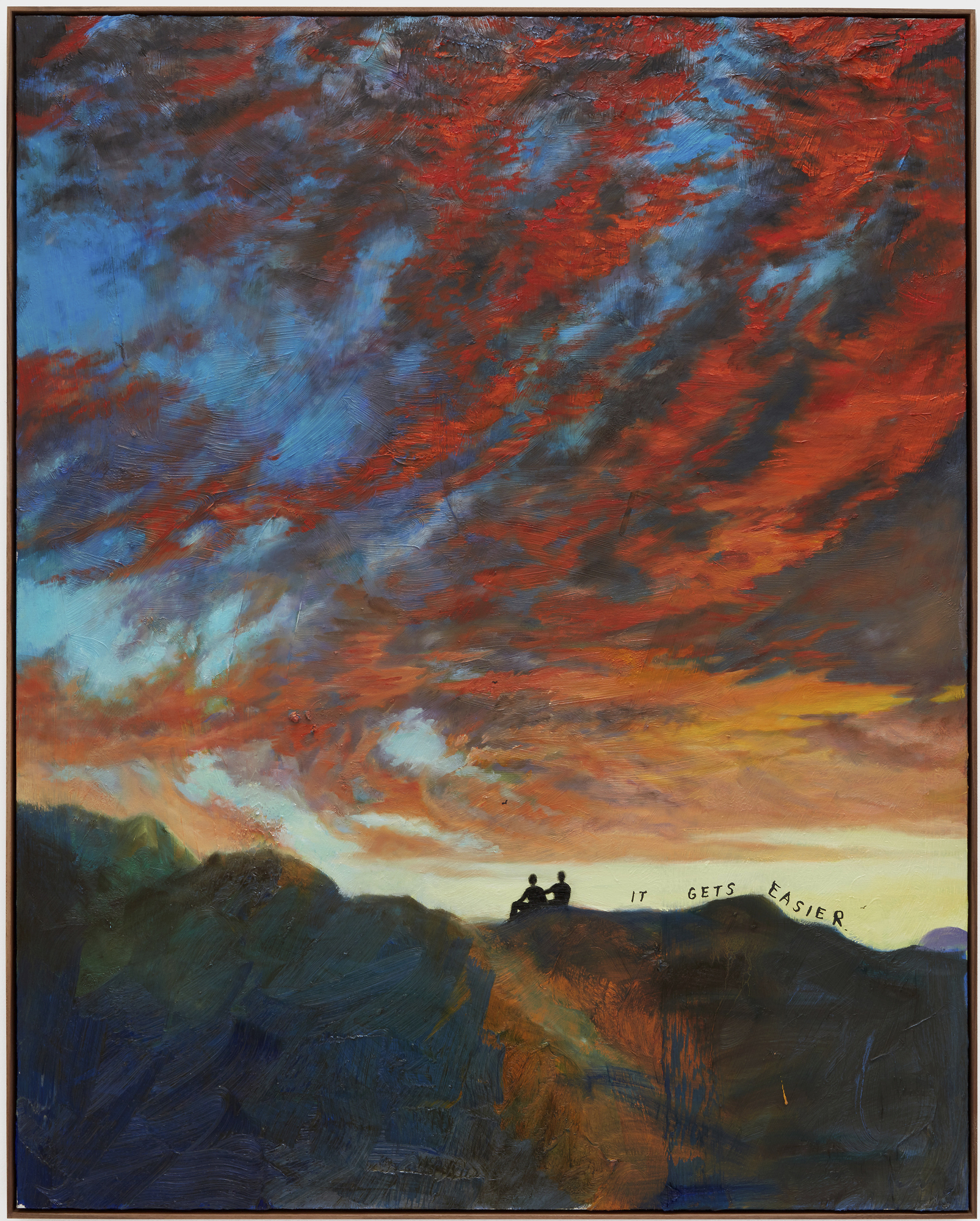
Describing his works as a combination of “sunshine and noir,” Friedrich Kunath creates paintings that contrast the sublime beauty of nature with stark text. German Romanticism is the most German of all German art ideas. It is the expression of, and opposition to, emergent modernism, and the deep connection between the art of painting and seemingly harmonious cultural landscapes at imminent risk of destruction from the ‘blessing’ of progress. In his work, Friedrich Kunath cites German Romanticism as he sees it in his Californian rear-view mirror: having left his homeland for the far, far west, he views it from a place where only a surrogate Romanticism exists.
With Kunath, a sequential transmission of emotional samples rattles through his pictures at breakneck speed. There is no straight route conveying what is real and/or real feelings any more. Our global visual culture has boiled almost every visual signal down to an emoji, and it’s into this tornado of representations that Kunath flees. He drifts — with paradoxes, sarcasm, and bar humour — from the sublime into the void. And yet every single painting, drawing and installation suggests a pathway that began with the longing for a Romantic feeling.
KUSAMA/ BOURGEOIS
Many of art history’s great female artists have battled psychological traumas throughout their careers. From Frida Kahlo to Aloïse Corbaz, history has taught us that, despite the pain, hardships provide a great source of inspiration. However, many of these grand dames of contemporary art began producing art at a time when mental health issues were far more stigmatised than they are today.

This makes for an interesting case study on the work of both Louise Bourgeois (1911-) and Yayoi Kusama (born 1929), making their practice all the more inspiring. Both now revered as central figures of 20th century art, Kusama and Bourgeois shared a profound interest in psychoanalysis, using personal trauma as their main source of inspiration, and conversely, using their art making practice as a way to heal from it. Foreign-born, burdened by childhood trauma and given to intense psychological states, both artists found some measure of relief in New York City, where they achieved recognition as major artistic figures. For these exceptional women, making art was always the way to salvation.

Throughout her career, the Paris-born Bourgeois created art that dealt with the emotions resulting from the discovery of her domineering father’s affair with her live-in tutor. Known for her autobiographical, brutally honest sculptures and paintings, she titled one of her pieces Art is a guaranty of sanity and once said, “art is restoration… the idea is to repair the damages that are inflicted in life.”

Kusama – born to a prosperous family in Matsumoto, Japan – had a difficult upbringing. Her mother’s contempt of a weak husband (who was prone to long absences and serial womanising) and her vehement and violent opposition to Kusama’s wish to become an artist exacerbated her nascent hallucinosis: a psychological condition that would become the lifelong well-spring for her obsessive-compulsive work. “By continuously producing the forms of things that terrify me, I am able to suppress my fear… I’m able to revel in my illness in the dazzling light of day.”

Louise Bourgeois
Born in France in 1911, and working in America from 1938 until her death in 2010, Louise Bourgeois is recognized as one of the most important and influential artists of the twentieth century. For over seven decades, Bourgeois’s creative process was fueled by an introspective reality, often rooted in cathartic re-visitations of early childhood trauma and frank examinations of female sexuality. Articulated by recurrent motifs (including body parts, houses and spiders), personal symbolism and psychological release, the conceptual and stylistic complexity of Bourgeois’s oeuvre – employing a variety of genres, media and materials – plays upon the powers of association, memory, fantasy, and fear.

Bourgeois’s work is inextricably entwined with her life and experiences: fathoming the depths of emotion and psychology across two- and three-dimensional planes of expression. ‘Art,’ as she once remarked in an interview, ‘is the experience, the re-experience of a trauma.’ Arising from distinct and highly individualized processes of conceptualization, Bourgeois’s multiplicity of forms and materials enact a perpetual play: at once embedding and conjuring emotions, only to dispel and disperse their psychological grasp. Employing motifs, dramatic colors, dense skeins of thread, and vast variety of media, Bourgeois’s distinctive symbolic code enmeshes the complexities of the human experience and individual introspection.

Rather than pursuing formalist concerns for their own sake, Bourgeois endeavored to find the most appropriate means of expressing her ideas and emotions, combining a wide range of materials – variously, fabric, plaster, latex, marble and bronze – with an endless repertoire of found objects. Although her oeuvre traverses the realms of painting, drawing, printmaking, and performance, Bourgeois remains best known for her work in sculpture.

Bourgeois’s early works include her distinct ‘Personages’ from the late 1940s and early 1950s; a series of free-standing sculptures which reference the human figure and various urban structures, including skyscrapers. The ‘Personages’ served as physical surrogates for the friends and family Bourgeois had left behind in France, while also highlighting an interest in architecture dating back to her childhood. Her installation of these sculptures as clustered ‘environments’ in 1949 and 1950 foreshadowed the immersive encounters of installation art twenty years before the genre’s rise to prominence.

Yayoi Kusama
Over the course of her distinguished career, Yayoi Kusama has developed a practice, which, though it shares affiliations with Surrealism, Minimalism, Pop art, Eccentric Abstraction, the Zero and Nul movements, resists any singular classification. Born in Matsumoto City, Japan in 1929, she studied painting in Kyoto before moving to New York in the late 1950s, and by the mid-1960s had become well known in the avant-garde world for her provocative happenings and exhibitions. Since this time, Kusama’s extraordinary artistic endeavours have spanned painting, drawing, collage, sculpture, performance, film, printmaking, installation and environmental art as well as literature, fashion (most notably in her 2012 collaboration with Louis Vuitton) and product design.

An enduring feature of Kusama’s unique art is the intricate lattice of paint that covers the surface of her Infinity Net canvases, the negative spaces between the individual loops of these all-over patterns emerging as delicate polka dots. These motifs have their roots in hallucinations from which she has suffered since childhood, in which the world appears to her to be covered with proliferating forms. Forging a path between abstract expressionism and minimalism, Kusama first showed her white Infinity Nets in New York in the late 1950s to critical acclaim. She continues to develop their possibilities in monochromatic works which are covered with undulating meshes that seem to fluctuate and dissolve as the viewer moves around them.

Another key motif is the pumpkin form, which has achieved an almost mythical status in Kusama’s art since the late 1940s. Coming from a family that made its living cultivating plant seeds, Kusama was familiar with the kabocha squash in the fields that surrounded her childhood home and the pumpkin continues to occupy a special place in her iconography. She has described her images of them as a form of self-portraiture.

From these to Accumulation sculptures, where everyday objects are made uncanny with a covering of soft-sculpture phallic forms or dried macaroni, to monumental outdoor sculptures and installations, such as Narcissus Garden, originating in 1966 when Kusama first participated in the Venice Biennale, and to the entrancing illusions of recent experiential mirrored room installations, Kusama’s work is far-reaching, expansive and immersive. Simultaneously infinitesimal and unlimited in scale, immeasurable yet intimate, it allows the viewer to enter into a fully realised world.

It is with characteristic dynamism that Kusama’s My Eternal Soul series, first began in 2009, has grown far in excess of the hundred works originally conceived by the artist. Distilled within the My Eternal Soul paintings are the themes and obsessions that characterise Kusama’s art, encapsulating a surreal and humorous, as well as instinctual approach to art making. Each new work of the ongoing series abounds with imagery including eyes, faces in profile and other more indeterminate forms recalling cell structures, often in pulsating combinations of colour. Some appear psychedelically primordial, other examples bring to mind ancient landscapes and grand geological patterns. This is Kusama, a pioneer in her command of a variety of media, at her most personal and direct, relying on brush, paint and canvas alone. They reveal an artist overflowing with ideas and undiminished in her desire to depict the apparently contradictory, unpredictable and undepictable, well into her ninth decade.

Life made art: Eminently Emin
Tracey Emin’s art is fuelled by passion, a burst violence, a hot-tempered assault on the canvas informed by her own struggles as a woman, once a child, who had the misfortune of being sexually abused; a teenager who fell in the rather toxic habit of venturing into bed with older men; a female who has had a tumultuous relationship with her own body, having had numerous abortions, and most recently, bladder cancer. An Enfant Terrible of the Young British Artists, Emin’s career awakening received misogynistic critiques from the press, which frequently commented on her breasts, on her voice, on her “masculinity”, often calling her rude. But against the popular opinion, the very few people who actually know Tracey Emin paint a very different portrait:
“Beneath the whirlwind personality and notorious reputation lies a generous, loyal, kind hearted soul, who is a dear and dedicated friend to many”
says Kenny Schachter in a recent publication for Tracey Emin’s current exhibition “Detail of Love” at Xavier Hufkens.

Her art to me is above all, generous. A feminist icon, it was Tracey Emin who brought confessional art to the public domain. Her love life and sexual encounters became part of her signature. Like her elder inspiration Louise Bourgeois, Emin brought feminism, raw emotion and glimpses of her personal trauma to the core of her practice. At times when discussing women’s issues is still considered shameful, abortion and rape remain a taboo and yet very few would dare to comment on substance abuse, Tracey Emin’s oeuvre opens a space for meditation and dialogue, but most importantly, it forms an allegory of endless beauty to the female condition. Years have passed since her first public exhibitions at White Cube and Saatchi, and her appeal to young women remains brutally relevant, revealing not only Emin’s own battles, but those of many in the process of finding themselves.

“Outspoken” is an adjective we easily grasp for when thinking of Tracey Emin. Many have condemned her of giving in to the lowest form voyeurism, with male critics unable to sympathise with the issues she so eloquently illuminates. The truth is, her art sabotages society’s expectations of the modern liberated woman by transforming harlot into heroine, making many uncomfortable. But it is that “outspokenness”, that glorification of tragedy after tragedy, what really transcends the poetic revelry and artistic mastery that so characterises her brushstrokes, her glowing neon works and her stitched canvases; or it might be the other way around. What is certain is that one feeds off the other, her practice becoming a cathartic act for the artist, and something for society to treasure. Emin herself said in a recent interview: “I work when I feel like it, when I feel something”. If feelings is all we have got, is there anything more empathetic, more tight to the human psyche than a tangible work of art that emerges from the act of feeling itself?

In her book “Strangeland” we learn that at the dawn of a love affair with a man old enough to be her father, the last words that the subject of her devotion said to Emin were: “Make our story beautiful”. And she did, as she has done with every misadventure she has ever delved into. Pure alchemy. Yes there are the well documented rapes, physical abuse and abortions, all transformed into violently delicate bodies of work, beautiful oxymorons: life made art.

Take the example of “My Bed” -which sold at Christies in 2015 for 4 M US, her auction record to date-. First exhibited in 1999, “My Bed” has become a legendary work of art, complete with its empty vodka bottles, used condoms and blood stained underwear. A testament to the end of a love affair portrayed in the total rawness and decay of Emin’s own mattress; a seminal feminist installation that far from being an unrestricted act of narcissistic oversharing, has earned symbolic status in the course of art history by shedding a light on the changing attitudes towards women that characterised UK culture in the 90’s. In line with third-wave feminism, the bed successfully embodied the evolution of society’s understanding of female sexuality, with women defining beauty in their own terms; and, violent as it is, it also radiates a palpable sense of vulnerability, an aspect of Emin’s persona that stimulates most of what the artist gets her hands into.

Of her artistic influences we can easily recognise Egon Schiele, Edvard Munch or Louise Bourgeois, to name a few. In making herself the subject of her paintings in a rather figurative way, the artist has associated herself to the rich art-historical tradition of employing the female figure as an emotive force, as seen in the work of the afore mentioned. Speaking of historical relevance, and career development, it was this week that The Royal Academy in London was set to open a major exhibition showcasing Tracey Emin’s infatuation with Edvard Munch, with masterpieces by both artists. Having a landmark exhibition at The Royal Academy is without a shadow of doubt one of the highest recognitions an artist can get in the UK. The exhibition will not only signify Tracey Emin’s importance on art history, but it will also elucidate how Munch’s portrayals of women have been a constant inspiration for the artist.

Note to finish, in her Feminist artist statement for The Brooklyn Museum the artist wrote:
“When I had my interview for art school in 1983, one of their questions was: “What do you think of Feminism?” My answer at the time: “I don’t.”
By that I meant that I didn’t think about Feminism. Of course that’s changed a lot now. I often think about feminism, in an everyday way and in an historic way. But to be honest, being a woman has never stopped me from doing anything I wanted to do. Apart from fuck a man really hard up the arse. I’ve never had penis envy, but I’ve often wondered what it must be like. I know that just having a penis definitely affects your wage packet, but I’m not bitter and twisted. I’m grateful to all the women that work so hard to enable women like me to have a voice. And I’m still shouting.”
Eminently, Emin. Thank you Tracey for all the screaming and shouting.

INSTALLATION ARTISTS THAT WE LOVE
Installation art is a term generally used to describe artwork located in three-dimensional interior space. It is often site-specific – designed to have a particular relationship, whether temporary or permanent, with its spatial environment. It also creates a high level of intimacy between itself and the viewer as it exists not as a precious object to be merely looked at but as a presence within the overall context of its designated room. Artworks are meant to evoke a mood or a feeling, and as such ask for a commitment from the viewer. Artists champion this genre for its potential to engage viewers in new ways.
Installation art arose organically from a lineage of conceptual, theatrical, site, and time specific ventures within multiple movements. The term came of use in the 1970s, during these decades of social, political, and cultural upheaval, the art world entered a time of experimentation that blurred the boundaries between disciplines. Installation artists were increasingly interested in doing work that could be displayed unconventionally and that would take into account the viewer’s entire sensory experience.

Because Installation art is especially difficult to collect and sell, this movement pushes against the commodification of art, thereby defying the traditional mechanisms used to determine the value of artworks. From Yayoi Kusama’s Infinity Rooms, to Christo and Jeanne-Claude, largely known for spectacular outdoor works, or Anish Kapoor’s enormous sculptural interventions into buildings, installation art has proven difficult to capitalise and collect. However, there are still options for art collectors’ to acquire installation artworks for their personal homes. In the list below, we highlight our favourite ones:
Olafur Eliasson
Olafur Eliasson uses technical devices and natural elements such as light, water, and fog to transform exhibition spaces into immersive, site-specific environments. Major themes include human perception and our relationship to the natural world. For his major 2003 commission The Weather Project, Eliasson installed a giant artificial sun inside Tate Modern. For Ice Watch (2014), he left giant blocks of glacial ice to melt in London, Paris, and Copenhagen. Both spectacular projects aimed to raise awareness about climate change. In other works, Eliasson has embraced optical illusions. He has been the subject of exhibitions at Fondation Louis Vuitton, Moderna Museet, Tate Modern, and the Museum of Contemporary Art Tokyo, among other institutions. In 2003, Eliasson represented Denmark at the Venice Biennale.

Olafur Eliasson’s famous lamps are smaller-scale examples of the artist’s work and, although highly immersive, they are very well collected and have the power to transform the room in which they are installed by responding and interacting with the space in innovative ways, creating optical illusions through the interplay between colours, lights and shadows.

Bill Viola
Bill Viola has been referred to as “the Rembrandt of the video age” and, indeed, his work pays homage not only to the famous Dutch master but to the tradition of creating large-scale works of art that draw the viewer into beautifully painted images and compelling narratives. There is often a spiritual component to his work, with elements of Zen Buddhism, Islamic Sufism, and Christian mysticism underpinning themes considered universal: birth, death, love, sex, grief, and redemption. Viola considers the “phenomena of sense perception” as a path to self-awareness; therefore, his work is a blend of experimental video art and sound, including avant-garde music performance. His exhibition at the Royal Academy of Arts in London in 2019 paired Viola’s powerful installations with rarely-seen drawings by Michelangelo in an immersive show that took viewers in a journey through the cycle of life.

Bill Viola was one of the earliest artists to explore the potential of the video camera, which in its most basic form in the 1970s only vaguely resembles the sophisticated devices of today. As one of the pioneers of the medium, he has consistently exploited its rapidly changing technology to create over 150 artworks over the last 40 years. In his small scale works, Bill Viola continues to explore the possibilities of the medium creating art that is fully immersive once activated yet easier to collect and live with.

James Turrell
For over half a century, the American artist James Turrell has worked directly with light and space to create artworks that engage viewers with the limits and wonder of human perception. Turrell often cites the Parable of Plato’s Cave to introduce the notion that we are living in a reality of our own creation, subject to our human sensory limitations as well as contextual and cultural norms. This is evident in Turrell’s over eighty Skyspaces, chambers with an aperture in the ceiling open to the sky. The simple act of witnessing the sky from within a Turrell Skyspace, notably at dawn and dusk, reveals how we internally create the colors we see and thus, our perceived reality. A Turrell Skyspace is a specifically proportioned chamber with an aperture in the ceiling open to the sky. Skyspaces can be autonomous structures or integrated into existing architecture and are large in scale.

Turrell’s medium is pure light. He says, “My work has no object, no image and no focus. With no object, no image and no focus, what are you looking at? You are looking at you looking. What is important to me is to create an experience of wordless thought.” His Projection Pieces, created by projecting a single, controlled beam of light from the opposing corner of the room are smaller in scale and can transform a room in a home into a meditative space.

Tomas Saraceno
Tomás Saraceno is a visionary artist whose multidisciplinary practice encompasses art, social and life sciences, he creates immersive works and participatory experiences that suggest a new way of living in our world by forging connections with such non-human phenomena as insects, dust particles and plants, which become players in his works and metaphors of the universe. For more than two decades he has explored the possibility of a future airborne existence as part of his ongoing Air-Port-City / Cloud City project – a utopia of flying metropolises made up of habitable, cell-like platforms that migrate and recombine as freely as clouds themselves.

Saraceno is best known for his monochromatic, room-sized installations of transparent bubbles and sculptural polyhedrons suspended from taut webs of cables. These pieces glimmer and appear to float, interacting with its surrounding walls. In his collectible pieces, Saraceno creates these same modules in a smaller scale.

Studio Drift
Dutch artists Lonneke Gordijn and Ralph Nauta founded DRIFT in 2007. With a multi-disciplinary team of 64, they work on experiential sculptures, installations and performances.DRIFT manifests the phenomena and hidden properties of nature with the use of technology in order to learn from the Earth’s underlying mechanisms and to re- establish our connection to it.With both depth and simplicity, DRIFT’s works of art illuminate parallels between man-made and natural structures through deconstructive, interactive, and innovative processes. The artists raise fundamental questions about what life is and explore a positive scenario for the future.All individual artworks have the ability to transform spaces.

The confined parameters of a museum or a gallery does not always do justice to a body of work, rather it often comes to its potential in the public sphere or through architecture. DRIFT brings people, space and nature on to the same frequency, uniting audiences with experiences that inspire a reconnection to our planet. However, some of their works are smaller in scale and hence highly collectible.

Carsten Höller
Using his training as a scientist in his work as an artist, Carsten Höller’s primary concerns relate to the nature of human perception and self-exploration. He has undertaken many projects that invite viewer participation and interaction while questioning human behavior, perception, and logic. His “laboratory of doubt,” embodied in objects ranging from carousels and slippery slides to upside-down goggles, often contains playful, hallucinatory or darkly humorous overtones in order to provoke experience and reflection. With his photographic prints of Ferris Wheels, merry-go-rounds, and roller coasters where the colors have been ‘displaced’ so as to create images that refuse to register; or his “flicker films” shot from multiple perspectives and projected sequentially to create a sense of movement; or a crop of magic mushrooms hanging upside-down from the ceiling, Höller aims to disorient and by doing so, stimulate precognitive moments of pure sensation.

As with all the artists highlighted above, it is possible to collect and live with works by Carsten Höller. For instance, the project entitled Synchro System (2000), designed by Höller for Fondazione Prada’s spaces in Milan, consisted in the realization of a ‘village of possibility’ composed of psychophysical stimuli and interactive tools. Within a labyrinthine, sensorial route, the viewer faced progressive situations of altered perception caused by intermittent lights, devices that affect corporeal sensations, dark and disorienting spaces, and environments that provoked a hallucinatory effect. The project overturned individual sensibilities by estrangement of the real, and the loss of the natural dimension as one of the strategies the artists utilizes in order to test his subjects, incurring a state of physical and psychological disorientation. Individually, one of the iconic “mushrooms” on display during the show could totally work in a private home.

The Socially Meaningful Dimension Behind The Success of Kiefer, Richter and Baselitz
The German philosopher Theodor Adorno said that there would be no poetry after Auschwitz. If poetry was to be unthinkable, imagine art.
Following the events of the Second World War, Adorno’s claim described a problem faced by German artists of every genre. How could one confront something as inhuman as the Holocaust? How could one ignore it?
In order to understand the cultural, political and visual context of post war Germany one must look back. During the Second World War, the Nazis had exploited the influence of the arts: from torch marches, to Albert Speer illuminated buildings in the night, to the propagandistic imagery of the party’s film industry. In particular, they had most proficiently abused the power of the visual and colossal monumentalism with a central-point perspective, turning national iconography into ornaments of power and control and thereby leaving a post 1945 country culture with a tabula rasa that was certain to instigate a flaming crisis of identity. And yet, over the consequent years after the end of World War Two, German art was very much evasive: the subject of the country’s fascist history was out of bounds.

The country that had created a wealth of avant-garde art during the 1920s was left image dead for about twenty years: a ground zero from a somehow enforced visual amnesia and a need to invent new imagery to recreate a national identity; a project which seemingly fuelled the artistic mission of three painters in particular: Georg Baselitz, Anselm Kiefer and Gerhard Richter; artists whose practice has stood out beyond the efforts of any other recent painter longing for appreciation of national essence; not to exhume history’s painful memories, not to redeem their country, but to do a collective act of memory for a society that didn’t want to forget, but didn’t know how to remember.
Consciously placing their work after conceptualism and minimalism, these artists’ denial to curtsey to the hypocrisies that conceived representational painting as a form of regression allowed them to experiment with the medium and the canvas whilst dealing directly with the ghosts of the motherland and the citizens’ relationship to their collective past, providing a compelling form of visual expression to the spiritual plight of humanity of the late twentieth century.
According to the German philosopher Jürgen Habermas in order for public and inclusive memory work to be realised, what Germany needed was an unrestricted and non-coercive discourse. It is necessary to mention the name of their predecessor Joseph Beuys, who explicitly referred to the Holocaust in a number of his artworks. However, it is Kiefer, Baselitz and Richter who, significantly over the course of the post-war years, achieved this precise type of discursive and pluralistic practice by adapting neo-avant-garde strategies to the “regressive” practice of representational painting. Indeed, their work could very much promote a critical discourse and collective reflexivity due to the fact that it was also concerned with a transformation of the medium, engaging with the public sphere and therefore performing an existential, collective and creative act of memory.
Central for this debate are three bodies of work: Kiefer’s paintings of architectural Nazi ruins, Gerhard Richter’s Birkenau paintings (2014) and Georg Baselitz’s paintings of German Heroes, later recognised as his Helden paintings (1965-1966).

As described by Andreas Huyssen in his 1989 essay The Terror of History, the Temptation of Myth, there is a visual pleasure in Kiefer’s representation of fascist architecture:
“Being confronted with Kiefer’s rendering of the interior of Albert Speer’s Reichs Chancellery is like seeing it for the first time, precisely because “it” is neither Speer’s famous building nor a “realistic” representation of it.”
Andreas Huyssen

What Kiefer wants us to see is an image of ruin, the ruin of fascism in the form of allegory. Somber as they are, these paintings lure the viewer into the fascination with fascist imagery so eloquently analysed by Walter Benjamin of turning politics into an aesthetic spectacle. Despite being images of fascist ruins, these paintings are monuments to the manipulative representation of power, and they affirm, through their overwhelming monumentality and persistent use of central-point perspective, the so questioned power of representation that modernism had done so much to critically reflect on. Perhaps Kiefer’s intentions were to force us to meet with the possibility that we ourselves are not invulnerable to what we so rationally condemn, while simultaneously conceiving a memorial to the lethal link between art and violence.

Parallel to his critical intentions, Kiefer’s necessity to place himself efficiently at the end of a genealogy of German art and thought gets in the way. In this specific context, Kiefer’s reworking of painterly vocabulary through multiple layered surfaces and materials such as emulsion, straw, thick oil paint and shellac seemingly weakens the paintings’ monumentality and provides a sense of melancholy; drawing in the problematic conceit that saw fascist politics as the ultimate Gesamtkunstwerk: Hitler’s infatuation with Albert Speer’s illuminated buildings and his party’s fanatical devotion and attempt to appropriate the music of Opera composer Richard Wagner.

Throughout his six-decade career, the German artist Gerhard Richter (b. 1932) has also explored the material, conceptual, and historical implications of painting. Like with Kiefer’s, at the heart of Richter’s practice there is a profound engagement with the titanic events of the 20th century, in particular with the atrocities of the Holocaust. What is more, at a time when painting was seen as, again, “regressive” -or even dead, to some critics- both his abstract and his representational -also known as “photo realistic”- paintings successfully granted Richter the status of the Postmodern saviour of painting for which he is internationally recognised and celebrated for. Indeed, Richter achieved to make his painting practice both self-conscious and self-referential by both criticising it and diminishing it.

As an allegorical representation of both his avow to the medium of painting and his commitment towards the victims of Nazism, the Birkenau series, which the artist created in 2014, consists of four heavily worked abstract paintings based on four photographs secretly taken by a Greek prisoner in the death camp of Auschwitz-Birkenau in August 1944. The photographer’s name was Alex, and his pictures depict naked corpses in open-air incineration pits at Birkenau crematorium and naked women slouching towards a gas chamber.

As the art historian Benjamin H.D. Buchloh observed in his catalog essay of the Birkenau series, Richter’s life long preoccupation with whether “any artist, and more improbably any German painter, could possibly construct a credible mnemonic representation” of the Holocaust, is successfully encapsulated in the Birkenau series through the medium of painting because, whilst evoking a poetic meditation around its subject matter, it also gives form to the uneasy relationship between representation and abstraction, and the dichotomies between reconstruction and destruction, revealing how Richter covered his initially figurative representations of the snapshots -blown up to mural scale- with layers of paint in a somber coloured palette, reflecting his struggle to address the historical trauma embedded in the initial photographs, and hence comprising one of Richter’s most ambitious and important bodies of work.

The German pavilion at the 1980 Venice Biennale was what brought German artist Georg Baselitz to an international audience. The artist says:
“I was in the German pavilion with Anselm Kiefer, another provocative artist, and it never occurred to me that my sculpture was doing a Hitler salute. But when a German TV channel reported on it they played the “Horst Wessel Song” (the Nazi anthem) to accompany their story. It was outrageous. But within a week I was getting approaches from all over the world to collaborate.”
Georg Baselitz

Since his scandalous intervention at the Biennale in 1980 -the artist presented a monumental carving of a man resting his left arm between his legs as if pleasuring himself, whilst making a gesture with his right arm that could be mistaken for a straight, open palmed Hitler salute- Georg Baselitz has been regarded as one of the most important European artists of the post war era. He is internationally acclaimed for his upside down paintings, but in 1965-66, when he painted his now widely known series Helden, “Heroes” or “New Types”, he was very young, and he had made very few, although intensely provocative, appearances on the international art scene. At a time when history was a touchy subject in Germany, Baselitz’s paintings delved deep into the past.

Refusing to accommodate himself to the conventions of the international art scene of the time that saw Tachism – European version of abstract expressionism – as the new orthodoxy through which to experiment with painting, Baselitz began to introduce figures and national archetypes in his work in a representational way, painting men in landscapes in a way that resonated with German folklore. Dressed in dull coloured uniforms, Baselitz’s painted his series of Heroes, men who, paradoxically, instead of appearing as what society would consider conventionally heroic, seem vulnerable, wounded and disoriented, filled with postwar tension. It is because of this paradox perhaps, that these paintings escape cliche; the contradictory subject matter is arrestingly obvious: a German hero brought down by defeat, vulnerable and powerless; an allegory for post war Germany and a metaphor for the dismissal of the house of painting itself. Indeed, albeit many of the paintings being titled “Rebel”, there is one in particular that Baselitz called “A Modern Painter”, conceiving a parallel between the wounded warrior and the overthrown painter that is both romantic and complex.
“What I wanted to do was something that totally contradicted internationalism: I wanted to examine what it was to be a German now. My teachers were the first to tell me that I was wrong. They said it was anachronistic. We had lost the war, but now we were free and liberated and there were wonderful times ahead in a wonderful world. But I disagreed. I had another view.”
Georg Baselitz
Like Kiefer and Richter, Baselitz took on the project of rebuilding national identity and, instead of adhering to international artistic tendencies, and instead of avoiding to refer to Germany’s past, he chose, like they did, to address the subject boldly and commandingly. Nowadays, Gerhard Richter is 88 years old, Anselm Kiefer is 75 and Georg Baselitz is 82. They are arguably three of the most successful living artists in the world today: their legacy extends not only to their paintings’ materiality and their influence on younger generations of artists, but also to the German people, and far more, the human psyche.
Korean Dansaekhwa Masters: Lee Ufan, Park Seo Bo, Lee Bae and Ha Chong Hyun
Art history books seem to ignore the existence of Dansaekhwa (단색화, also transliterated as Tansaekhwa), which literally means “monochrome painting” and refers to the loosely organised movement that arose in South Korea during the 1970s, a significant moment in modern Korean history. The end of Japanese colonialism on Korea, followed by Park Chung Hee’s authoritarian rule, led state-planned modernization to pave the way for Korea’s astonishing economic growth. However, human rights abuses were rampant in such pursuit, to the point that Lee Ufan, one of the most prominent exponents of Dansaekhwa, defines the 1970s in Korea as an “oppressive and windowless reality”. Dansaekhwa Art can, therefore, be seen as the “sole heir” to the ideologies pertaining to an era in which hope and helplessness coexisted.

The English transliteration “Dansaekhwa” was used for the first time at the 3rd edition of the Gwanju Biennale in 2000. The at the time curator of the Biennale, Yoon Jin Sup, describes the movement as not influenced by those qualities identified within Western Minimalism: according to Sup, “Dansaekhwa possesses aesthetics traits inherited from specifically Korean cultural sentiments, historical traits and reasoning”. It is characterized by a unique “Koreaness”, uncontaminated from the influence of any other Asian or Western cultures, which is a rather unique feature, considering the current globalized nature of the world.
The Japanese audience was the first to acknowledge Dansaekhwa, organising the Korea: Five Artists Five Hinsek, White show, held at the prestigious Tokyo Gallery in 1975. On the other hand, the movement started being recognized within the Western audience only during the last decade, thanks to the 2001’s Lee Ufan’s retrospective at the Guggenheim Museum and to the exhibition Dansaekhwa and Minimalism organized by the gallery Blum & Poe in 2016.

Dansaekhwa artists such as the aforementioned Lee Ufan, Park Seo Bo, Lee Bae and Ha Chong Hyun – whose works have been represented by blue-chip galleries as well as major cultural institutions- sublimated the painful memories of the war and colonialism through a holistic and meditative art, producing an so-called “art form of the mind”. If the past generation had been troubled by the horrible memories of the war, mental illnesses such as anxiety and depression are increasingly suffocating the contemporary man, who is entrapped into a bubble where money and appearance seem to be the only factors determining whether one’s existence can be considered worth it or not. While mental health is an issue too often ignored by society, without specifically addressing such problematic, Dansaekhwa masters seem to address it in an inexplicit way: in fact, their works, soothe the viewer’s preoccupations, acting as a balsam on the wounds.

According to the Dansaekhwa master Ha Chong Hyun, the movement was not collectively established, it was rather as if the movement’s exponents were “facing a wall while being in the same room”, in the sense that their works shared the reflections of the same troubled period of their country. However, Park Seo Bo is often regarded as the “founder” of Dansaekhwa: similarly to the Impressionists rebelling to the Parisian Salon, Park went against the conservative style upheld by The National Art Exhibition with its Manifesto Against the Grand Art Exhibition of Korea, in which he sustained the quality of the new abstract form pursued by Korean artists at the time. It must be noted that Dansaekhwa’s abstractions are conceptual rather than purely aesthetic: they are self-sufficient without the implementation of any anecdotal or narrative aspects, offering, at the same time, a peaceful zone of positive energy, purity and spirituality to their viewers. The sincerity – which is one of the most fundamental Confucian values – of the artist plays a fundamental role in determining the quality of the artwork. Furthermore, such sincerity can be achieved only through “the accumulation of time, during which the artist’s mind is thought to seep into the canvas” through the medium he adopts. Korean scholarly tradition stands as the basis for this unique commitment to the art practice itself, ultimately resulting in the disappearance of negative states of mind. According to Park Seo Bo:
“Korean scholars back in the day sat in sarang bang(reception rooms), clearing their throats and grinding ink all day. They repeated these mundane actions over and over again. While repeatedly grinding the ink, they found their thoughts and feelings—such as anger—more at ease. Through this repetitive action, they rendered themselves pure and more self-aware.That was their method of removing evil and cultivating goodness to reach purity.” –P.C.B
Ecriture No. 950719 is part of the series Ecritures, started by the artist in the early 90s. Inspired by the Taoist philosophy, according to which men could reach the zen, or purity of mind, through the repetition of the same action, he applied repetitive gestures on the canvas while taking advantage of hanji’s (Korean mulberry paper) malleability and resilience.

The medium adopted by the artist plays a fundamental role also in the oeuvre of Lee Bae: the Dansaekhwa master chooses to use the natural material of charcoal, bringing into his artistic practice the meaningful connection between Korean traditions and nature. In Bae’s canvases the black charcoal ink, made with water-fed pigment, passes through the paper creating a unique pattern of brushstrokes.

Commonly seen as a poor material, during Korean history charcoal was actually endowed by symbolic meanings, as it was considered a protector and purifier. For instance, Korean families used to hang charcoal over the door when a baby was born to ward off sickness. Nowadays, charcoal is still part of Korean cooking techniques: it is used in the making of soy sauce, to prevent bad bacteria from growing during the fermentation process. Furthermore, Lee Bae himself underlines the “richness of this poor material”, which after being applied by the artist on the canvas through wise and solemn gestures, enable the viewer to explore the realm of his mind. Furthermore, the work Issu du Feu, through the dark tones provided by charcoal, creates the perfect meditative atmosphere for the viewer to face his own fragilities. It recalls the ancient Greek concept of παθει μαθς (pathei mathos), which literally means that “wisdom arises from suffering, and that personal experience is the genesis of true learning”.

A crucial figure for Japanese and South Korean art scene, Lee Ufan is a pioneer of the former’s Mono Ha and of the latter’s Dansaekhwa. The work From Line no. 800128, greatly summarize the artist’s strengths: an elegant austerity obtained through dedication and meticulous labor. The painting process behind the work, in fact, is visible, with the pigment being denser on a side and fainter on the other. The canvases of the From Line series needs the viewer’s gaze to complete them: the brushstrokes’ movements described by the fading lines on the canvas are, in fact, activated through the act of looking.

Furthermore, the work From Line no. 800128 can be looked at from different perspectives: from the upper side of the canvas to the lower one, it is as if the Ego of the painting (and of the viewer) slowly vanishes into the void, while from the lower to the upper one, its (his, her) purified soul progressively materialise. It is the concretisation of a catharsis, which is finally materialised through a deep blue, considered as the heaven’s colour. According to art historian Joan Kee, Ufan’s artistic production is characterised by an “aesthetic unselfconsciousness”,which gives for the viewer a new meditative zone of tranquility

The oeuvre of Ha Chong Hyun brings further the main elements of Dansaekhwa through original and unexpected artistic techniques. Influenced by the turbulent political situation of South Korea at the time, he incorporated into his works a material which was still easily acquirable during such an unstable moment: burlap sack. During the Korean War, in fact, burlap sacks were used by American soldiers to transport goods and it was possible to find them in any markets. Such a “cheap” material assumed a symbolical meaning for the artist, representing the resistance through the pains of the Korean population.
From 1974, the artist started creating his signature works, the Conjuction series, adopting the so-called “back-pressure-method”, which is based on pushing layers of painting from behind the burlap. This manipulation of paint led to its “surpassing” onto the canvas’ surface through the holes of the burlap. Once again, therefore, the spotlight is turned on the medium and, in particular, on its materiality and tactility. Furthermore, similarly to Lee Bae use of charcoal, it must be praised the artist’s ability to create outstanding artwork using a commonly considered “cheap” material.

As it can be noticed from the work Conjunction 17-38, the artist began to use colours in his canvas, a phenomenon also happened to Lee Ufan’s From Line series, as can be seen from the work From Line No.79088. The rather captivating reason behind the addition of colours is reported by the Korea Times in an interview with Ha Chong Hyun, who recounts:
“About 10 years ago, I encountered the god of the underworld in my dream. He asked me what my profession is and I answered ‘I am a painter’. The god stormed at me with, ‘What kind of painter does not use colour?’ and the remark struck my head”. -HCH
On a final note, Ha Chong Hyun underlined that the right setting is fundamental to enable an artist to truly express himself. Furthermore, he decided to live and work in the countryside rather than in the hectic city of Seoul, affirming that “his greatest mentor is nature itself”, thus recalling once again the fundamental role played by nature and its meditative connotation for Dansaekhwa Art.

The reflections on the pains of the past, the unique Korean traditions and the constant presence of nature, are blended together using the talent and constancy of Dansaekhwa artists, producing an art of unprecedented quality and spiritual meaning and enriching to the world the only contemporary art movement that is so purely construed as an ethical practice.
Forms of Abstraction: 5 Contemporary Abstract Artists We Love
Employing an array of artistic mediums, the artists in this curation redefine the genre of Abstraction and confirm its enduring relevance in today’s contemporary art scene. Influenced by their great predecessors, their works revive the decades long tradition by adapting the subject matter to focus and explore contemporary ideas of collective significance. Exploring the plurality and malleability of the genre, the distinctive language of their work, simultaneously ethereal and dense, alludes to narratives and ideas outside the picture frame.
Mary Weatherford
Born 1963 in Ojai, California. Lives and works in California.

Mary Weatherford (b. 1963, Ojai, California) has become increasingly recognised as one of the leading painters of her generation, as well as one of the most astute and daring practitioners taking on the legacies of American abstraction. As she explores and expands the medium’s possibilities, she honours its history by seizing opportunities to break with tradition at every turn. Over the course of her career, she has produced feminist revisions of large-scale Color Field painting, posited new directions for the landscape genre, and explored the social histories of California. Her notable incorporation of sculptural elements—including the neon tubes that have been a presence in her work since 2012—as well as her fearless and physically embodied approach to painterly gesture, have allowed her to employ abstraction as both a formal language and a poetic, highly personal mode of engagement with the world outside the studio.

Donna Huanca
Born in 1980, Chicago, IL. Lives and works in Berlin.

The interdisciplinary practice of Donna Huanca evolves across painting, sculpture, performance, choreography, video and sound, crafting a unique visual language based in collaboration and innovation. At the very heart of her oeuvre is an exploration of the human body and its relationship to space and identity. Her live sculptural pieces, or in the artist’s words, ‘original paintings’, work primarily with the nude female body, drawing particular attention to the skin as a complex surface via which we experience the world around us. By exposing the naked body, while at the same time concealing it beneath layers of paint, cosmetics and latex, Huanca and her performers urge the viewer to confront their own instinctive response to the human form, which, in the artist’s hands, is both familiar and distorted, decorative and abstract.

Cerith Wyn Evans
Born 1958 in Llanelli, UK. Lives and works in London.

Cerith Wyn Evans’ conceptual practice explores the way that ideas can be communicated through form, incorporating a diverse range of media including installation, sculpture, photography, film and text. He began his career as a filmmaker producing short, experimental films and collaborative works, but since the 1990s has created artworks that deal with language and perception, focusing with precise clarity on their manifestation in space. Evans employs strategies of exhibition making that are often site-specific, viewing exhibitions as a catalyst to produce a reservoir of possible meanings and discursive experiences.
His poetic work derives its refined aesthetic from a wide range of influences including film, music, literature and philosophy. Visual or textual sources and ideas are often repeated across different bodies of work, an indication of his desire to keep ideas in play or to bring them back to life as raw material for future use. He harnesses the potential of language to create moments of rupture and delight, where desire and reality conjoin, evident in his series of firework sculptures where wooden structures spell out open-ended texts and fleetingly burn over a designated period of time. These performative sculptures exist only as a durational event, but take on new life when documented through photographs or film. Likewise, in an ongoing series of neon text sculptures, he uses favourite passages of text or the subtitles from films to create open-ended, powerful works that produce a retinal after-image in the viewer.

Lucy Dodd
Born 1981 in New York. Lives and works in New York.

Lucy Dodd has created a painterly universe that can be understood as a radical reinterpretation of lyrical abstraction and action painting. Her works—biomorphic topographies of random and intentional marks—resemble painted evocations of cosmological and spiritual landscapes. They are characterised by an emphatically process-oriented approach to painting and the use of unusual colour pigments, which often derive from nature and Dodd’s personal environment, often incorporating elements of ritual and theater.
Dodd’s works convey a profound freedom, confidently balancing painterly control and the relinquishing of that control. Circular contours left by kombucha cultures merge with arborescent colour structures created in the chemical interplay of certain colouring agents with the canvas. These elements are embedded in moving, organic whirls of colour attained through the application, smudging, subtraction and re-addition of pigment extracts. The result are biomorphic colour fantasies and atmospheric compositions made of mineral patterns, spots, smears and traces recalling fossils, corals, sky constellations or rock formations. Dodd’s works advance the pictorial repertoire of abstraction in unexpected ways. Possessed of an ethereal, fearless beauty, they are the product of an aesthetic vision that expands the legacy of high modernism to include archaic and cultic aspects.

Oscar Murillo
Born 1986 in Colombia. Lives and works in various locations.

Oscar Murillo leaves his calligraphic, mixed-media canvases on his studio floor to gather dirt and dust; the resulting paintings explore incompletion, transformation, and the realities of maintaining a studio practice. Murillo repurposes discarded scraps of previous works, turning his gestural abstractions into layered palimpsests that meditate on time and process. The artist’s inventive, itinerant practice also spans drawing, sculpture, installation, video, and performance and often considers notions of circulation and globalization. Murillo has exhibited in New York, London, Paris, Berlin, Hong Kong, Bogotá, and Los Angeles. His work has sold for six figures at auction and belongs in the collections of The Broad, Moderna Museet, Fondazione Prada, the Museum of Modern Art, the Rubell Museum, the S.M.A.K. Museum of Contemporary Art, and the Museum of Contemporary Art, Los Angeles.

From art of the revolution to the multiple revolutions in contemporary Chinese art
In 1989, Chinese contemporary artists entered the international art scene with the exhibition Magiciens de la terre in Paris, soon followed by the China’s New Art post ’89 in Hong Kong and China Avant Garde in Berlin, rapidly encountering public favour and interest from collectors. From the late 1990s, China’s economy began to flourish, and the country became a member of the World Trade Organisation. The Chinese Art ecosystem was positively affected by this: Beijing’s galleries grew from only 5 in 2000, to a total of 300 in 2008. This increase was due to a “Museum boom” during the late 90s: most notably the Guanfu museum of classic arts inaugurated by Ma Weidu and the Poly Museum founded in 1999. In spite of the new attitude of the Chinese government towards museums, it must be said that the “cultural institutions validating model”, typical of Western countries, cannot be applied to the Chinese art market. Chinese auction houses successfully sell new artworks straight out of the artist’s studio, which would be unusual both in Europe and the US. This brings the spotlight on the “uniqueness” of the domestic Chinese art market, which is increasingly detaching itself from its Western counterparts.

In 2005, Chinese contemporary art was featured as a category for the first time at Christie’s and in 2006, Sotheby’s and Christie’s combined made $190 million revenue from ‘the Asian sale’, of which most of the artworks sold were by Chinese artists. In 2014, 47 Chinese artists ranked among the top 100 contemporary artists by turnover, compared to only 19 from the US. The display of Chinese contemporary artworks at the prestigious China Club in Hong Kong, a popular meeting hub among wealthy expatriates and business people, acted as a turning point for Chinese contemporary artists, that started becoming increasingly known to a broader audience. The curatorial suggestions of Johnson Chang, a friend of China’s Club owner David Tang, also played a fundamental role. Throughout the years, in spite of the 2008 global Economic crisis, the Chinese art market’s performance has managed to remain relatively stable, keeping the interest of both Chinese and international collectors, as it can be noticed by the market performance of artists such as Zhang Xiao Gang and Zeng Fanzhi, whose market record prices and sensational turnover annually.

Contemporary Chinese art in the context of the auction market across the first two decades of the twenty-first century relates to a genre of art that, during the 1980s and 1990s, was referred to as “Avant-garde”, “experimental” or “unofficial” art. These artists grew up during China’s Cultural Revolution, the socio-political movement initiated by Mao Zeodong in 1966 which lasted until 1976. During these years, the peasant class started to receive an art education, finalised at the production of imagery that had to respect the “orthodox style” established by the Propaganda. Such an artistic production would have ultimately resulted into the, to use Mao’s words, “military and cultural victory” of the Public Republic of China.

The environment in which Chinese contemporary artists commenced their careers, therefore, was entirely composed of radically mainstream subjects and techniques and was certainly not the most favourable to create works characterised by a more personal touch. Although Maoist ideologies must have certainly affected these artists’ life, they completely failed to weaken their subjectivity, as noticeable by the powerful emotional nature of their works. Art should never be a servant of Politics, and after having painted those models required by the curriculum in class, artists such as Zeng Fanzhi, Liu Xiaodong, Fang Lijun, Yue Minjun and Zhang Xiaogang immediately implemented their own subjects and artistic techniques in their works.
“At that time, what I desired to express was my feelings: I always get a special feeling when I see the emotions of people in pictures.” – Zeng Fanzhi

Zeng Fanzhi
Escaping from the strict norms of Social Realism, Zeng Fanzhi found great inspiration in the German Expressionism, of which he mastered the thick and emotionally charged brushstrokes and the implementation of a darker palette, as can be noticed from his early works such as the Hospital and Meat series. In 1993, Zeng relocated to Beijing, where the unfamiliar environment left him feeling isolated. It is during this time that he started his new Mask series, shifting from the “brutality and rawness” of his past works towards apathetic subjects. The artist produced his Mask works from 1994 to 2004, and they are dominated by the sense of alienation and solitude that was affecting the artist in that particular period. The large and scary eyes of his masks, deprived of any particular expression, provokes a deep sense of discomfort in the viewer: in fact, the artist aims at denouncing the profound social transformations of our times, due to the excessively accelerated development of the society, eventually leading to the loss of human contact.

It is worth mentioning the skyrocketing price achieved during the 2013 auction at Sotheby’s Hong Kong: at the Asian Contemporary 40th Anniversary Sale, Zeng Fanzhi’s The Last Supper was sold for US $23.3 million, setting a new record for a contemporary Asian artwork.

Liu Xiaodong
Liu Xiaodong is another artist who refused to follow the rules of Socialist Realism in Chinese art, according to which figures had to be represented as “decent, grand, and deprived of any imperfection”. The artist’s oeuvre is, in fact, characterised by an “honest” style and daily life subjects. As the artist himself recounted in many interviews, he usually takes photographs and videos of people around him, to then depict them on his canvas in a sort of ‘recollection in tranquillity’, as the Romantic poet William Wordsworth may say, producing works characterised by brushstrokes layered with meaning. As mentioned above, ordinary people coming from all around the world are the protagonists of his canvases: the 2015 exhibition “Painting as shooting”, organised at the Fondazione Giorgio Cini in Venice during the 56th edition of the Venice Biennale, may be the best example of it. The paintings on display flew the visitors to the rural corners and urban centres of the artist’s motherland, China, including the autonomous regions of Tibet and Xinjiang, as well as around the world, from Cuba to Greenland, Iceland to Thailand.

Fang Lijun
Fang Lijun’s work aims at conveying a message of denouncing towards the oppression of human rights in contemporary society: protagonists of this works are shaven headmen who, similarly to the masked men represented by Zeng Fanzhi, seem to be incapable of expressing any real emotion or to establish a dialogue with each other. Other elements which are greatly present in his works are water and flowers: in his Swimming series, Fang Lijun depicts a man drowning into the water, representing the sense of impotence he felt during the oppressive times he was living, and that is still affecting the contemporary society, as reported by the artist himself during a recent interview:
“One could say that our society is progressing at a runway pace, like an express train. Do you know the high-speed trains in China? We launch these trains without installing a breaking- systems. In traditional Chinese philosophy, and even in contemporary society, one is always conscious of the smallness of people and their powerlessness.” – Fang Lijun

Yue Minjun
According to Marcello Kwan, a specialist in Asian contemporary art at Christie’s, the Chinese contemporary artist Yue Minjun is, with his works, directly answering to Mao Zedong, who used to be the idol: with his ever laughing men, (a depiction of the artist) he is using himself as the basis for a new idol through a rather unique subversion:
“To laugh is an expression of pain. When you have endured the maximum level of pain you can tolerate, all you could do is to laugh” – Yue Minjun
The artist defines himself as a pessimist, and the laughter which populates all of his oeuvre is, in truth, the scream of grief of the whole mankind, of which artists must carry the weight and translate it in something incredible in their works.

Zhang Xiaogang
If for Yue Minjun the starting point for producing art is his himself, on the other hand, Zhang Xiaogang found the theme for his oeuvre after discovering his family photos, which reminded him of the memories destroyed by the contextual cultural setting of the Cultural Revolution in Chinese history. According to the artist:
“There was a complex relationship between the state and the people that I could express by using the Cultural Revolution. China is like a family, a big family. Everyone has to rely on each other and to confront each other. This was the issue I wanted to give attention to and, gradually, it became less and less linked to the Cultural Revolution and more to people’s states of mind.” – Zhang Xiaogang
Inspired by these old photographs, therefore, he started producing his Bloodline series, that made him one of the favourites contemporary Chinese artist among western collectors. It is worth mention the 2014 auction result of Bloodline: Big Family No. 3, sold at Sotheby’s Hong Kong for more than $12 million.

Inside the studios of four masters from our latest exhibition
Take a look behind closed doors into the birthplace of creative visions, as we explore the studios of four artists who are part of our latest show What’s Up / Seoul ‘12 Masters’.
Alexander Calder
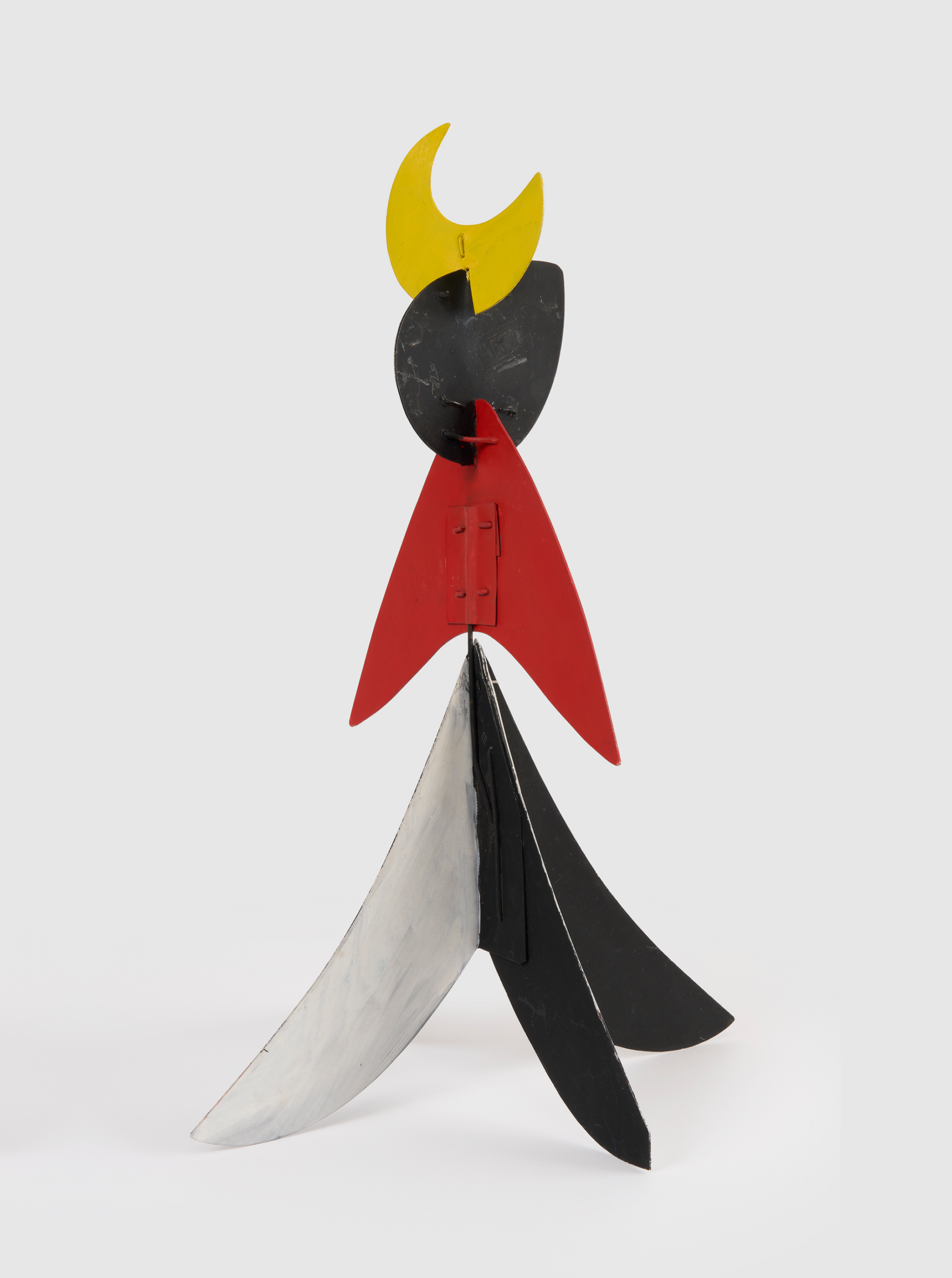
The American sculptor Alexander Calder produced large scale hanging mobiles, as well as colossal stationary floor sculptures which he called “stabiles”. Having studied mechanical engineering in his early career, Calder often produced works using large sheets of metal. By introducing a delicate new slant to his art form, Calder became the pioneer of ‘mobile’ art and changed the landscape of 20th century sculpture.
In 1933, Calder and his wife Louisa bought a farmhouse in Roxbury, Connecticut. It soon became a hub for the avant-garde and a place where European émigrés, intellectuals and bohemian artists exchanged ideas. Inside Calder’s glass and cinder-block studio, the air is crowded with his hanging mobiles and an array of materials. The seeds and traces of his creative process are scattered on the studio floor, with rows of supplies, cut metal sheets, metal rods and many other materials. His kinetic sculptures move continuously through space and time, carefully weighted to achieve balance and harmony. In October 1930, Calder visited the studio of Piet Mondrian in Paris, he was deeply impressed by a wall of several coloured cardboard rectangles that Mondrian carefully repositioned in his experimental compositions. This experience marked a pivotal moment in the sculptor’s move towards total abstraction and kinetic sculpture. Calder’s studio becomes a fascinating wonderland where his convention-breaking sculptures and installations come to life as playful colourful forms.


Alexander Calder
La lune (1963)
Click here to enquire
Included in our latest show, La lune (1963), is one of Calder’s incredible creations made within his Connecticut studio.
Giorgio Morandi
Giorgio Morandi, a protagonist of still life natura morta painting, was known for his tonal subtlety and the unifying, atmospheric haze of his images of everyday household objects and familiar landscapes, all of which are at once mind-expandingly simple and complex. Working alone in a small room in Bologna, Giorgio Morandi asked profound questions of modern painting by seeking to understand the structure that underlies the process of representation.
His exceptionally crafted still life paintings range from traditional representational images to a new minimalist aesthetic that remained the core of his creativity. His natura morta compositions are arranged in horizontal planes, against neutral backgrounds, just as he set them in his studio. The studio is filled with objects and tools that reflect Morandi’s meticulous approach to his craft. His work depicts unremarkable elements of daily life that convey a profound sense of his introspective personality and exploration. With painstaking precision and technical care, Morandi’s sparse palette, clean lines, and careful brushwork imbued these banal objects with a mesmerising painterly beauty and timeless simplicity. Working in silent concentration, Morandi’s studio became a sanctuary for meditative contemplation where he worked to shape the body and harmony of his work. One of his exquisite natura morta drawings, included in the ‘12 Masters’, demonstrates Morandi’s extraordinary manipulation of chiaroscuro and the mysterious quietude and serenity which goes beyond the canvas. Morandi’s gentle experimentation modernised still life painting and revitalised ideas that have re-connected painters to the old masters of still life and landscape genres.


Giorgio Morandi
Natura morta (1941)
Click here to enquire

Lucas Arruda
The dreamscapes of the Brazilian painter Lucas Arruda are characterised by romantic washes of paint which blur the boundaries between abstraction and figurative imagery. Working from his spacious light-filled studio in São Paulo, Arruda says his transcendental landscapes insist on “the idea of landscape as a structure, rather than a real place”.
He draws inspiration from J.M.W. Turner’s late work, the uncanny landscapes of Venezuelan artist Armando Reverón and the tranquil harmony of Giorgio Morandi’s works. These diverse influences emphasise the mathematical and metaphysical impulses behind his work. Arruda’s mastery captures the fragile sense of landscape evoked from memory. His observation of nature was inspired by countless trips to Barra do Una, where Arruda developed a strong relationship with its beaches and tropical forest. In his studio, he experiments with washed out colours, palettes of greys and beiges. Like Constable’s clouds, he plays with the relationship and nuances of every colour. His landscapes have a desire to burst beyond their limits and he creates a variety of pieces and sizes that suit the landscapes. Arruda describes this process as “building a score from a sequence, from colour, from sizes and from distances”. Through meticulous thought and keen sensitivity to nature, Arruda’s works evoke a transcendent and emotive response in which chaos manifests an escapist desire for abstraction.


LUCAS ARRUDA
Untitled (2014)
Click here to enquire

Andy Warhol
Andy Warhol’s legendary factory also known as the “silver factory” was a volcano of 1960’s creativity. His factory was a hub for New Yorkers from all walks of life. Musicians, socialites, models, film stars and free thinkers came to unleash their creativity. It became famous for wild parties and influential experimental artistic expression. As Lou Reed of The Velvet Underground noted: “I was a product of Andy Warhol’s Factory. All I did was sit there and observe these incredibly talented and creative people who were continually making art, and it was impossible not to be affected by that.” This was the space where Warhol would film his convention-busting ‘screen tests’ of famous friends, including Bob Dylan, Salvador Dali and Marcel Duchamp. At the same time, Warhol was pioneering a mechanical approach to his art in the factory.

Warhol’s 1982 Dollar Sign series, of which one is currently exhibited in our ‘12 Masters’ exhibition, epitomises Warhol’s mass production technique and reflects his fascination with the intersection of art, wealth and consumerism. To produce silk screen prints, Warhol would simply transfer his stencilled designs, allowing him to reproduce a work multiple times and at a greater speed. The Factory vividly captured Warhol’s collaborative approach to art and everyday life and demonstrated his interest in running a successful business. As a Pop artist, Warhol re-defined what an artist’s studio can be. Rather than an artist working alone in a studio, the factory showed that artists work as a team. This has provided a model for artists such as Jeff Koons or Damien Hirst, who employ hundreds of people in their studios. But Andy Warhol’s hive of artists and provocateurs, on the fifth floor of 231 East 47th Street, became the melting pot for art in the mid 1960s and the catalyst for one of the most creative chapters in 20th century art.

Andy Warhol
Dollar Sign (1941)
Click here to enquire

To access the full list of works included in What’s Up / Seoul ’12 Masters’, click here.
Engineers of beauty: Takis, Calder and Tinguely
Since the early twentieth century artists have been incorporating movement into art. This manifestation of their fascination with motion soon became referred to as kinetic art. In presenting works of art which moved, or which gave the impression of movement, Kinetic artists offered us some of the most quintessential expressions of modern art’s concern with presenting rather than representing living reality, soon growing into a lively avant-garde art movement after the Second World War.
In creating paintings, sculptures, and art environments which relied on the presentation of motion for effect, the Kinetic art movement was the first to offer works of art which extended in time as well as space. This was a revolutionary gesture: not only because it introduced an entirely new dimension into the viewing experience, but because it so effectively expressed the new fascination with the interrelationship of time and space which defined modern intellectual culture since the discoveries of Einstein.

Kinetic artists often presented works of art which relied on mechanised movement, or which otherwise explored the drive towards mechanisation and scientific knowledge which characterised modern society. Different artists expressed a different stance on this process, however: those more influenced by Constructivism felt that by embracing the machine, art could integrate itself with everyday life, taking on a newly central role in the Utopian societies of the future; artists more influenced by Dada utilised mechanical processes in an anarchic, satirical spirit, to comment on the potential enslavement of humankind by science, technology, and capitalist production.

Many Kinetic artists were interested in analogies between machines and human bodies. Rather than regarding the two entities as radically different – one being soulless and functional, the other governed by intuition and insight – they used their art to imply that humans might be little more than irrational engines of conflicting lusts and urges, like dysfunctional machines. This idea has deep roots in Dada, but is also related to the mid-century concept of cybernetics. A few were the artists that explored the possibilities of the movement, but the following three really made a long standing impact on art history and the endless potential of combining pioneering technology, mechanics and engineering with art, leaving behind a legacy of outstanding beauty and relevance.
Takis (1925-2019)
Born Panagiotis Vassilakis in Athens, Takis (1925–2019) spent more than seventy years expanding the purview of art and taking it into domains previously belonging to experimental physicists. A leading figure in the kinetic art movement of the 1960s, he made sculptures, paintings, performances and sound works incorporating invisible forces as a fourth dimension − especially magnetics, his lifelong subject of study. Among his many works involving electromechanical devices, often salvaged from army surplus stores, are the ‘Signals’ series, antenna-like sculptures topped with metal shapes or flashing lights that sway in response to the slightest vibrations. Takis also created reliefs, paintings and self-performing sculptures that use magnets to animate metallic objects suspended near their surfaces. While another series, titled ‘Musicals’, are automated instruments employing electromagnets and electric guitar pickups to create reverberant sounds the artist called ‘raw music’.

Active in Paris, London, New York and his native Greece, Takis met the Beat poets, The Beatles, and Marcel Duchamp, the latter of whom dubbed him ‘the ploughman of magnetic fields and signalman on soft railroads’. During his career Takis channelled aspects of his research into social spheres, regarding his discoveries as forces for peace and healing. In 1960, he launched his own version of the Cold War space race, using magnets to suspend the poet Sinclair Beiles mid-air, the climax of a public event at which the poet read Takis’ anti-war ‘Magnetic Manifesto’, ahead of Yuri Gagarin’s historic flight a year later. Also in 1969, he co-founded the Art Workers Coalition in New York, pushing for more artist’s rights and diversity in museums. Until his death, the artist headed the Takis K.E.T.E., founded in 1986, a research centre for the arts and sciences in Athens that advanced his research and its practical applications for improving the quality and length of life. He also practiced Solar Yoga, a form of his own invention focused on drawing energy from the sun.

Since the 1960s, Takis has participated in numerous international exhibitions, including Documenta in Kassel, Germany (1977 and 2017); the Venice Biennale (1995); and the Paris Biennale, where he was awarded first prize 1985. More recently, his work was featured in important solo exhibitions at MACBA Museu d’Art Contemporani de Barcelona (2019); Tate Modern, London (2019); Palais de Tokyo, Paris (2015); and the Menil Collection, Houston (2015). He also received patents from the French government for his ‘Télésculpture’ and ‘Télésculpture Electromagnétique’, static and kinetic forms of sculpture animated by magnetism. Among the museums holding his works are the Centre Pompidou, Paris; MoMA and Guggenheim Museum, New York; the Menil Collection, Houston; Tate, London; and Peggy Guggenheim Collection, Venice. In 1987 Takis completed Foret Lumineuse (Luminous Forest), a multi-part installation of ‘Signals’ in the Espalande de La Défense, Paris and the city’s biggest public art commission.
Alexander Calder (1898-1976)
Alexander Calder’s invention of the mobile (a term that Marcel Duchamp coined to describe these new kinetic sculptures) resonated with early Conceptual and Constructivist art as well as the language of early abstract painting. Flat, abstract shapes made in steel, boldly painted in a restricted primary palette, black or white, hang in perfect balance from wires. While the latent energy and dynamism of the mobiles remained of primary interest to Calder throughout his life, he also created important standing sculptures, which Jean Arp named “stabiles” to distinguish them from their ethereal kinetic counterparts. These works reject the weight and solidity of sculptural mass, yet displace space in a three–dimensional manner while remaining linear, open, planar, and suggestive of motion.

Alexander Calder was born in 1898 in, Lawnton, Pennsylvania, and died in 1976 in New York. He received his B.S. in 1919 from Stevens Institute of Technology, Hoboken. From 1923 to 1925, Calder attended the Art Students League, New York, and in 1926, he attended the Académie de la Grande Chaumière, Paris. Calder’s public commissions are on view in cities all over the world and his work has been the subject of numerous museum exhibitions, including the National Gallery of Art, Washington, D.C. (1998, traveled to San Francisco Museum of Modern Art, California); The Phillips Collection, Washington, D.C. (1998–99); Wadsworth Atheneum Museum of Art, Hartford (2000); Museum of Contemporary Art, Chicago (2000); Iwaki City Art Museum, Japan (2000, traveled to The Museum of Modern Art, Japan; Hokkaido Obihiro Museum of Art, Japan; The Museum of Art, Japan; Hiroshima Prefectural Art Museum, Japan; Nagoya City Art Museum, Japan); Storm King Art Center, New York (2001–03); Guggenheim Museum, Bilbao (2003, traveled to Museo Nacional Centro de Arte Reina Sofía, Madrid, through 2004); Foundation Beyeler, Switzerland (2004, traveled to Phillips Collection, Washington, D.C., through 2005); Los Angeles County Museum of Art, California (2013); Rijksmuseum, Amsterdam (2014); Fondation Beyeler, Basel (2014); Museo Jumex, Mexico City (2015); and Pulitzer Arts Foundation, Saint Louis (2015).

Jean Tinguely (1925-1991)
Jean Tinguely was born on May 22, 1925, in Fribourg, Switzerland. As early as the late 1930s, he began to create hanging sculptures that used motors to propel them into motion. He later called his form of mechanised sculpture “Méta-Malevich.” In 1954, art historian Pontus Hultén coined the term “Méta-mécaniques” (meta-mechanical devices) by which these works are now known. Tinguely studied at the Allgemeine Gewerbeschule Basel under Julia Ris from 1941 to 1945. There he discovered Kurt Schwitters’s Dadaist work, which would have a great influence on his constructions. Tinguely went through a brief Surrealist painting phase after World War II, but ultimately abandoned painting in favor of sculpture.

Tinguely’s interest in self-propelled motion is central to his sculptural oeuvre. In 1953 he and Daniel Spoerri, a Romanian dancer and artist, planned a live event called the Autothéâtre (Automatic theater), a performance that would use a mechanical set designed by Tinguely to move colored shapes and objects around a stage without human performers. In the late 1950s, he created a series of automatic drawing machines, the Meta-Matics, which use chalk or markers to create abstract works of art through a mechanised process. His constructions, which combine junk sculpture with kinetics, are often witty, humorous, and ironic, owing a great deal to the Dadaist legacy of anti-art. Tinguely was also a pioneer in the field of art that engenders social engagement. His sculptures often rely on the spectator to push a button, pull a lever, or somehow cause them to start moving. Tinguely was also one of the artists who signed the manifesto of the Nouveaux Réalistes (New Realists, 1960–63) in October 1960.

Tinguely participated in several important exhibitions, including one devoted to Kinetic art, Le mouvement (Movement, 1955), Galerie Denise René, Paris. This important exhibition also featured artists Alexander Calder, Jesús Rafael Soto, and Victor Vasarely, among others. Additional exhibitions/performances include Vitesse pure et stabilité monochrome (Pure velocity and monochromatic stability, 1958) with Yves Klein at the Galerie Iris Clert, Paris; Cyclo-Matic-Evening (1959), a “happening” at the Institute of Contemporary Arts, London; Study for an End of the World, no. 1 (Étude pour une fin du monde No. 1, 1961), at the Louisiana Museum of Modern Art, Humlebæk, Denmark; and Study for an End of the World, no. 2 (Étude pour une fin du monde No. 2, 1962), the successful self-destruction of a work in a desert near Las Vegas. Other notable retrospectives were at the Tate Gallery, London (1982), and Palazzo Grassi, Venice (1987). Tinguely died on August 30, 1991, in Bern. In 1996 the Museum Tinguely opened in Basel.
