

(index.php)
Perez Museum presents a Retrospective on the Inimitable masters Christo and Jeanne-Claude
“Works on paper can be a combination of photographs, fragments of other projects, technical information… […] the drawings reflect the evolution of the project. It doesn’t emerge from my thoughts ‘fully equipped.”
Christo
Perez Art Museum Miami has an ongoing exhibition featuring artworks by established artist Christo, since August 19, 2022. The immaculate works gifted to PAMM by Maria Bechily and Scott Hodes, Christo’s lifelong friends, which showcase methods of artistic process and drawing traditions.

The exhibition consists of conceived and realized projects on the American landscape, featuring characteristic drawings that demonstrates Christo’s iconic and monumental installations that were co-authored by his wife and artistic collaborated Jeanne-Claude. The works on paper evince the duo’s boundless impact on the history of art since the mid-20th century. In thoughtfully selected outdoor locations, they designed large-scale, public art projects involving considerable interventions. Christo and Jeanne-Claude were pioneers in expanding the understanding of art beyond classic mediums such as paintings and sculpture, visualizing a democratic art form breaking the boundaries in hopes of addressing audiences across a full spectrum of society. Often by use of techniques of draping, wrapping or surrounding vast areas of existing landscapes with meticulously manipulated fabric, Christo and Jeanne-Claude’s intend to convey a new appreciation of the natural world and built environment through adapted visual and physical experiences of the sites.

The works on paper are considered fine examples of Christo’s drawing practice that is deemed a crucial aspect of his production process. In protest of traditional funding structures of art, Christo and Jean- Claude refused all financial support from institutions, single patrons, foundations and governments, favouring funding their large-scale projects through direct sales of drawing such as these. The exemplifying aspects of the drawings are the spectacular overview of Christo and Jeanne-Claude’s oeuvre, culminating their major projects spanning from the late 1960s to the early 2000s.

From the initial illustrations to the final detailed works, Christo’s drawings portray the evolution of a notion and constitutes what Christo referred to as the “growing process”. “Works on paper can be a combination of photographs, fragments of other projects, technical information… […] the drawings reflect the evolution of the project. It doesn’t emerge from my thoughts ‘fully equipped”. Christo’s drawings reflect decades of research and culminated understanding around visualizing and creating these spectacular, historic projects.

Christos Drawings: A Gift from the Maria Bechily and Scott Hodes Collection
is on view from August 19, 2022 through June 11, 2023
Pioneers of Abstraction
Abstract art has come a long way from its inception in the early 20th century. In its early days, the world of Abstraction was dominated by male artists, and the contributions of women to this field was often overlooked. However, there were a few female artists who played a pivotal role in the development of Abstract art and made significant contributions to the field. Among them were Joan Mitchell, Helen Frankenthaler, and Yayoi Kusama.

Joan Mitchell was an American painter known for her powerful and expressive canvases that explored color and gesture in a way that broke away from traditional figurative painting. Her works are characterized by her thick, vigorous brushstrokes and her intense and layered application of paint. She drew inspiration from her love of nature, particularly the landscape of France where she lived and worked, and often used the colors and forms found in nature to inform her compositions. Her paintings are notable for their boldness, their emotional intensity, and their dynamic movement that seems to suggest the natural world in motion. One of Mitchell’s most famous works is “Ladybug,” a large-scale painting created in 1957. The painting features a vibrant red background with black and white brushstrokes that evoke the movement of ladybugs. Mitchell’s use of color and gesture in “Ladybug” is a testament to her innovative style and her ability to capture the energy and vitality of nature in her work.

Helen Frankenthaler was another American painter whose distinctive style of painting revolutionized the art world. Frankenthaler’s unique technique involved the staining of the canvas with thinned-out paint, creating an almost watercolour-like effect. This method allowed her to create a sense of depth and space in her work, and her use of color and gesture was central to her artistic vision. Her paintings are characterized by a dreamlike quality, with fluid forms and sweeping brushstrokes that invite the viewer into an immersive and contemplative experience. One of Frankenthaler’s most famous works is “Mountains and Sea,” a painting created in 1952. The painting features a blue-green background with bold red and orange shapes that suggest mountains and waves. Frankenthaler’s use of color and her unique technique in “Mountains and Sea” paved the way for future generations of artists and established her as a leading figure in the Abstract Expressionist movement.

Yayoi Kusama, a Japanese artist, has become renowned for her psychedelic and immersive installations, which explore themes of repetition, infinity, and the relationship between the individual and the collective. Her signature dots, which cover much of her work, are meant to symbolize the idea of infinity, and her use of repetition creates a sense of endlessness and the infinite. Her installations often encourage active participation and interaction from the viewer, inviting them to become part of the work. One of Kusama’s most famous works is “Infinity Mirrored Room – The Souls of Millions of Light Years Away,” an installation that features an enclosed room with mirrors on all sides, a shallow pool of water on the floor, and LED lights hanging from the ceiling. The lights change color and create the illusion of infinite space, with the viewer becoming a part of the work as their reflection is multiplied infinitely. Kusama’s innovative installations have had a profound impact on the contemporary art world and have inspired countless artists to explore the possibilities of immersive and interactive art.

Together, these female pioneers of abstraction represent a powerful shift in the art world, challenging traditional gender roles and pushing the boundaries of what was thought to be possible in abstract art. Their unique styles, innovative techniques, and bold use of color and form continue to inspire artists around the world, and their influence can still be felt today. Through their ground-breaking work, they not only left a lasting legacy but also paved the way for future generations of female artists. Their willingness to take risks, experiment with different techniques and embrace new forms of expression has created an enduring legacy that continues to inspire artists and audiences alike.

The contributions of Joan Mitchell, Helen Frankenthaler, and Yayoi Kusama have helped to reshape the landscape of abstract art, breaking down barriers and challenging traditional conventions. Their bold and innovative work has had a profound impact on the art world and continues to inspire artists around the world to this day. Their legacy serves as a powerful reminder of the transformative power of art and the importance of diversity and inclusion in the creative world.
WHAT’S UP/ HONG KONG ‘Women in Abstraction’ is on view between 20.03.2023 – 25.03.2023 at 6/F Pedder Building, Hong Kong
From Icons to Influence: The Continued Relevance of Pop Art
Major exhibitions around the world revisit the work of key artists from the Pop Art movement. In an era where technology rules, Pop Art seamlessly integrates into our visual culture, mirroring the modern day desire for instant gratification.
It remains omnipresent not just in galleries and museums, but also in the broader cultural landscape. Today we desire everything all at once. This endless pursuit makes Pop Art’s exploration of consumerism and fame as captivating now as it was in the 1960s.

Opening October 17th, ‘POP Forever, Tom Wesselmann &…’ exhibition at the Fondation Louis Vuitton in Paris will explore Wesselmann’s bold depictions of the female form and consumerism. The upcoming exhibition will focus on Pop Art, the pivotal movement of the 1960s. The show is focused around Tom Wesselmann as one of Pop Art’s leading figures and will display 150 of his works. Adding to the conversation, works from other key Pop Artists will be exhibited. These artists span from the Dadaist roots of the movement in the 1920s to its contemporary forms today, reflecting Pop Art’s evolving legacy across different eras and mediums.

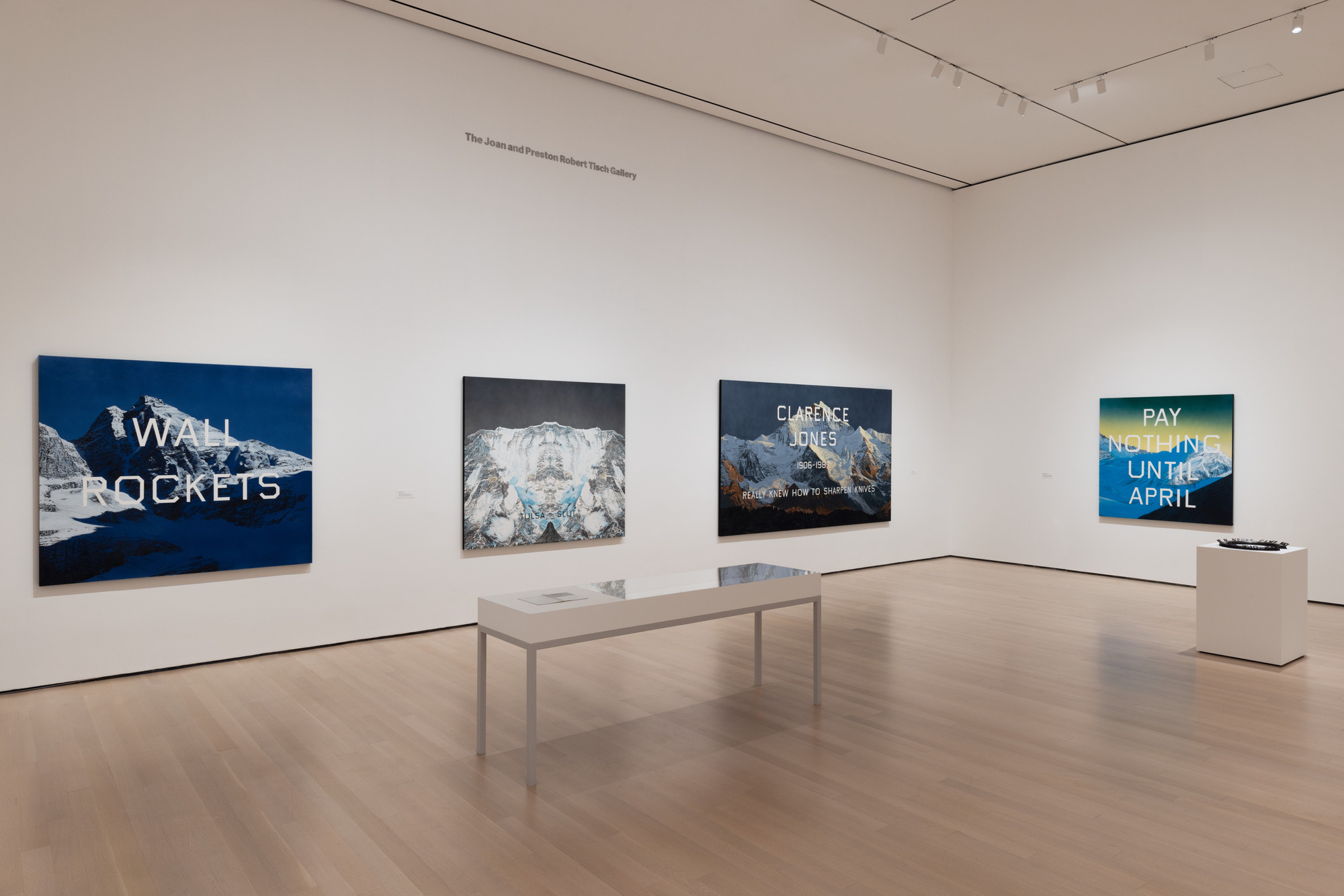
Lately there have been numerous exhibitions that focus on Pop Art’s defining works. Opened in 2023 and closed the earlier part of 2024, MoMA ‘Now Then’ Ed Ruscha show featured over 200 works exploring his 6 decade long creative career. The show captivated New York and brought attention to a lot of his lesser known works from his over six decade career. In December 2023, LVH brought Pop Art to India for the first time with the ‘POP: FAME, LOVE AND POWER’ show in Mumbai. LVH brought 12 Pop Artists including Andy Warhol, Keith Haring, Robert Rauschenberg, Robert Indiana, Ed Ruscha, Claes Oldenburg, and Roy Lichtenstein to exhibit in the Nita Mukesh Ambani cultural centre, a museum that was designed by Richard Gluckman, an architect who designed the Andy Warhol museum.


The Albertina museum in Vienna showed Roy Lichenstein ‘Centennial Exhibition’ from this spring to summer. Roy Lichenstein is also currently on exhibition at ‘Lichtenstein100’ at Rose Art Museum in Waltham, Massachusetts. Lichtenstein’s style is timeless, and so relevant to now; his appropriation of iconic characters and commercial imagery fuses fine art with everyday visual languages, like memes and graphic design.

The resurgence of pop art is unmistakable, with major galleries and museums worldwide showcasing prominent works by Pop Artists. Leading galleries like Gagosian, Pace, Hauser & Wirth, David Zwirner, and White Cube feature exhibitions showcasing pop art’s enduring influence. This trend is also reflected in renowned museums such as MoMA, the Tate, and the Centre Pompidou, again emphasizing the genre’s lasting impact on the contemporary art scene and its continued relevance to both collectors and the public.

Beyond its thematic relevance, Pop Art’s ever present status in the art market underscores its lasting appeal. Big names like Warhol, Wesselmann, and Lichtenstein continue to dominate auctions, solidifying Pop Art’s status as both a cultural staple and a reliable investment. The highest-priced pop art pieces sold include Andy Warhol’s ‘Shot Sage Blue Marilyn,’ which sold for $195.4 million at a Christie’s auction. Roy Lichtenstein’s ‘Masterpiece’ was sold privately for $165 million. Robert Rauschenberg’s ‘Buffalo II’ was sold at Christie’s 2019 auction for $ 88 million. Ed Ruscha’s ‘Hurting the World Radio #2’ sold for $52 million at Christies in 2019 and Tom Wesselmann’s ‘Great American Nude No. 48’ was sold at Sotheby’s New York for $10.6 million in 2008. These sales highlight the immense value of pop art in the auction world, solidifying its status as one of the most sought-after genres in the contemporary art market.

These exhibitions of Pop Art align with contemporary topics of social media, branding, and the commercialization of culture. This comeback also taps into a cultural desire for nostalgia. Pop Art’s bold, vibrant aesthetics resonate today. They offer a visually striking counterpoint to the often overwhelming flood of oversaturated digital images. In an era where online personas are curated and consumed, the themes of Pop Art, celebrity worship, media saturation, and consumer culture feel more relevant than ever. As people grapple with the influence of social media on identity and culture, Pop Art’s investigation and reflection on mass media and celebrity continues to captivate and connect modern audiences.
In today’s fashion, consumers gravitate towards bold, culturally relevant designs, much like the early Pop Art era. The resurgence of vintage fashion mirrors the return of pop art, with both embracing nostalgic references. In the 1960s, Gianni Versace collaborated with Andy Warhol, and in the 1980’s Vivienne Westwood teamed up with Keith Haring. These iconic partnerships exaggerate the timeless connection between art and fashion. We continue to see bold artist / designer collaborations that blend nostalgia with striking aesthetics, especially in today’s image-driven digital world.

Pop Art artists originally sparked the phenomenon of image abundance and obsession with material wealth, fame, and celebrity culture, elements relevant today in our social media-driven world. The digital age, dominated by platforms like TikTok and Instagram, perpetuates these themes, making Pop Art’s bold, eye-catching aesthetics and critiques more relevant than ever.

NICOLAS PARTY THROUGH THE LOOKING-GLASS
Nicolas Party is our white rabbit, and we eagerly follow him down the rabbit hole of the surreal, into a world familiar yet tantalizingly colourful, fantastical, and strange. A world where trees shimmy to unheard music, the sun burns blue over a golden sea, and the barrette in your hair might suddenly become a butterfly. Party has just turned 40 years old, and in recent years has hit the scene in a major way. This was not unexpected however, as some of his earliest works are iconic pieces in his oeuvre. His signature style and championing of his pastel medium have secured his place in the contemporary art landscape. Crisp lines, saturated colours, and velvety finishes make his work a sensual experience and a pleasure to look at. The Swiss artist can place himself firmly in his native country’s extensive history of landscape painting, with an unbelievably fresh twist; Party grew up as a street artist and traveled Europe decorating anything and everything he could in colour and lines. His work holds the energy of an artist at play and demonstrates a perceived beauty of all things. He removes all extraneous signifiers of the subjects of his work and lets the viewer collaborate in the imaginative questions he poses: what if trees were the soft and pale colours of Easter eggs, and what if we were comfortable enough with animals to wear a snake as a shawl? His works are filled with a buzzing vibrancy, though flattened in depth of field. We see an artist who successfully found away to harness the fearless attitude of on-the-run spray can painting in the streets laid flat on a canvas.
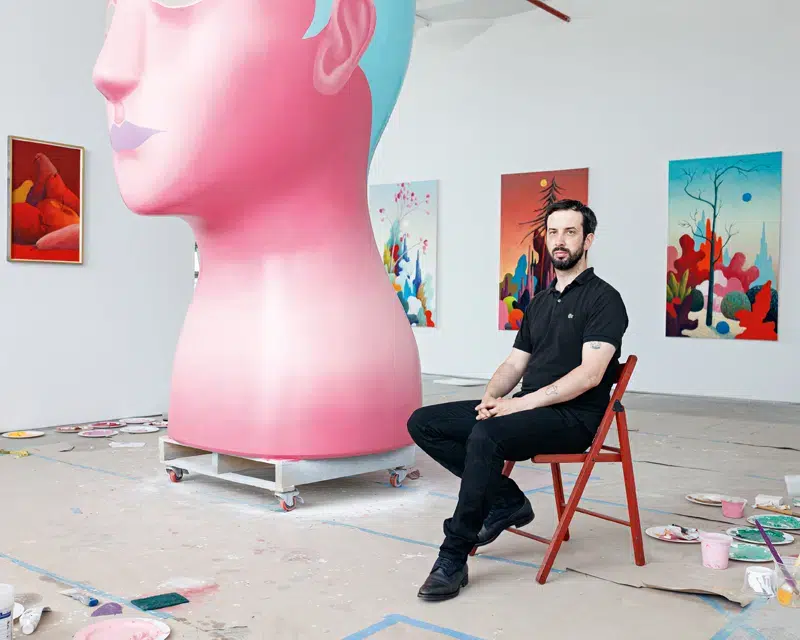
Party is the champion of pastels yet doesn’t limit himself by medium. Since his art school days, Party has courted many mediums, including sculpture, installations, painting and performance art. In 2011, he received his first major attention with a performative event he staged at Glasgow’s Modern Institute. For Dinner for 24 Elephants, 2011, Party invited two dozen guests, an eclectic mix of art world professionals, to a dinner party at a gallery for which he designed every piece, including the plates, the furniture, and the food. He and the gallery directors acted as waiters and served the guests for a four-hour meal. Most notably, the guests were sat on stools painted to appear as if they were riding elephants.

When at a Party exhibition there is always more to see than the works themselves. Party’s “architectural interventions” are part of his curatorial magic and create a comprehensive detachment from reality to surround the otherworldly content of the works. His most recent exhibition at Hauser & Wirth in Los Angeles, his first solo exhibition with the gallery and a show that launched with the second edition of Frieze LA, is a firm example of this magic. The walls of each room were completely saturated with red, blue, teal, and pink, separated by de Chirico-esque narrow rounded archways. Moving through the narrow space from one room to the other created an experience of traveling through worlds. Upon entering the gallery, the viewer is immediately confronted with options of these archways, and immediately seized by the surreal disorientation of the space, this is no white cube. In the middle of the exhibition space stands the Sottobosco Chapel, 2019, a chapel-like structure that appears to be made of marbles and exotic wood, but is in fact wood panels masterfully painted in the Trompe l’oeil technique, a technique used in the Renaissance to create realistic optical illusions of other materials, such as marble.

Inside Sottobosco Chapel, 2019, is Three Snakes, Lizard, and Toad, 1663 by Otto Marseus van Schrieck, the Dutch artist who made the sottobosco still life famous. Sottobosco means “undergrowth” or “underbrush”, and the sottobosco still life emerged with the scientific developments of the 17th-century Dutch Golden Age, when the invention of the microscope ignited a fascination with all things miniscule. Marseus directed the viewers gaze away from the domestic scenes of art at the time, and downward, toward the dense universe of a forest floor, teeming with life. The microscope allowed detailed viewing of these minuscule flora and fauna and rendering their depictions enlarged, alive and relatable. The inclusion of works my Marseus clues us into Party’s influence and makes his contemporality of the concept even more striking. This historical context reignites the revelation of seeing these tiny life forms as a rare and wonderous event.

The main gallery space comprises the right side of the building and holds three rooms separated by narrow archways. This space is bookended by enormous mirroring wall murals, one in hues of red and one in blue, of a scene reminiscent of grotto whose pillars of melting morphic rocks open up to a sea and an overexposed horizon. Hauser and Wirth is a gallery notorious for exhibiting work that is sold far before the exhibition opening, and this curatorial detail of Party’s is special. These wall murals are artworks made for those visiting the space itself, an inclusive ephemeral experience made just for viewers, most of which who are not in the blue-chip gallery purchasing game. It’s very street artist of him.
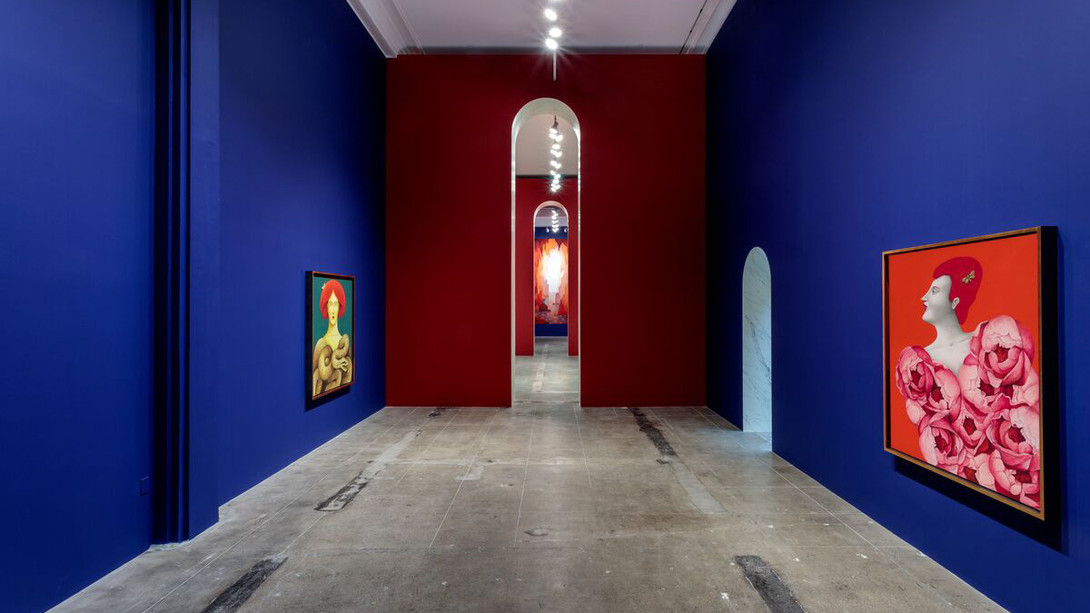
The first and last rooms of the main gallery hold portraits, on walls of deep sapphire. Party’s portrait subjects are stoic and glamourous. Their faces are poised, and their hair pristinely coiffed in smooth updos. They are fantastically dressed, in elements of nature. In Portrait with Roses, 2019 a woman is gowned in blooming pink roses. In Portrait with Mushrooms, 2019 large assembled mushrooms conceal a woman’s teal skin from the chest down. Portrait with Snakes, 2019 show a proud woman facing the viewer head on with a snake coiled loosely around her, draped as if a shawl, and a singular moth adorning her hair. Two giant frogs shape the coat of a man in Portrait with Frogs, 2019 with a lone butterfly fluttering near his blue skinned face and unbothered expression. The viewer moves through an archway and the walls of the middle room are painted in cameo pink. This room holds Landscape, 2019 an assemblage of tall skinny trees, with trunks of blues, reds, and orange with bushy canopies of canary yellow. Across from Landscape, 2019 is Sunset, 2019 a moody depiction of a yellow sun lowering towards a lagoon-esque sea of deep greens and teals. This work is complementary to Sunset, 2020 which depicts a robin egg blue sun setting over a liquid gold sea with shades of deep red and orange.

In the upstairs space of the gallery we are introduced to Party’s sculptures. They are four chest high yellow busts, with delicate lips and features of a lady. Each bust, in place of hair, wears a cap of Party’s flora and fauna: mushrooms, roses, frogs, and a snake. They appear as if the enlarged pawns of a chessboard, stout and stoic. The viewer is welcome to walk around the busts and admire them closely, another possible iteration of the modern ability of viewers to get up close and personal with microscopic organisms in the world of nature. The last room holds a subject unlike any of the previous. The walls of this room are of deep burgundy and matte black, and the contents of the works depict macroscopic views of folds pinky grey flesh spotted with flies. All four works of this series are titled Creases 2019-2020 and take his approach of a macroscopic view of the familiar to what is most familiar to all, the human body. Some works in the series depict the flesh with large unnatural bumps and may also refer to Party’s theme of the uncanny and the surreal.

Party’s latest exhibition for Hauser and Wirth is “Canopy” a show of works in the medium of watercolours. The show is currently on view as an exclusively online exhibition and opened May 8th. The works are landscapes exclusively of trees in his signature palette of unexpected colours. This collection is prominently in muted jewel tones, with the occasional pop of a neon pink. On the subject of trees Party states:
“One of the first things you draw as a child are trees… trees are natures alphabets. The infinite flexibility of the visual language of the tree makes its execution endlessly playful”. – Nicolas Party
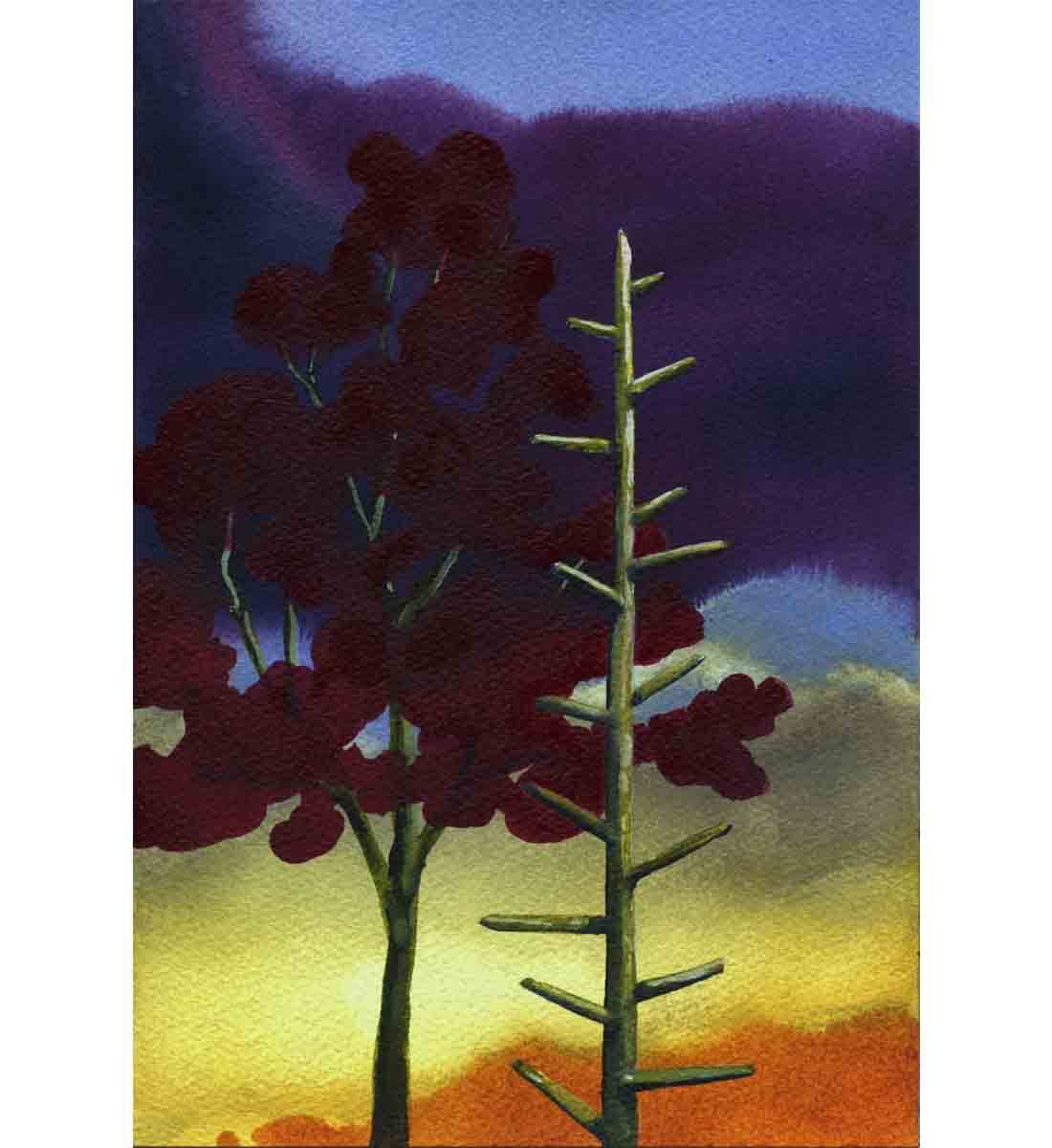
From the forest floor to the treetops, Party continues to surprise us with familiar scenes through a vibrant new lens. We put on his kaleidoscope eyes and the world is a wonderland. Party’s work is a celebration of nature, and the beauty of rediscovering the tiny and large familiarities of the natural world and revolutionizing them in the modernity of colour. Party’s world is a wonderland, and one where even a moth or a mushroom becomes radiant and remarkable.
Niemeyer and Beyond: 5 Brazilian Modernist Designers We Love
For the people of Brazil, 1922 was a landmark year. Not only did it mark a full century of independence from Portugal, it was also the year that put Brazilian art on the international map. Running alongside the government organised centenary celebrations, the Semana de Arte Moderna (Modern Art Week) of 1922 in São Paulo, gave birth to the Brazilian Modernist movement, becoming a pivotal moment in the development of modern art and thought in the country.
Lead by Mário de Andrade, Brazilian Modernists wanted to promote a unique Brazilian culture and national identity that emphasised indigenous and non-European elements. Their objective was to break down a colonial mentality in art and letters that largely ignored national realities, treating distinctively Brazilian themes based on native folklore and legend as a means to spring a cultural revolution and social reform within the country, rather than as an end in itself.

By depicting old stereotypes of African culture, the movement suggested that the African elements of Brazilian culture birthed the modern nation and tried to impulse a more inclusive society, suggesting a form of racial democracy inconsistent with the persistent racism faced by non-white Brazilians. Paintings by Tarsila do Amaral or Emiliano di Cavalcanti showed multiracialism as a part of everyday life, idealising the image of a perfectly mixed-race society.

The rise of Brazilian Modernism made São Paulo a new centre for the arts. The movement not only modernised Brazilian thought and action but revealed a more integrated Brazil to the world. The nation became liberated and independent from European and North American ideals, at the same time that it continued to adapt foreign materials.
Soon, the movement spread to furniture design, imbuing it with the same attributes that were present in art and literacy, namely a progressive reinterpretation of indigenous and colonial forms, harnessing natural and cultural resources, looking to the past as well as the future, and maintaining a tradition of craftsmanship with a deep appreciation for the particular qualities of native materials.

Over the course of the years, the country produced a series of design masters who brought forth a unique design language. Examples circulated throughout Europe and received increasing approval and media acclaim. The country’s main Furniture Designers became national icons and their pieces symbols of Brazilian identity, and Design became the main cultural export that distinguished Brazil as a rising, modern nation in the postwar era. Here are our five favourite Modernist Brazilian designers:
Jorge Zalszupin
The immediate reading of the furniture signed by Jorge Zalszupin is that of the elegance and sensuality. Jorge Zalszupin was born in Warsaw, Poland, in 1922. He studied architecture in Bucharest and, before emigrating to Brazil, worked in the reconstruction of Dunkirk, France. He disembarks in Rio de Janeiro in 1949 and soon settles in São Paulo, where he works for Polish architect Lucien Korngold. He establishes shortly after his own architecture office. Like many of his peers, he founded L’Atelier to produce furniture for his clients. In 1962, the first store was inaugurated, in the iconic Conjunto Nacional building, on Avenida Paulista. There were ten stores in Brazil, making L’Atelier one of the most important furniture manufacturers of the 1960s.

Lina Bo Bardi
Achillina Bo Bardi was born in 1914 in Rome, Italy, but it was in Brazil that she established herself as one of the great architecture personalities of the 20th century. Lina graduated as an architect at the Roman University of Architecture in 1939 and arrived in Brazilian shores in 1946 with her husband, Pietro Maria Bardi, who was commissioned by Assis Chateaubriand for the conception and direction of the São Paulo Art Museum – MASP, designed by her. Lina’s first piece of furniture, the chair designed for the museum’s auditorium, dates from 1947. It is in São Paulo and throughout her travels in Bahia that Bo Bardi conceptually matures her work and determines the direction of her production – guided by the appreciation of local culture, its regional materials and elements aimed at common use. Bo Bardi’s legacy extends itself over the architectural landmarks she built around Brazil, illustrations, lectures given at USP’s Faculty of Architecture, and articles for newspapers and magazines, as well as drawings and other sketches of design and architecture.

Oscar Niemeyer
Oscar Niemeyer was born in Rio de Janeiro in 1907. He studied architecture at the National School of Fine Arts. In 1936, he was part of team that built the first modern building in Brazil, the Ministry of Education and Culture, in Rio de Janeiro, the design of which was done by Le Corbusier. In 1947, he wins alongside the French-swiss architect the contest to design the UN headquarters in New York. The 1940s also see the building of the Pampulha Complex in Belo Horizonte, which exemplifies his modernist design aesthetics. The invitation was made by future president Juscelino Kubitscheck, whom a decade later enlists Lucio Costa and Niemeyer to conceptualise, respectively, the urban and architectural plan for Brasilia. The new capital is inaugurated in 1960, and its repercussion makes Niemeyer one of the most celebrated architects of his time. Niemeyer is in Europe when the military coup takes place in Brazil in 1964. He chooses political exile in France, where he designs in the 1970s, his first set of furniture alongside his daughter Anna Maria. He returns to Brazil in 1985. He wins the Pritzker in 1988. He dies in 2012, at 105 years old, having done projects in Brazilian cities and New York, Paris, Beiruth, Caracas, Tel Aviv, Argel, Milan, Aviles and Le Havre.

Sérgio Rodrigues
Sergio Rodrigues was born in Rio de Janeiro, 1927. He descended from a family of intellectuals, including writer and playwright Nelson Rodrigues, his uncle. He studied architecture at the National School of Fine Arts, where he met Lucio Costa and Oscar Niemeyer. His store and factory Oca was inaugurated in 1954. The company was one of the most notable of that moment, and amongst the main suppliers of furniture for Brasilia. In the early 1970s, to complete the furniture production for the Editora Manchete headquarters in Rio de Janeiro – the foremost private commission he ever received – Rodrigues created an on-site workshop. Before his death in 2014, he participated in the establishment of the institute that houses his archive.

Joaquim Tenreiro
Joaquim Tenreiro was born in the small village of Melo, Portugal, 1906. A third generation carpenter, since childhood he worked with wood. He settled in Rio de Janeiro at the age of 22 and studied drawing at the Liceu of Arts and Crafts. There he participated in the Bernardelli nucleus, composed of anti-academic painters. The need for a steady job leads him to work as a designer at Laubisch & Hirth, a company that manufactured European style furniture to suit the elite. In the 1940s, from a first order made by Oscar Niemeyer, Tenreiro began his path in modern furniture. He opens stores in Rio de Janeiro and São Paulo, where highly sought-after orders are dispatched. He died in 1992, in Rio de Janeiro.

Artists We Love For The Outdoors
Alicja Kwade
B. 1979, Poland. Lives and works in Berlin.
Alicja Kwade’s work investigates and questions the structures of our reality and society and reflects on the perception of time in our everyday life. Her diverse practice is based around concepts of space, time, science and philosophy, takes shape in sculptural objects, video and even photography. Her work was exhibited in multiple solo shows in museums and institutions such as the Langen Foundation, Neuss or the YUZ Museum, Shanghai. In 2019, she was commissioned to create a site-specific monumental installation for The Met’s Roof Garden in New York. She has also taken part in international events all around the world such as Desert X, Coachella in 2021; or the 57th Venice Biennale in 2017.

Jeppe Hein
B. 1974 in Copenhagen, Denmark. Lives and works between Berlin and Copenhagen.
Jeppe Hein is a contemporary Danish artist whose interactive works combine different elements of architecture and art for the viewer to confront. By employing materials such as mirrors, balloons, and benches, Hein invites spectators to activate the exhibition space. “I want to show that the work isn’t anything on its own, it is only what the public informs it with. The viewer’s role brings the piece to the centre of attention,” he has explained.
“I want to show that the work isn’t anything on its own, it is only what the public informs it with. The viewer’s role brings the piece to the centre of attention,”
Jeppe Hein.
Hein’s sense of playfulness towards the history of both Minimalist sculpture and Conceptual Art can be seen in his use of mazes and movable sculptures, which balance humour with structure. Today, his works are held in the collections of the Centre Georges Pompidou in Paris, the Museum of Contemporary Art in Los Angeles, and the Tate Gallery in London, among others.

Annie Morris
B. 1978 in London. Lives and works in London.
Encompassing sculpture, tapestry, painting and drawing, Morris’s intuitive use of line weaves between abstraction and representation. Morris’s most recognisable body of work is her ‘Stack’ series, begun in 2014 and inspired by the artist’s grief following a stillbirth.
The sculptures, which are comprised of irregular spheres precariously arranged into tall columns, evoke the swell of pregnancy. Sculpted in plaster or cast in bronze, the forms are painted with hand-sourced, raw pigments in vivid hues such as Ultramarine, Viridian and Ochre, which give Morris’s lumpen orbs a rich, vibrant hue. Morris uses the same deep pigments in her drawing and tapestry practice, which combines personal ciphers with abstract mark-making and grid-like structures.

Erwin Wurm
B. 1954 in Vienna, Austria. Lives and works in Vienna, Austria.
Over the course of his career, Erwin Wurm has radically expanded conceptions of sculpture, space and the human form. His sculptures straddle abstraction and representation, presenting familiar objects in a surprising and inventive way that prompts viewers to consider them in a new light. He often explores mundane, everyday decisions as well as existential questions in his works, focusing on the objects that help us cope with daily life and through which we ultimately define ourselves. These include the material objects that surround us – the clothes we wear, the cars we drive, the food we eat and the homes we live in.
The artist has twice participated in the Venice Biennale: with his installation Narrow House at the Palazzo Cavalli-Franchetti in 2011 and when he represented Austria in 2017. Recent solo museum exhibitions have been held at the Taipei Fine Arts Museum (2020); Musée Cantini, Marseille (2019); K11 MUSEA, Hong Kong (2019); Vancouver Art Gallery (2019); Albertina Museum, Vienna (2018); 21er Haus at the Belvedere, Vienna (2017); Leopold Museum, Vienna (2017); Centro Cultural Banco do Brasil, São Paulo (2017); and Berlinische Galerie, Berlin (2016).

Richard Long
B. 1945 in Bristol, UK. Lives and works in the UK.

Takuro Kuwata
B. 1981, Hiroshima.
Takuro Kuwata is a contemporary Japanese potter known for his revolutionary style. His work is a contemporary take on “Wabi-sabi,” a traditional Japanese aesthetic theory that centers transience and imperfection as necessary elements of beauty. In his practice, Kuwata seeks to update Wabi-sabi as he creates clay objects that break many rules of the medium all the while allowing an element of chance to play a major part in the final result. Often, Kuwata’s characteristic surfaces are coated with an extremely thick glaze that explodes when baked in the kiln. Kuwata also employs several other experimental techniques, such as adding stones to his clay mix which burst and puncture the outer layer when fired and, in other works, applying needles to catch the glaze on his pieces as it melts over the surface.
His work has been shown extensively in Japan, including the exhibition Japanese Kogei | Future Forward at the 21st Century, at the Museum of Contemporary Art in Kanazawa, which traveled to the Museum of Art and Design in New York in October 2015. He has had numerous solo shows all over the world as well as participating in group exhibitions at Cherry and Martin in Los Angeles, Rhona Hoffman Gallery in Chicago and Salon 94 in New York. Kuwata currently lives and works in Toki City, Gifu, Japan.

Giuseppe Penone
B. 1947. Lives and works in Italy.
“The veins of water that pour from the earth flow in trickles that merge, like the branches in the trunk, like the fingers in the palm of a hand, like the bronze in the matrix of a tree.”
Giuseppe Penone
Throughout his fifty-year career, Giuseppe Penone has employed a wide range of materials and forms in an exploration of the fundamental language of sculpture. A protagonist of Arte Povera, Penone explores respiration, growth, and aging—among other involuntary processes—to create an expansive body of work including sculpture, performance, works on paper, and photography.
In 1969 Penone created the first of his Alberi (Trees): “stripped” trees made by carving into mature timbers and removing the wood along the outer growth rings to reveal the memory of a sapling at the core of the trunk. This ongoing series has taken on various permutations as Penone refines his techniques and experiments with different sizes and installations. In 1970 he even carved an Albero in the presence of an audience, merging sculpture and performance. This same year he made the Rovesciare i propri occhi (Reversing One’s Eyes) works, in which he wore custom-made mirrored contact lenses and had himself photographed. The lenses, though they deprived the artist of his own gaze, allowed him to objectively record images, literally reflecting his surroundings.

Carol Bove
B. 1971. Lives and works in New York.
Carol Bove is a contemporary American conceptual artist. Working in a multimedia practice, she creates installations of archival objects gathered from personal experience, literature, art history, and nature. Bove describes herself as an anthropologist carefully categorizing intellectual works and popular culture that have had a lasting effect on contemporary life, including texts such as The Feminine Mystique and Playboy magazine. The unexpected layering of these juxtapositions creates poetic and subtle new relationships between otherwise familiar objects. Born in 1971 in Geneva, Switzerland, Bove grew up in Berkeley, CA before earning a degree from New York University in 2000. Her relational works regularly employ connections to trends and movements in the cultural and societal spheres, connecting aesthetic form and content with broader statistical and relationships. “I’m interested in making room for other people in my work,” she has said. Bove’s work has been met with widespread critical acclaim, exhibited at institutions like The Museum of Modern Art, Palais de Tokyo in Paris, Kunsthalle Zürich, and the Institute of Contemporary Art Boston.

Carsten Höller
B. 1961. Lives and works Stockholm and Biriwa, Ghana.

Jean-Marie Appriou
B. 1986. Lives and works in France.
Jean-Marie Appriou develops a reflection on sculpture by exploring materials such as aluminium, glass, bronze and clay in unconventional processes. From his experiments of an alchemical nature emerge human, animal and plant figures which meet and complement each other, giving rise to different scenarios. This fantastic and marvellous universe draws on a variety of inspirations, from Egyptian mythology to Pre-Raphaelite painting, from science fiction literature to cinema and comics. His work has been exhibited at the Consortium Museum in Dijon, Central Park in New York at the invitation of the Public Art Fund, the Lyon Biennial, the Fondation Louis Vuitton, Paris, the Palais de Tokyo, Paris, the MAMVP, Paris, the Château de Versailles, the David Roberts Art Foundation, London, the Astrup Fearnley Museet, Oslo, the Vienna Biennial, as well as in the galleries of Jan Kaps, Cologne, Simon Lee, New York, and Eva Presenhuber, Zurich; C L E A R I N G, New York and Brussels.

Claudia Comte
B. 1983. Lives and works in Berlin and Switzerland.
Claudia Comte is a Swiss contemporary artist known for her use of natural materials set against abstract backgrounds in her mixed media installations and her interest in ecological conservation. Her works explore the lifecycle of natural materials, juxtaposing wooden sculptures against graphic wall paintings. For each piece, she uses her unique measurement system so that every artwork relates to one another. “For me, the work is about bringing people together…allowing us to see and engage with an art installation that embraces all of the senses,” she says.
In 2013, her work was included in a group show at Gladstone Gallery in New York, leading to a solo show later that year at Gladstone Gallery in Brussels. Her career grew from there, leading to exhibitions across the world, including König Galerie in Berlin, Art Basel, and moCa in Cleveland, Ohio. In 2019, she collaborated with the Alligator Head Foundation in Portland, Jamaica to create “The Cacti Series,” a collection of concrete sculptures placed underwater at the East Portland Fish Sanctuary in Jamaica as part of a larger project to help inspire people to learn more about conservation and climate change, protect marine life, and ultimately revive the local coral reef.
“For me, the work is about bringing people together…allowing us to see and engage with an art installation that embraces all of the senses,”
Claudia Comte

Ugo Rondinone
B. 1964. Lives and works in New York.
Ugo Rondinone is a Swiss contemporary artist working in mixed-media installations that include sculpture, painting, video, sound, and photography. His wide-ranging practice utilizes metaphoric and iconographic images such as clouds, animals, and figures, as well as powerful declarative sayings like “Hell, Yes!” By co-opting the language of psychedelia and advertising, Rondinone conveys his profound interest in the contemplation of everyday life and activities. “I see art-making as a ritual, a meditation for myself,” the artist explains. “It’s to exclude myself from society and to create my own rites…The energy of art is that you can spend time with yourself.” Born in 1964 in Brunne, Switzerland, he went on to study at the Hochschule für Angewandte Kunste in Vienna and moved to New York in 1998. He has represented his home country in the 2007 Venice Biennale, and his work can be found in the permanent collection of the New Museum of Contemporary Art in New York.

Franz West
1947-2012
Lived and worked in Vienna.
From abstract and interactive sculpture to furniture and collage, Franz West’s oeuvre possesses a character that is at once lighthearted and deeply philosophical. Belonging to a generation of artists exposed to the Actionist and Performance Art of the 1960s and 70s, West instinctively rejected the idea of a passive relationship between artwork and viewer. Opposed to the existential intensity requisite to his performative forebears (such as Actionism), he produced work that was vigorous and imposing yet unbounded and buoyant. In 1973, he began creating compact, portable, mixed media sculptures called Passstücke (Adaptives). These “ergonomically inclined” objects were actualised as artworks only when touched, held, worn, carried, or otherwise physically or cognitively engaged. Transposing the concepts engendered by these formative works, he explored sculpture increasingly through the framework of the ongoing dialogue between viewers and objects, while probing the internal aesthetic relations between sculpture and painting. Manipulating everyday materials and imagery in order to examine art’s relation to social experience, West revolutionised the interplay of concealment and exposure, action and reaction, both in and outside the gallery.

Iconic Minimalist Design Pieces We Love at the Moment
Minimalism in design isn’t a single, rigid style; it’s an evolving language that has taken many different forms over the past century.
The roots of minimalism can be traced back to the early 20th century, particularly to the De Stijl movement (1917–1931) in the Netherlands and the Bauhaus school (1919–1933) in Germany. These movements championed simplicity, geometric abstraction, and the use of industrial materials, influencing what would later become the core tenets of minimalism. Figures like Gerrit Rietveld, Walter Gropius, and Ludwig Mies van der Rohe laid the groundwork, emphasizing function over ornamentation with their designs. By the mid-20th century, minimalism emerged as a defining force in both architecture and furniture design, with leading designers like Donald Judd and Isamu Noguchi shaping the movement in their own unique ways. This article highlights designers who are currently pushing the boundaries of minimalism or who have done so in the past, demonstrating that simplicity can be as diverse as any other movement. We’ve compiled a list of our top 16 minimalist designers to inspire you on your design journey
1. Donald Judd
Donald Judd is known as one of the fathers of minimalist art. He never set out to be a furniture designer and believed that many of his designs were extensions of his sculptural practice. Yet, they have become some of the most iconic minimalist furniture pieces ever made. They have a very honest quality to them – often crafted from simple materials like plywood, aluminum, or painted MDF and assembled with absolute clarity and simplicity. His design pieces do not have hidden joints, decorative elements, or any other unnecessary parts. His approach was uncompromising, with the goal to reduce each piece to pure structure and function. They have become timeless pieces that reflect his minimalist art, prioritizing form, material, and proportionality over personal expression or narrative.

2. Isamu Noguchi
Noguchi’s work wasn’t about strict geometry or reducing form in the way Donald Judd’s was, instead his goal was to achieve a balance with as little as possible. Noguchi is perhaps best known for his iconic Akari lights, characterised by weightless luminosity, which he began in 1951. He chose the name ‘akari’ for these objects, a word that means ‘light’ in Japanese, connoting both illumination and physical lightness. During a journey to Japan, Noguchi paid a visit to Gifu, a town known for its manufacture of paper parasols and lanterns. While there he sketched his first two Akari Light Sculptures, and over the following years he created a total of more than 100 models. For Noguchi, there was no distinction between art and furniture—he viewed design as art while ensuring it remained deeply functional. With a sculptor’s sensibility, he constantly considered negative space and how an object interacts with its surroundings. His work always had this quiet tension between softness and precision, organic and geometric, tradition and modernity. That balance is what gives his approach to minimalism an effortless quality.

3. Junya Ishigami
Junya Ishigami takes minimalist design to an extreme, stripping it down to the bare minimum. By pushing materials to their absolute limits, he turns chairs and tables into structural experiments rather than just everyday objects. His work exists at the intersection of furniture, sculpture, and architecture, intentionally blurring the lines between them. A trained architect, he founded his own studio, junya.ishigami+associates, in 2004. In 2010, the studio won the prestigious Golden Lion for Best Project at the 12th International Architecture Biennale in Venice, Italy.

4. Shigeru Uchida
A prolific designer and a major figure in post-war Japan, Shigeru Uchida (1943–2016) left a lasting impact on his era with a distinctly contemporary approach. His work seamlessly blended a deep reflection on Japanese aesthetics with the cutting edge of global design. Among his many creative pursuits, chair design held a fundamental and special place. Exploring the ways space is occupied in both Japan and the West, Uchida aspired to create “transparent, lightweight furniture with a minimal sense of gravity, transcending physical presence.” His iconic 1977 design, September, perfectly embodies this vision—a pure silhouette, slender steel elements, and a mesh structure that enhances its sense of lightness.His practice was deeply rooted in theory and research. A renowned design theorist, he authored numerous books examining key themes in contemporary Japanese design.

5. Shiro Kuramata
Kuramata was known for combining European design with Japanese sensibilities. Kuramata first encountered Italian design through Memphis Design Group, then in 1987, for whom he created the Progetti Compiuti chest of drawers series. All of the pieces Kuramata made for the company were incredibly well-received. In 1965, he founded the Kuramata Design Office in Tokyo, where he remained until the year of his death. Shiro Kuramata’s minimalism wasn’t about making things feel stark or rigid, it was light, playful, and a little surreal. He didn’t strip objects down to be austere; he reduced them to create something unexpected. Take the How High the Moon chair, just steel mesh, no excess, yet it completely defies expectations. It looks fragile, almost like it’s barely there, but it’s solid and functional. His acrylic furniture and transparent surfaces pushed minimalism in a new direction, proving it didn’t have to be severe, it could be poetic, even mischievous. While many minimalists focused on material and structure, Kuramata played with perception. His designs often felt like illusions, almost dreamlike designs. His acrylic pieces and industrial materials gave objects an ephemeral quality, making them feel like they existed somewhere between reality and imagination.

6. John Pawson
John Pawson is one of the UK’s most renowned architects, celebrated for his signature white, pared-back aesthetic that prioritizes space over clutter. His diverse portfolio includes high-end private homes, hotels, shops, restaurants, monasteries, and London’s Design Museum. His design philosophy aligns closely with his architectural principles, placing strong emphasis on materials and seeking to capture their essence in the purest way possible. His minimalist style was further shaped by a formative period in Japan as a young student, where he had the opportunity to meet Shiro Kuramata, one of the most influential Japanese furniture and interior designers of the 20th century. Additionally, the work of Donald Judd in Marfa, Texas, played a significant role in inspiring his approach to design.

7. Vincent Van Duysen
Van Duysen is a Belgian designer renowned for his work in architecture and interior design. His creations are timeless and understated, focusing solely on the essential. After earning his degree from the Sint-Lucas School of Architecture in Ghent, he worked with Aldo Cibic in Milan before collaborating with Jean De Meulder in Antwerp. In 1989, he founded Vincent Van Duysen Architects. His design philosophy is rooted in the use of pure, tactile materials, resulting in clean and enduring forms. With a deep respect for context and tradition, his approach prioritizes sensory and physical experiences—where space, texture, and light enhance the integrity of the user. Functionality, durability, and comfort are at the core of his work, forming an architectural language that embraces aesthetics while consciously avoiding fleeting trends.

8. EJR Barnes
Straddling the line between industrial design and decorative art, London-based designer EJR Barnes creates subtly striking objects and furnishings that echo the past while forging a nonconformist path into the future. The term “usable sculpture” is often thrown around, but in Barnes’ case, it truly applies—his dreamlike designs contrast with the weight and presence of heavy materials. Entirely self-taught, Barnes began his creative journey as a drummer before working in a bespoke eyewear shop. His passion for furniture simmered beneath the surface—when not assisting customers, he immersed himself in the work of furniture makers and designers. Recognizing his interest, the shop’s owner generously offered him space in the back to use as a studio, where he began to experiment.

9. Pierre Paulin
Pierre Paulin created some of the most iconic seating designs of the 20th century. Born in Paris in 1927, he was inspired by his uncle, automotive innovator Georges Paulin. Initially training as a ceramist and stone-carver, a hand injury ended his sculpting ambitions, leading him to study at the École Camondo, an interior design school in Paris. Paulin’s career was defined by innovation, blending form, function, and futuristic aesthetics. In the 1950s, he began designing furniture, famously stretching swimwear fabrics over chair frames. His groundbreaking work led to prestigious commissions, including furniture for the Louvre and interiors for France’s presidential residence. His most famous designs included The Dune Sofa (1970), a modular masterpiece featured in Frank Ocean’s home, and various pieces for the Alpha Collection (1960), originally created for the Élysée Palace. The Alpha Collection pieces are constructed from foam-wrapped wood, and remain celebrated for their avant-garde design and comfort. Paulin’s furniture stands out for its bold, sculptural shapes and pioneering use of stretch fabric over molded foam or wood, giving his pieces a seamless, organic look. His designs balance innovation and comfort, and have become some of the most instantly recognisable design items of the 20th century. His legacy was revived by his widow, Maïa, and their family through Paulin Paulin Paulin, a company dedicated to preserving and promoting his work.

10. Xavier Feal
Xavier Féal was a French designer known for his sleek, minimalist furniture that captured the avant-garde aesthetics of the 1970s. His work emphasized clean lines, geometric forms, and a bold use of stainless steel, creating a refined yet striking visual language. Little is known about his personal life, but his limited-production pieces remain highly sought after for their architectural quality and distinctive modernism. A graduate of the École Boulle and the Arts Décoratifs in Paris, Féal was commissioned by Inox Industrie to create a range of stainless steel furniture. With his radical designs and small-scale production, the Xavier Féal design items remain a rare and highly collectible reflection of modernist experimentation.

11. Arno Declercq
Arno Declercq (b. 1994, Belgium) is a designer and art dealer known for his sculptural interior objects that merge design, history, and craftsmanship. After studying interior design, he opened a gallery specializing in ethnographic art before launching his own brand in 2017. Inspired by architecture, ancient arts, and tribal culture, his collections, often crafted from black-burned wood, feature bold geometric lines and architectural forms. How work can be described as dark and bespoke monolithic pieces that serve both as furniture and sculptural works of art. In 2023, he opened a private showroom in Antwerp, offering an immersive experience while continuing to create bespoke projects worldwide. Alongside furniture and decorative pieces like candlesticks and bowls, Arno creates sculptures as well, demonstrating his effortless transition from functional design to sculptural art. His pieces complement fine art beautifully, and he has completed multiple commissions with Claes Gallery, where his furniture has been paired with artworks.

12. Theoreme editions
Théorème Editions is a French design house that partners with contemporary designers and skilled European craftsmen to create poetic furniture and objects. They carefully select only a few of the most exciting designers working today. While their aesthetic varies, a common thread in all their pieces is a unique, often playful approach to materials. Their objects are as much sculptural works as they are functional furniture, offering beauty, intrigue, and inspiration. The Achille Chair, designed by Pool, features a sculpted foam form with gentle curves, upholstered in a wool and alpaca bouclé fabric. Its soft contours are contrasted by the rigid brass cube it rests upon. Each chair is a limited edition piece, numbered and signed.

13. Studioutte Studio
Studioutte was founded in 2020 by Guglielmo Giagnotti and Patrizio Gola, a Milan-based studio dedicated to interior architecture, decoration, and collectible design. With Giagnotti’s background as an architect and Gola’s expertise as an interior designer, the two combined their talents to create a unique multidisciplinary practice. The studio’s work is defined by a clear, expressive approach focused on purity and the essence of form. While their designs are minimalist and pared back, they maintain an inviting warmth. studioutte’s vision is to embody a refined yet approachable style, blending warm minimalism with a sense of the vernacular.

14. Brett Robinson
The New York Based-designer and decorator Brett Robinson pieces offer a fresh take on hard-edged sculptural designs. Robinson crafts stunning furniture from cast aluminium, including tables with reinforced epoxy tops, as well as sofas and stools upholstered in plush alpaca, featuring soft, undulating lines. His ability to transform metal into something that appears soft and pliable is captivating. Born and raised in Manhattan Beach, California, Robinson’s journey into interior design stemmed from his time spent his time exploring flea markets, where he developed a deep passion for vintage furniture. Robinson’s debut collection, “Halcyon,” was showcased at Just One Eye in Los Angeles, a celebrated concept store. The exhibition featured an eclectic mix of Art Deco furniture, and works by renowned photographers like Andy Warhol, Nobuyoshi Araki, and Thomas Ruff. Even amidst such high-profile art world figures, Robinson’s pieces stood out for their exceptional quality and originality. His work is beautifully crafted and timelessly designed. One of Brett Robinson’s signature pieces, the SV_1 ottoman, combines cast aluminum with soft alpaca. The contrast between these two materials is beautifully balanced, resulting in a minimalist design that is both elegant and invitingly comfortable.

15. Wonmin Park
Wonmin Park graduated from the Design Academy Eindhoven in the Netherlands in 2011. Since then, he has exhibited at renowned fairs, and his work has been featured in museum exhibitions at the Musée des Arts Décoratifs in Paris, and the Triennale Design Museum in Milan. Shortly after graduating, Park established his studio in Eindhoven, where he has worked for the past nine years. He has since expanded with a production facility in Rotterdam and a creative studio in Paris. Park is renowned for his mastery of resin, a material that defines much of his design work. The use of resin imparts a surreal, dreamlike quality to his pieces, evoking the sensation of viewing objects without fixed contours, held together by light and air. As the artist describes, his goal is to create a “sense of lightness and purity.”

16. Maria Pergay
Maria Pergay was a pioneering French designer known for her innovative use of stainless steel in furniture and objects. A favorite of Dalí and Christian Dior, she is considered one of the greats of 20th-century design, alongside Eero Aarnio, Verner Panton, and Charlotte Perriand. Originally trained as a sculptor under Ossip Zadkine, Pergay returned to design in the 1960s, creating decorative items for brands like Hermès and Christian Dior. In 1967, steel company Uginox approached her to design gifts, but she instead proposed a line of furniture. This marked a pivotal moment in her career, and she later described working with steel as a material that “talks” to her—”if it is ready to obey, it is like a tamed animal, but if it is bad, it’s a slap in the face.’ Her work for Uginox debuted in 1968 at Galerie Maison et Jardin in Paris, featuring simple shapes and impeccable finishes that showcased the technical qualities of stainless steel. The pieces were an immediate hit, attracting collectors like Pierre Cardin and the Shah of Iran. Among the highlights were a ‘Ring’ chair (chaise ‘Anneaux’) inspired by the coiling shape of orange peel, and a wavelike ‘Flying Carpet‘ daybed (lit ‘Tapis volant’), which she said came to her in a dream. The daybed became an instant sensation when Brigitte Bardot, the icon of the French New Wave, famously draped herself across it on the set of Sacha Distel’s TV show.

Nan Goldin’s Photography: A Journey Through Love, Loss, and Identity
Nan Goldin’s art is a deeply personal and often controversial portrayal of the lives of her friends and lovers, capturing moments of intimacy, joy, and pain. Her most notable work, “The Ballad of Sexual Dependency,” is a series of photographs that spans several decades and is a testament to the resilience of the human spirit in the face of adversity. Through her art, Goldin explores themes of sexuality, gender identity, addiction, trauma, and memory, and has used her own struggles with addiction to confront the stigma and shame surrounding the disease. Her photography is characterized by its rawness and honesty and has been instrumental in the development of contemporary art, particularly in the area of documentary photography. Her contributions to the field have been recognized with numerous awards and honors, and her work continues to inspire and provoke audiences around the world.

Born in 1953 in Washington, D.C., Goldin grew up in a turbulent household with an abusive father. As a result of the trauma she experienced, she found solace in art, using photography as a way to express herself and process her experiences. Goldin’s work gained international recognition in the 1980s, when she began documenting the queer subculture of New York City.

Her photographs from this time, which feature drag queens, transgender people, and other marginalized groups, are celebrated for their raw, unfiltered depictions of LGBTQ+ life. They capture the beauty, the pain, and the joy of queer existence at a time when such representation was still rare in mainstream media. Goldin’s work from this period was not without controversy. Her 1986 exhibition at the Whitney Museum of American Art, titled “Witnesses: Against Our Vanishing,” included graphic images of drug use, sex, and nudity. The exhibition drew criticism from conservative groups, who accused Goldin of promoting degenerate behavior. However, for Goldin, the exhibition was a way to shine a light on the realities of addiction and the societal factors that contribute to it.

Goldin’s own struggle with addiction would later become a central theme of her work. In the 1990s, she began to document her own life and the lives of those around her in a series of photographs titled “The Ballad of Sexual Dependency.” The photographs, which are often blurry and raw, capture the ups and downs of life in all its complexity. They feature scenes of parties, drug use, love, and loss, providing a glimpse into the messy, beautiful, and sometimes tragic lives of the people in Goldin’s world.

In 2017, Goldin’s work took on a new urgency when she launched a campaign against the Sackler family, owners of Purdue Pharma, the makers of OxyContin. Goldin, who had struggled with addiction herself and lost friends to overdoses, accused the Sacklers of profiting from the opioid epidemic. She organized protests at the Guggenheim Museum and the Metropolitan Museum of Art, both of which have wings named after the Sacklers, calling for the institutions to remove the family’s name from their walls. Her activism has brought attention to the role that wealthy families and corporations have played in creating and perpetuating the opioid crisis.

In 2022, a new documentary titled “All the Beauty and the Bloodshed” was released, which provides a glimpse into Goldin’s life and work. Directed by Adèle Haenel, the film explores Goldin’s ongoing battle with addiction and the impact it has had on her work. The documentary shows how Goldin’s art has evolved over the years, from her early days as a young artist in New York to her ongoing fight against addiction and the opioid crisis.

Through her art, Goldin has created a powerful legacy that continues to inspire and provoke. She has used her photography as a way to connect with others and to express her own truth. She has fought for marginalized communities and against the systems that oppress them. And she has shown us that even in the darkest of times, there is beauty to be found.

NEW YORK MUSEUM TACKLES INEQUALITY BY SELLING ITS ONLY JACKSON POLLOCK PAINTING
In September 2019, the International Council of Museums (ICOM) was supposed to vote on a new definition of the word “museum”.
While the old – and still current – version is a concise sentence that explains the characterising activities of a museum, a commission led by Danish curator Jette Sandahl proposed a new definition that resembles an ideological manifesto and reads as follows:
“Museums are democratising, inclusive and polyphonic spaces for critical dialogue about the pasts and the futures. Acknowledging and addressing the conflict and challenges of the present […] aiming to contribute to human dignity and social justice, global equality and planetary wellbeing”.
Although the vote has been postponed, this definition raises questions around what museums really capture in the 21st century. Are museums really “inclusive”? Do they really contribute to “global equality”? These dilemmas seem more relevant than ever in light of the recent political unrest focused on eradicating white supremacy and on creating more space for minorities.
Museums are starting to take a stand in this debate by deaccessioning artworks by well-known white male artists in order to have more funds dedicated to the acquisition of art by women and people of colour. One of the first museums to spark a controversy around this topic is the Baltimore Museum of Art (BMA), which in 2018 sold seven works by artists such as Franz Kline and Andy Warhol to buy works by African-American portraitist Amy Sherald, British artist and writer Lynette Yiadom-Boakye and other artists from underrepresented communities. In 2019, the San Francisco Museum of Modern Art (SFMOMA) deaccessioned a Mark Rothko’s masterpiece fro $50.1 million at Sotheby’s and bought works by British-Mexican surrealist Leonora Carrington, American abstract painter Alma Thomas and other artists to broaden the scope of its permanent collection.
The latest institution to follow this trend is the Everson Museum in Syracuse, New York, which recently announced the sale of the early Jackson Pollock Red Composition (1946) to raise funds in support to its “Collecting Priorities Plan”, established in 2017 with the purpose of increasing the representation of women and artists of colour within its permanent collection.

The artwork will be sold at Christie’s upcoming 20th Century Art auction in New York and its estimate is between $12 million and $18 million. What’s Up artist Jackson Pollock revolutionised contemporary art being at the forefront of the development of the Abstract Expressionism, when in the mid-1940s he introduced his signature drip paintings.
Red Composition (1946) is part of a series of seven paintings created in 1946, a year that marks the complete abandonment of the brush by the artist, who started to spread the pigment directly onto his canvasses. Christie’s Executive Deputy Chairman Barrett White stated that “Christie’s is thrilled to be entrusted with the sale of this early and seminal painting Red Composition from the collection of the Everson Museum. The last painting the artist completed in 1946, Red Composition is an exceedingly rare opportunity to acquire a museum quality work by Pollock that marks the breakthrough of his fabled “drip” technique.

Red Composition was painted directly after Free Form, arguably his first drip painting, which is in the collection of the Museum of Modern Art. Reveiling in his flowing skeins of paint, Pollock announces his arrival and leadership of the New York School Irascibles with the daring composition and vibrant palette of Red Composition”. Moreover, the piece has a remarkable provenance: it first belonged to Pollock’s prominent patron Peggy Guggenheim, who later on gave the painting to James Ernst, son of her husband and famous surrealist painter Max Ernst in 1947.

The latest owners were New York-based collectors Dorothy and Marshall Reisman, who acquired the piece in the early 1950s and then donated it in 1991 to the Everson Museum. The work is being sold with the support of their Foundations’ Trustee Robert Falter, who affirmed that “As a longtime Board Member and benefactor of the Everson, Marshall would have been extremely happy to see his gift used for the greater good of the Museum, its future sustainability, and its impact on the community”. Some controversies might arise as this is the only Jackson Pollock painting in the collection, however, the museum specified that it is retaining an important work on paper by the same artist and that with the deaccession of a single work they will be able to actively work towards addressing inequality within the institution itself and towards being more representative of the community it serves.
Masters of French Midcentury Design
The term Midcentury Modern refers to the dominant furnishings of the mid-20th century—simple, functional wooden pieces made from teak and curved designs reigned supreme. Midcentury modern design evolved in response to a post-Industrial Revolution, post- World War II environment, where designers and architects were eager to develop new ideas that married the mass production and technology invented during the first half of the 20th century with a more optimistic outlook for the future.
The aesthetics of mid century modern brought the geometric forms and clean lines of the Bauhaus teachings into the Modernist movement, pioneered by iconic designers who combined sleek lines with organic shapes, using new materials, and methods to reimagine traditional pieces.
From Pierre Paulin to Le Corbusier, here is our guide to the leading figures in French mid-century design.
Pierre Paulin
French, 1927–2009

Mushrooms, oysters, tongues, and tulips are some of the iconic shapes French designer Pierre Paulin was best known for creating. Having trained under Parisian designer Marcel Gascion, Paulin was influenced by the Scandinavian aesthetic as well as American pre-fabricated designs by Charles and Ray Eames and Florence Knoll. Inspired to develop his own brand of accessible luxury, Paulin began designing and manufacturing seats made of molded wood lined with foam padding and fashioned with a stretch elastic jersey fabric. Paulin’s forward-looking, innovative designs for chairs, divans, and sofas in an array of bright and vivid colours, can be found in contemporary art and design collections around the world, from the Museum of Modern Art, New York to the Victoria and Albert Museum, London and the National Centre for Art and Culture Georges Pompidou in Paris.

Jean Prouvé
French, 1901–1984

Inspired by avant-garde architects and his idea of design as a moral issue, influential 20th-century designer, architect, engineer, and teacher Jean Prouvé played a major role in the development of systems for mass production in the postwar Modernist period. From his beginnings as a blacksmith’s apprentice, he gained an understanding of metal and its limitations, driving him to seek new materials and processes like steel, aluminum, and arc welding, producing prefabricated houses, building components, and furniture for the social sector.
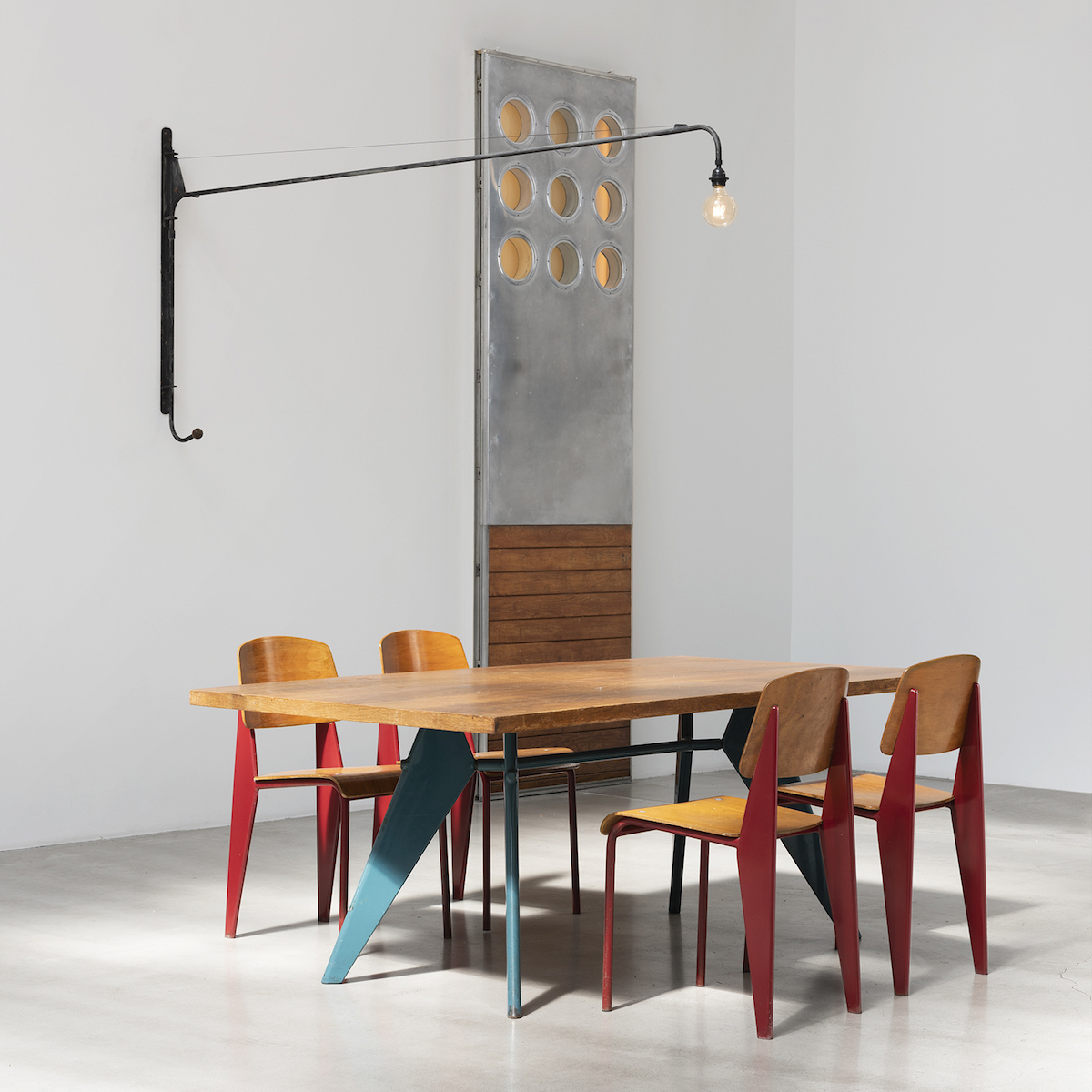
Pierre Jeanneret
French/ Swiss, 1896–1967

Though overshadowed by his cousin Le Corbusier, Pierre Jeanneret was a visionary of modernist architecture and design. Together, the pair pioneered a new aesthetic vocabulary that placed function and order over embellishment—Jeanneret’s work imbuing the strict geometry of modernism with energetic diagonals and lighter materials like cane and wood. A consistent innovator, he collaborated with Charlotte Perriand on experiments in aluminum and wood, and developed prefabricated housing with Jean Prouvé. In the early 1950s Jeanneret joined his cousin in Chandigarh, India, where they embarked on a massive urban-planning project, laying out the city and designing low-cost buildings and furniture. Though Corbusier abandoned the project halfway through, Jeanneret remained for 15 years as the project’s chief architect. The city remains a masterpiece of the modern vision.

Le Corbusier
French/ Swiss, 1887–1965

Born Charles-Édouard Jeanneret, visionary architect and designer Le Corbusier developed new models for post-industrial urban living. He based his design philosophy on systems of proportion, modularity, and geometry; these principles infiltrated his writing, theory, and painting, as well as urban planning. Though Le Corbusier took inspiration from historical architects such as Vitruvius, Leonardo da Vinci, and Leon Battista Alberti—polymaths who similarly explored the relationship between the body and the built environment—his designs were decidedly modern and unembellished. His buildings can be found in France, India, Japan, and beyond. As a painter, Le Corbusier co-founded the early 20th-century Purist movement, which dictated that objects should be depicted in their most pared-back forms. He later embraced a more abstract sensibility centered on lines, shadows, and curvilinear shapes. At auction, Le Corbusier’s work has sold for millions.

Charlotte Perriand
French, 1903–1999

Charlotte Perriand was a rare female voice among the avant-garde designers whose designs shaped modern living in the early 20th century. As a student, she rejected the popular Beaux-Arts style and found inspiration instead in machine-age technology. She joined the studio of Le Corbusier at 24, where she experimented with steel, aluminum, and glass, developing a series of tubular steel chairs that remain a modern icon. In 1940, she traveled to Japan to advise the government on how to export products to the West, and spent WWII exiled in Vietnam, where she discovered local woodwork and weaving techniques and embraced natural materials. “The most important thing to realise is that what drives the modern movement is a spirit of enquiry; it’s a process of analysis and not a style,” she said near the end of her life. “We worked with ideals.”

Jean Royère
French, 1902–1984

Jean Royère was already 29 when he decided to quit his job and take up design. He began his second career in Paris’ cabinetmaking workshops, before receiving his first big commission, designing a new layout for the Brasserie Carlton on the Champs Elysées in 1934. From then his luxurious style caught the eye of the world’s elite, and he spent the rest of his career designing couture furniture and spaces for the likes of King Hussein of Jordan and the Shah of Iran. Unlike the modernists who came before him, the self-taught designer offered a more sensuous approach to design. He reveled in color, working with rich jewel tones, precious materials, velvets, brass, and satin, with shape and material as his only ornamentation.
