

(index.php)
Turning Words into Art: Lawrence Weiner and His Enduring Legacy
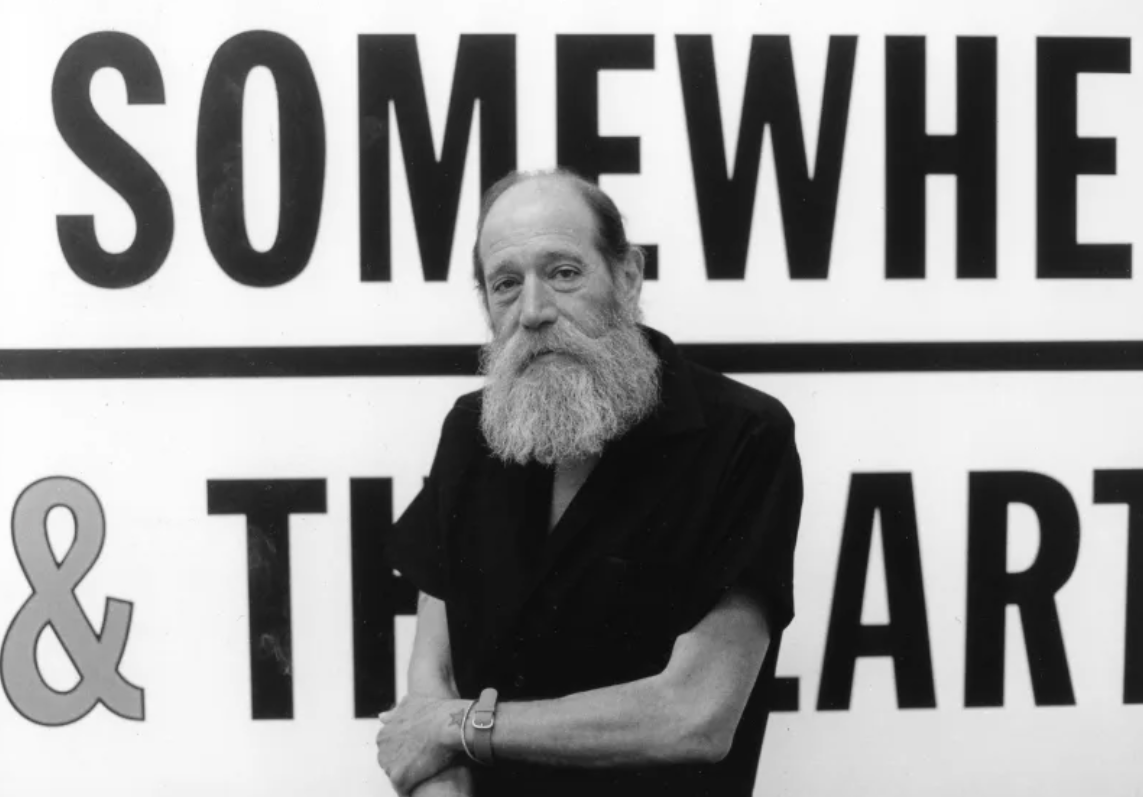
Lawrence Weiner (1942–2021) was one of the most influential voices in Conceptual art, emerging in the late 1960s as a pioneer who redefined the role of the artist and the nature of the artwork itself. His practice proposed a new relationship between art, its maker, and its audience, dismantling long-held notions of ownership, creation, and permanence.
Conceptual art, which emerged in the 1960s, is founded on the principle that the idea behind a work holds greater importance than its physical form. Recognised as one of the movement’s leading figures, Weiner turned to language as his primary medium in the late 1960s. His works, most often presented in a clean sans serif font, frequently refer to materials and constructions that suggest a physical process. While he did not define his practice as site-specific, each piece develops a distinct connection with the place in which it appears. Whether situated in a public square, on a gallery wall, or within the pages of a book, each context offers viewers the opportunity to form their own interpretations through their personal experience.
Like much of Conceptual art, Weiner’s works do not require the artist to physically execute them. In rethinking the traditional dynamic between maker and viewer, he placed responsibility for the work’s realisation into the hands of its audience. Over the course of his career, his engagement with language evolved from describing straightforward actions to employing ready-made verbal structures such as aphorisms and sayings, each highlighting the inherently subjective nature of interpretation.
Biography
Born in 1942 in New York, Lawrence Weiner lived and worked in the city for most of his life until his death in 2021. He had no formal art school training, a fact that perhaps contributed to the independence of his approach. Before focusing on language, he explored painting, constructed works, and sculpture. In 1970, he discovered a houseboat in Amsterdam that became his second home, and for decades afterward, he divided his time between Amsterdam and New York City.
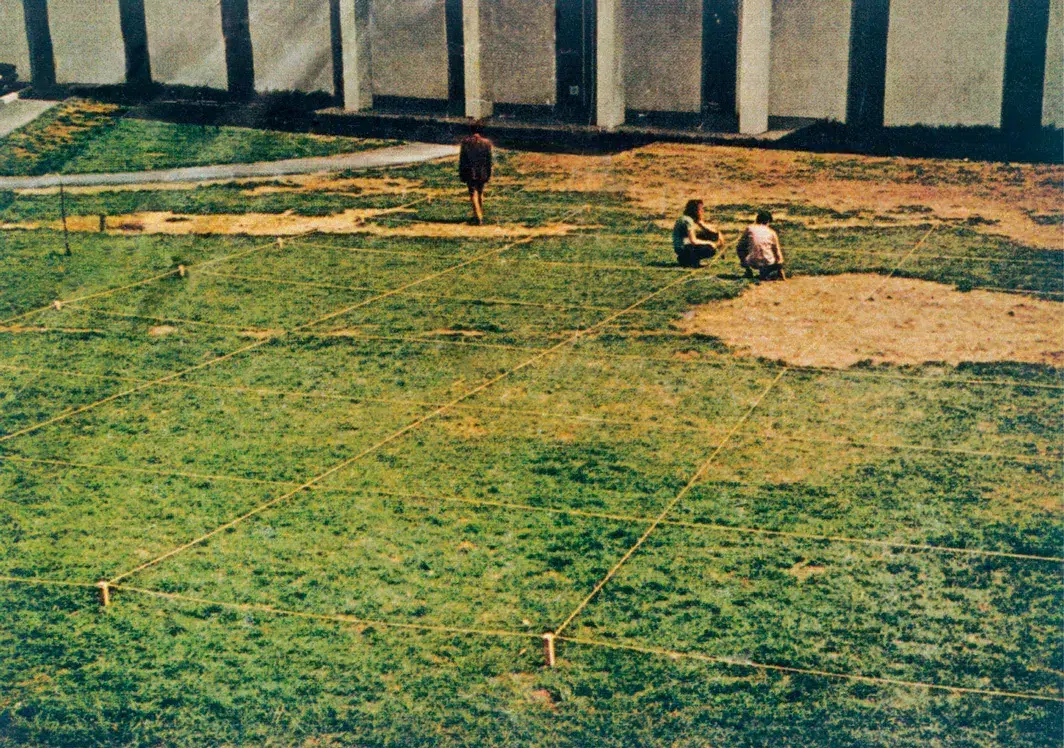
In 1968, Weiner reached a pivotal moment in his practice during an outdoor exhibition at Windham College in Vermont, organised by Seth Siegelaub. He created a sculptural installation marking a large rectangle on the campus lawn with wooden stakes and twine, within which a smaller section was designated as “removed,” a conceptual subtraction defined by absence. Before the exhibition concluded, students cut through the twine to take a shortcut across the lawn. Confronted with the disappearance of the physical work, Weiner realised its essence remained intact when expressed in words, leading him to regard the idea as equal to its material realisation and to shift toward language as his primary medium.
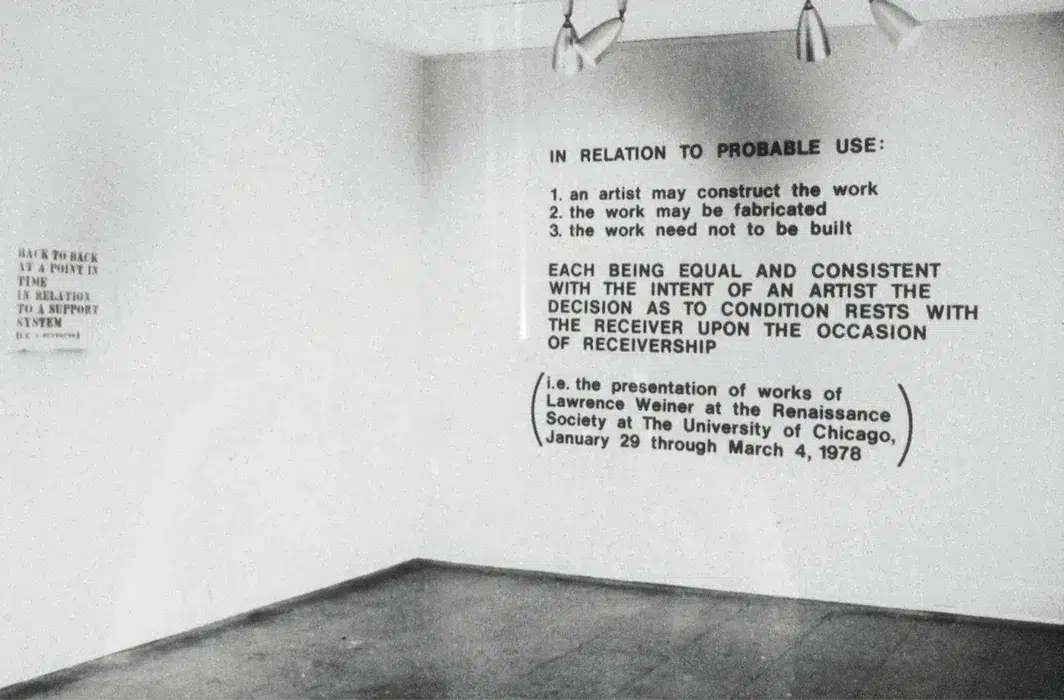
That same year, he wrote his now-famous Statement of Intent, a foundational text in conceptual art, which states: 1. The artist may construct the work. 2. The work may be fabricated. 3. The work need not be built.
This statement not only codified his break from object-based practice but also redefined the artist–audience relationship, placing equal value on conception and execution.
Throughout his career, Weiner maintained a strong presence in both institutional and public contexts, producing works that often bridged the gap between the gallery and the street. Public space, in particular, became a vital arena for his practice. His texts appeared on the façades of buildings, on functional infrastructure, and in ephemeral printed matter such as matchboxes, entering the visual environment of daily life without the framing devices of the museum. These interventions were not conceived as site-specific in the traditional sense, yet they inevitably developed layered relationships with their surroundings, shaped by cultural, linguistic, and architectural contexts.
A selection of our favourite works by Weiner

His public projects, SMASHED TO PIECES (IN THE STILL OF THE NIGHT) (1991–2016), was emblazoned in both English and German on the side of a former Nazi flak tower in Vienna. The work, visible from a great distance, confronted the site’s historical weight while remaining open to multiple readings, its terse phrasing shifting between metaphor, memory, and political commentary.
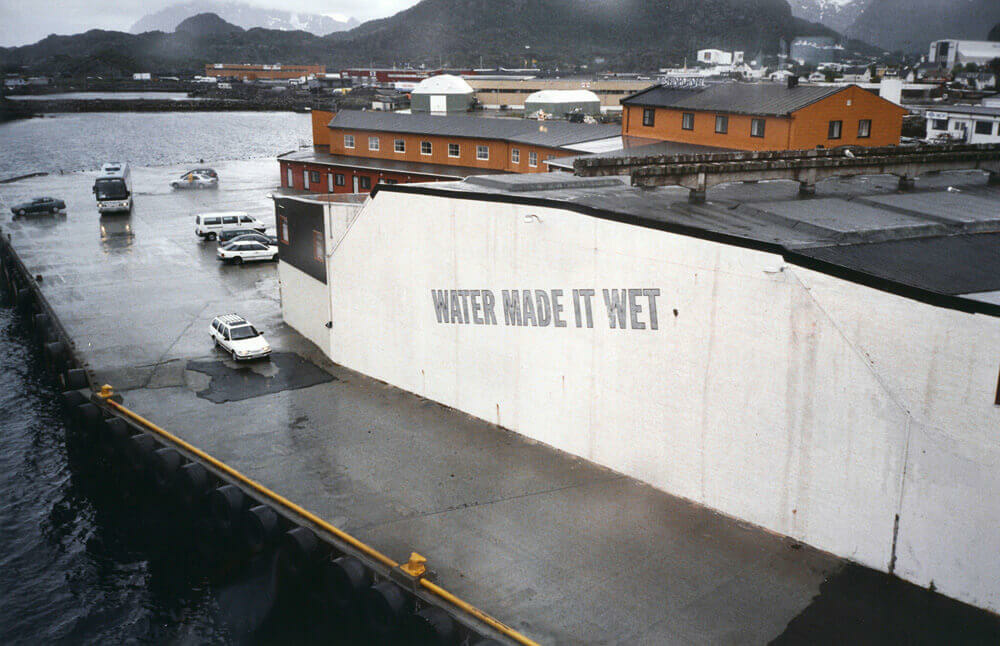
WATER MADE IT WET (1998) was created for the Lofoten International Art Festival in Svolvaer, Norway, an intriguing work installed on the facade of a building in the town’s harbour. The text, deceptively simple, reads just as the title: “WATER MADE IT WET.” Its tautological phrase highlights Weiner’s talent for distilling common observations into poetic and conceptual propositions. Placed in the coastal environment of Lofoten, the statement becomes both humorous and profound, drawing attention to water’s intrinsic qualities while anchoring the work in its literal and conceptual context.

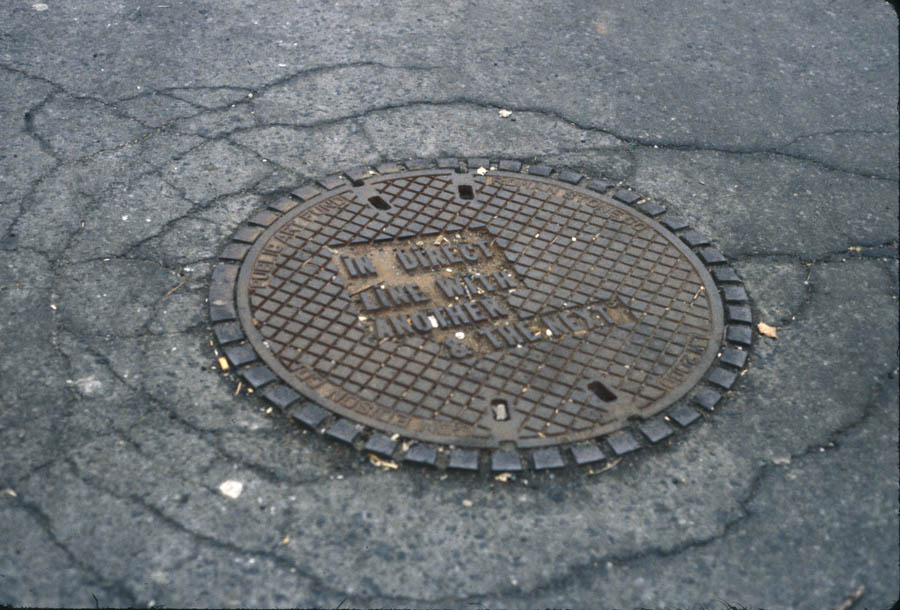
In 2000, working with the Public Art Fund in New York, Weiner produced IN DIRECT LINE WITH ANOTHER & THE NEXT, a work literally embedded into the city’s infrastructure. Nineteen functional manhole covers were cast with the phrase, distributing the piece across the urban grid so that it was encountered unexpectedly in the course of daily movement.
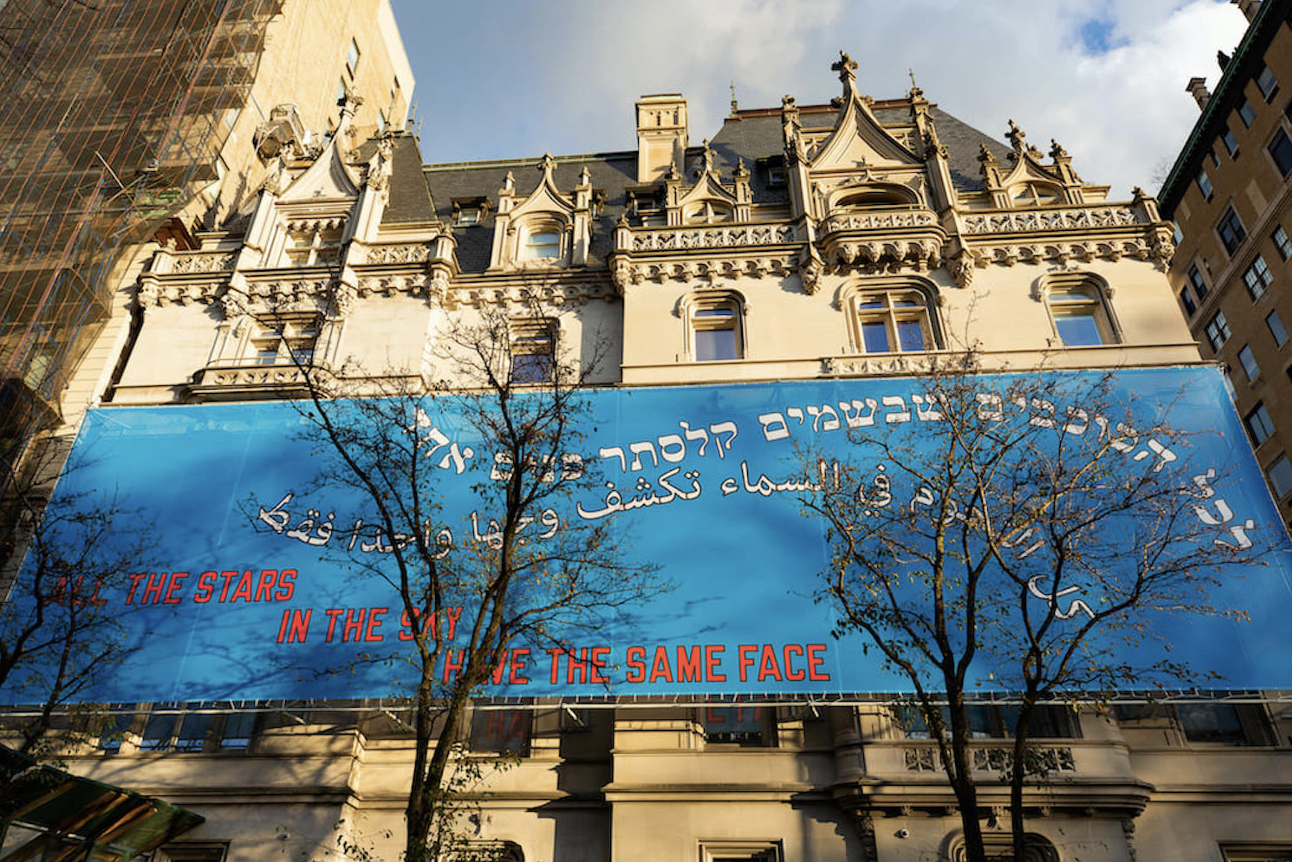
His ability to adapt language to the specificity of place was also evident in ALL THE STARS IN THE SKY HAVE THE SAME FACE (2020–21), commissioned for the façade of the Jewish Museum in New York. Rendered in English, Arabic, and Hebrew, the work operated simultaneously as a poetic assertion of shared humanity and as a subtle meditation on translation, difference, and commonality.

In BROUGHT TO LIGHT / SUBSEQUENTLY ALLOWED TO DISSIPATE (2009), created for the University of California, San Francisco, Weiner staged a layered interplay between revelation and disappearance. The rooftop phrase BROUGHT TO LIGHT, visible from surrounding streets, was paired with rusting steel disks on the plaza below bearing SUBSEQUENTLY ALLOWED TO DISSIPATE. Together, they formed a meditation on temporality, presence, and the shifting states of knowledge.
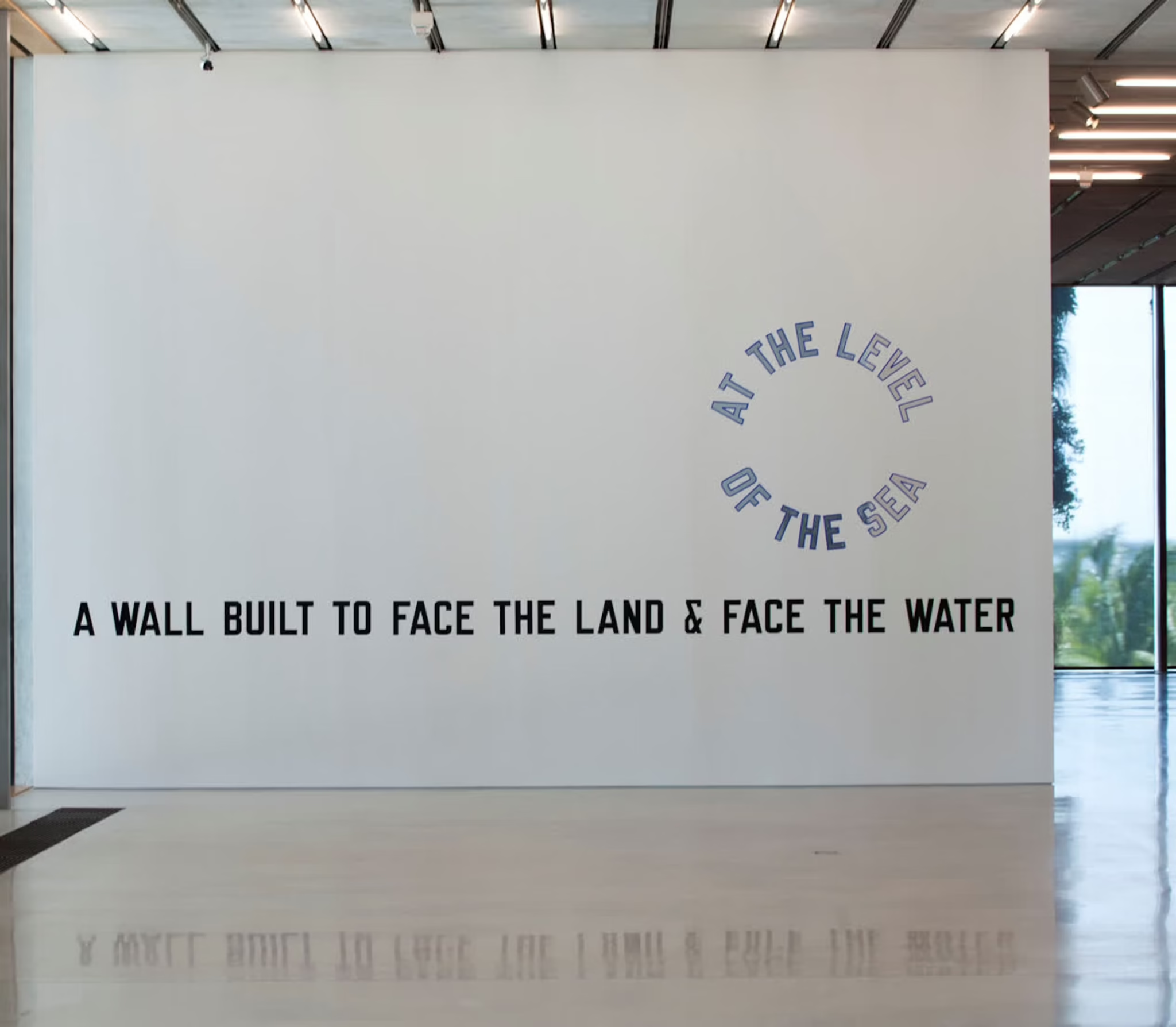
A WALL BUILT TO FACE THE LAND & FACE THE WATER AT THE LEVEL OF THE SEA (2008) exemplifies Weiner’s capacity to transform language into a spatial and architectural proposition. Installed at the Pérez Art Museum Miami, the work presents its statement directly on the gallery wall, pairing bold black text with a faded blue circular inscription. The phrasing conjures the image of a structure positioned between two elemental forces, namely land and water, yet no physical wall exists. Instead, the viewer is invited to construct it mentally, engaging with the tension between presence and absence. In this way, the work underscores Weiner’s conviction that language can delineate space as effectively as material form, situating the act of building within the realm of thought.

Weiner’s engagement with institutions was equally significant. His permanent installations at Dia:Beacon exemplify his capacity to create works that, while not dependent on a particular site, resonate deeply with their architectural context. In these spaces, his texts operate not merely as visual elements but as structuring devices that shape the viewer’s navigation and perception of the environment.
His Legacy
Weiner’s contribution to late twentieth-century art stands alongside that of Joseph Kosuth, On Kawara, and Sol LeWitt, establishing him as a foundational figure in the history of Conceptual art. His Statement of Intent became a foundational text for artists seeking to explore the dematerialisation of the art object, offering a clear and adaptable framework for thinking about the equivalence of conception and execution. By placing the idea at the centre of the work, Weiner proposed a model of art that was portable, reproducible, and capable of existing independently of any specific material form.
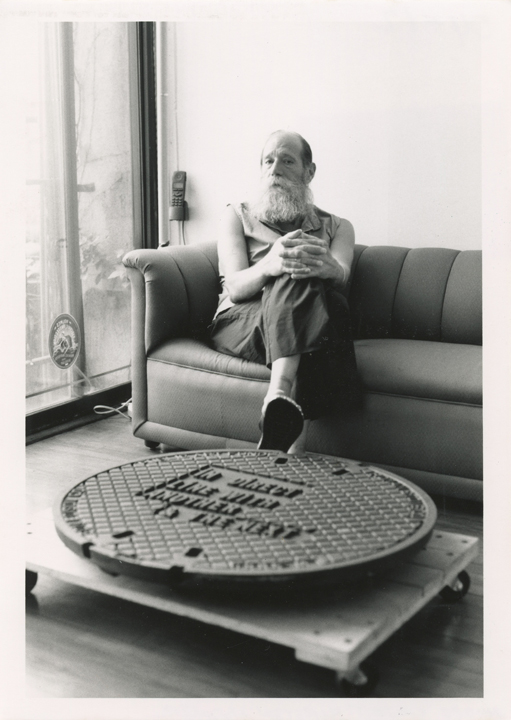
This emphasis on the mobility of ideas shaped the work of successive generations who engaged with language and instruction as artistic media, from Jenny Holzer’s illuminated public texts to Barbara Kruger’s politically charged slogans. More than five decades after Weiner first turned to language, his core proposition — that the conception of a work is sufficient for it to exist — remains deeply embedded in contemporary practice.
Eleven Emerging Artists on the Rise
LVH Art presents a list of emerging artists to follow now. We’ve curated a selection of fresh voices who are reshaping the contemporary art scene through varied mediums, distinct perspectives, and diverse backgrounds.
Working across painting, photography, and installation, and often incorporating unconventional materials and techniques, these artists offer a fresh perspective on material, image, and form. From detailed portraits of Giangiacomo Rossetti, Magdalena Skupinska’s use of natural pigments and organic matter, to Nour Jaouda’s heavy, layered textiles, and many others — these artists represent a range of emerging approaches shaping the contemporary art scene.
Sonya Derviz (b. 1994, Moscow, Russia)

Sonya Derviz, installation view of ‘Near and Far’ exhibition, Sherbet Green, London, 2025. Image courtesy of the artist and Sherbet Green.


Sonya Derviz is a London-based artist known for atmospheric, psychologically charged compositions that blend figuration and abstraction. Her works evoke a dreamlike ambiguity, drawing from memory, literature, and emotional states to explore themes of interiority and transformation. Derviz has exhibited extensively in the UK and abroad, with solo shows at Sherbet Green (‘Near and Far’, 2025; ‘Closer’, 2023) and a collaborative two-person exhibition at Sadie Coles HQ (‘Conditions’, 2025). A graduate of the Slade School of Fine Art, Derviz is the recipient of the Stanbury Prize and UCL Art Museum Award.
Lorenzo Amos (b. 2002, New York City, USA)
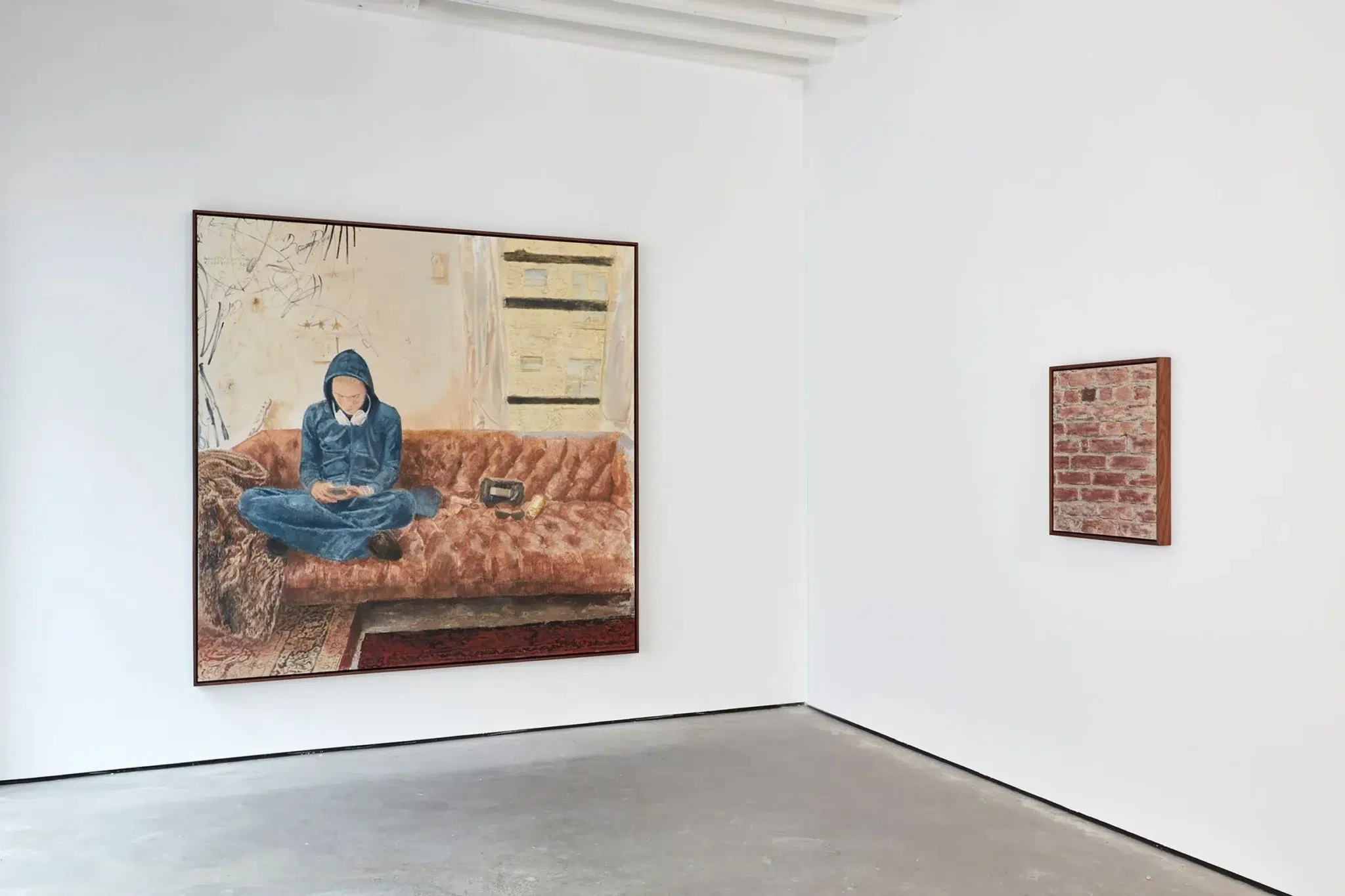


Lorenzo Amos’s practice centres on capturing the immediacy of everyday life through figurative painting and drawing. His works often focusing on fleeting urban moments, dreams, and personal memory. His visual language draws from the legacies of figurative expressionism, Symbolist painters like Odilon Redon, and poets such as Arthur Rimbaud, infusing his work with both emotional urgency and poetic resonance. After spending some years in Milan, returning to New York has become both a creative sanctuary and an emotional homecoming, with the city itself serving as muse and backdrop for his work. Discover more about his work in our recent interview with the artist.
Filippo Antonello (b. 2002, Lugano, Switzerland)
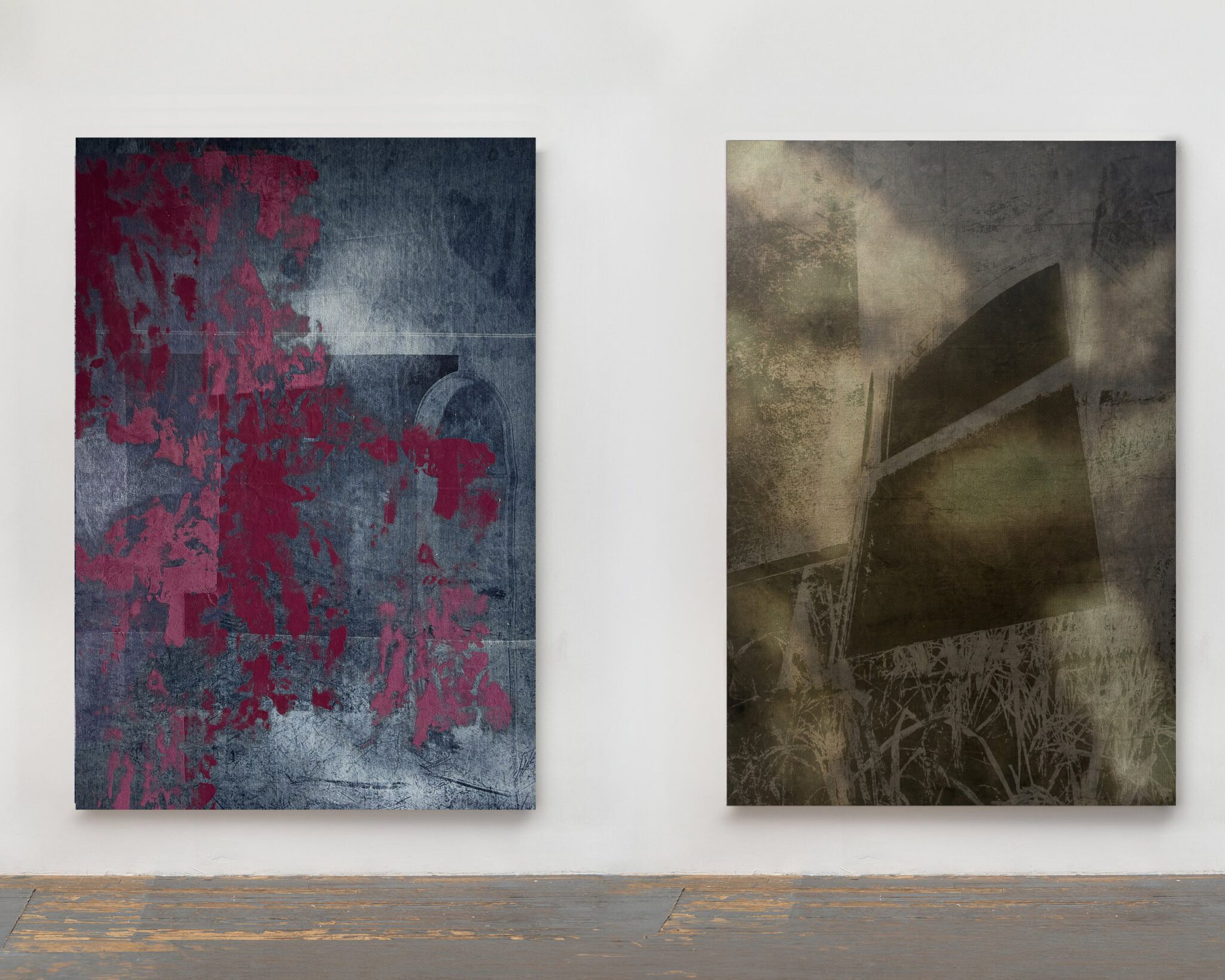
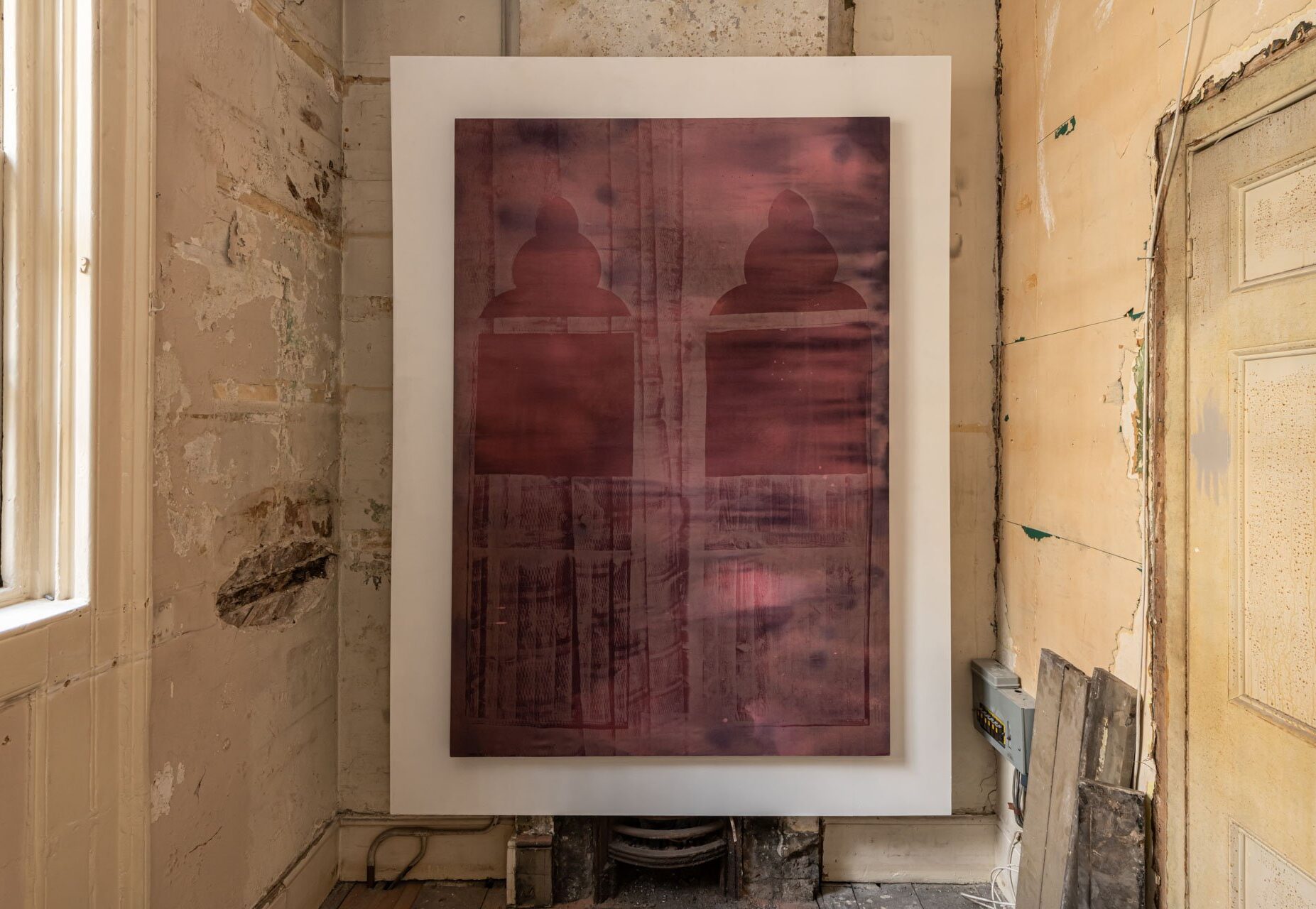

Filippo Antonello is known for his mixed-media works using bleach and ink on unconventional supports like velvet, corduroy, and denim. In his first solo exhibition, ‘Aufheben’, held at the newly established permanent space of Kearsey & Gold on Cork Street, Antonello explored the interplay between realism and abstraction, and how materiality plays a role in this. As he put it: “the paintings are less about representation than about tuning: the viewer is not positioned in front of the work, but inside its wavelength, caught in the recursive motion of perception and loss.” He holds a BA in History and Philosophy from the University of Amsterdam and an MA from the University of the Arts London. Antonello now lives and works in London.
Francesco Cima (b. 1990, Pietrasanta, Italy)

Francesco Cima, installation view of ‘Vedrai, vedrai’ exhibition, Amanita, New York, 2024. Image courtesy of the artist and Amanita.


Based in Venice, Francesco Cima is a painter whose work has increasingly focused on landscape, which now plays a central role in his practice. His paintings rarely include the human figure, instead giving space to other life forms and imagined relics drawn from a personal mythology. Influenced by the landscape of Versilia in northwestern Tuscany, with its blend of sea, hills, and mountains, Cima grounds his work in a strong sense of place. His paintings also drift into deserts, dreamlike visions of Venice, and imagined terrains beyond time and geography. Often lit by a dim, transitional light, his works carry a quiet intensity, echoing the introspective spirit of Romanticism. Cima graduated from the Academy of Fine Arts in Venice (2019) and also has an MFA from the Slade School of Fine Art. He has exhibited widely across Italy and internationally, including solo and group presentations at Galleria A+A, Monitor, Marselleria, M+M Gallery, and most recently at Spazio Amanita.
Magdalena Skupinska (b. 1991, Warsaw, Poland)


Magdalena Skupinska is a London-based artist known for her use of natural pigments such as turmeric, chili, and corn to create organic, abstract compositions. Her practice draws from Arte Povera and Minimalism, resulting in tactile works that encourage sensory engagement and a renewed connection with the natural world. Often displayed flat on raised wooden platforms, the works remain physically grounded, inviting viewers to look down into their surfaces. Her solo exhibitions include ‘Blending Elements’ at Maximillian William in 2025 and ‘Fertile Plate’ at Blum & Poe in 2023. She has a degree from Central Saint Martins (BA) and the Royal College of Art (MA).
Gregory Olympio (b. 1986, Lomé, Togo)


Gregory Olympio lives and works between Besançon, France and Cape Town, South Africa. He is a self-taught artist who mostly paints portraits and character studies. His paintings are sensitive renderings: expressive, yet precise in their simplicity. Rooted in a life shaped by movement across Benin, Togo, and France, Olympio’s works explore the complexities of belonging. Rather than fixed categories, he sees culture and identity as ever-evolving, shaped by context and connection between places and people. Olympio has held five solo exhibitions to date, most recently ‘Ceux qui sont partis et ceux qui sont restés’ (2024) at Blank Projects, and he was featured at the Dakar Biennale in 2022.
Nour Jaouda (b. 1997, Libya)


Nour Jaouda is a Libyan artist based between London and Cairo whose practice fuses painting, textiles, and installation into sensorial meditations on memory, displacement, and cultural geography. Jaouda creates works that embody the tension between rootedness and rootlessness, often drawing from the emotional landscapes of migration and transience. Her hand-dyed, richly textured textiles crafted with vegetal pigments are central to her process, serving as vessels for memory and transformation. In Jaouda’s view, textiles embody a divine continuity without beginning or end, reflecting the ongoing process of becoming that shapes both identity and creative labour. She is a graduate of the Royal College of Art (MA Painting, 2021) and Oxford’s Ruskin School of Art (BFA, 2018). Jaouda won the CAS Collections Fund at Frieze in 2024 and was commissioned to make a work Saudi Arabia’s Diriyah Biennale this year.
Kate Spencer Stewart (b. 1984, Phoenix, USA)


Kate Spencer Stewart is a Los Angeles–based painter who typically works in oil and tempera on square linen canvases, which is an intentional choice that sidesteps traditional portrait or landscape formats. Her work explores archival memory and feminine narratives through abstraction and material layering. Her process involves repetitive mark-making, concealed underpaintings, and shifts between crushed pigment and iridescent oil, creating surfaces that oscillate between presence and erasure. Stewart’s work is non-representational, focusing instead on evoking a mood or atmosphere. Her work is currently on view in London as part of the exhibition ‘Nuit’ at Emalin Gallery, where her paintings are shown in conversation with Odilon Redon’s La Nuit (1886), creating a dialogue across time and sensibility.
Giangiacomo Rossetti (b. 1989, Milan, Italy)

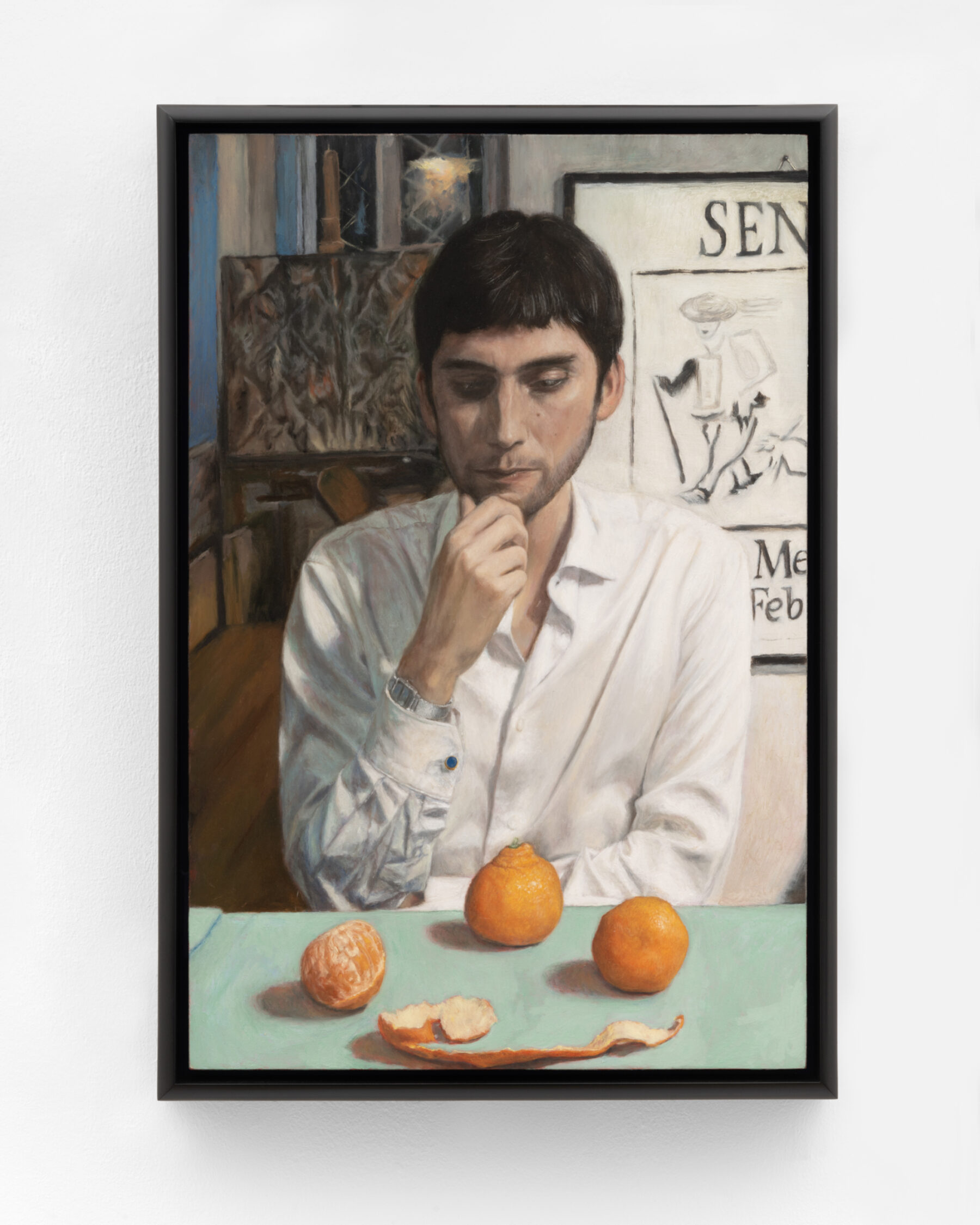
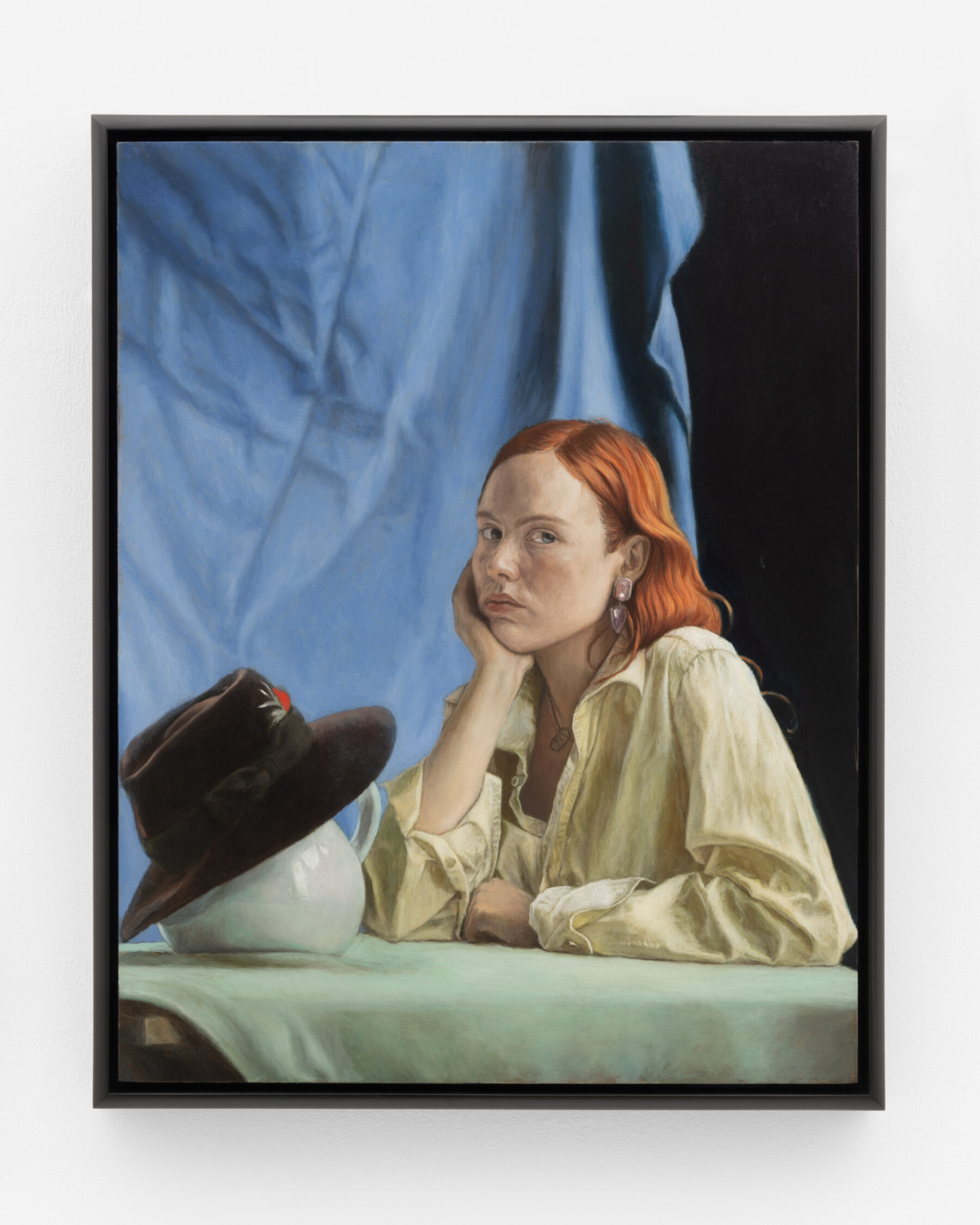
Giangiacomo Rossetti is a figurative painter who lives and works in New York City. Rossetti’s work often features self-portraits, weaving his own image, or those of people close to him, into richly layered compositions. His paintings pay homage to Renaissance masters and the Pre-Raphaelites, blending personal narrative with art historical reference. His engagement with traditional models reflects both a profound respect for these artistic masters and a confident declaration of his own unique creativity and artistic voice. After initially working with conceptual art, Rossetti turned to painting later in his career, educating himself through an intensive study of art history and technical literature. Rossetti attended the Accademia di Belle Arti di Brera in Milan and in 2019 graduated from Die Institut Kunst FHNW in Basel.
Asemahle Ntlonti (b. 1993, Cape Town, South Africa)


Asemahle Ntlonti is a South African artist whose creations are both beautifully textured and deeply layered with meaning. Her painting method involves layering paint, paper, and stitched thread directly onto canvas. She works on the floor, fully engaging her body in the creative process, gradually building and peeling back layers through an intuitive rhythm. Ntlonti’s work is deeply influenced by the textures and colors found in the traditional architecture of her ancestral Eastern Cape in South Africa. Recently, her practice has been shaped by her experiences with the ruins of her mother’s homestead, particularly the weathered interior surfaces. Her works frequently evoke the essence of topographical maps — landscapes rich with memory, nostalgia, and longing. Ntlonti was awarded the Spirit Now London Acquisition Prize at Frieze London 2024. She graduated from the University of Cape Town’s Michaelis School of Fine Art in 2017.
Wang Ye (b. 1991, Changsha, China)


Wang Ye is a Chinese multidisciplinary artist whose practice spans painting, video, and installation. His work delves into the psychological terrains of urban life, focusing particularly on the effects of rapid modernisation and cultural displacement in East Asia. Drawing inspiration from folk art, Ye highlights how cultural heritage shapes and transforms aesthetics and values over time. Recently, he was studying the traditional Hunan Embroidery technique, for which he has gained significant recognition. For Art Basel Hong Kong 2025, Ye developed these themes through a series inspired by the hair accessories worn by embroiderers. As Ye explains: “Since embroidery is done at a desk, I often notice how their hair is pinned up”. He graduated from the Design Department of Central Academy of Fine Arts in 2013 in Beijing. In 2017, Wang Ye graduated with a Masters of Fine Arts from the Sculpture Department of Yale University School of Art.
The World in Black and White: 6 Photographers Who have Mastered the Monochrome Lens
This article explores some of the most influential masters of black and white photography, artists who have redefined the medium with their unique perspectives. From the sculptural elegance of Robert Mapplethorpe to the haunting portraits of Peter Hujar, the provocative fashion imagery of Helmut Newton, and the dreamlike self-portraits of Francesca Woodman, these photographers each offered a unique view of the world. Hiroshi Sugimoto’s meditative, otherworldly landscapes probe the passage of time in deeply impactful ways, while Carrie Mae Weems harnesses black and white imagery to powerfully examine race, gender, and history.
Before the world was captured in vibrant hues through the lens of colour photography, photographers worked exclusively in black and white, playing on light and shadow. Black and white photography dominated from the mid 19th century until the mid 20th century. While colour photography existed as early as the 19th century, it remained expensive and less common until the development of Kodachrome in the 1930s.
Even today, in an era dominated by saturated colour, black and white photography remains a powerful choice, stripping away distraction to highlight contrast, texture, and emotion. With this in mind, we wanted to explore some of the most iconic photographers who have embraced this medium as a deliberate and defining style. These artists have used monochrome to capture identity, beauty, and mortality, proving that sometimes, the absence of colour can say the most.
Though their styles and subjects differ, what unites them is their mastery of monochrome, transforming light and shadow into timeless, unforgettable works of art.


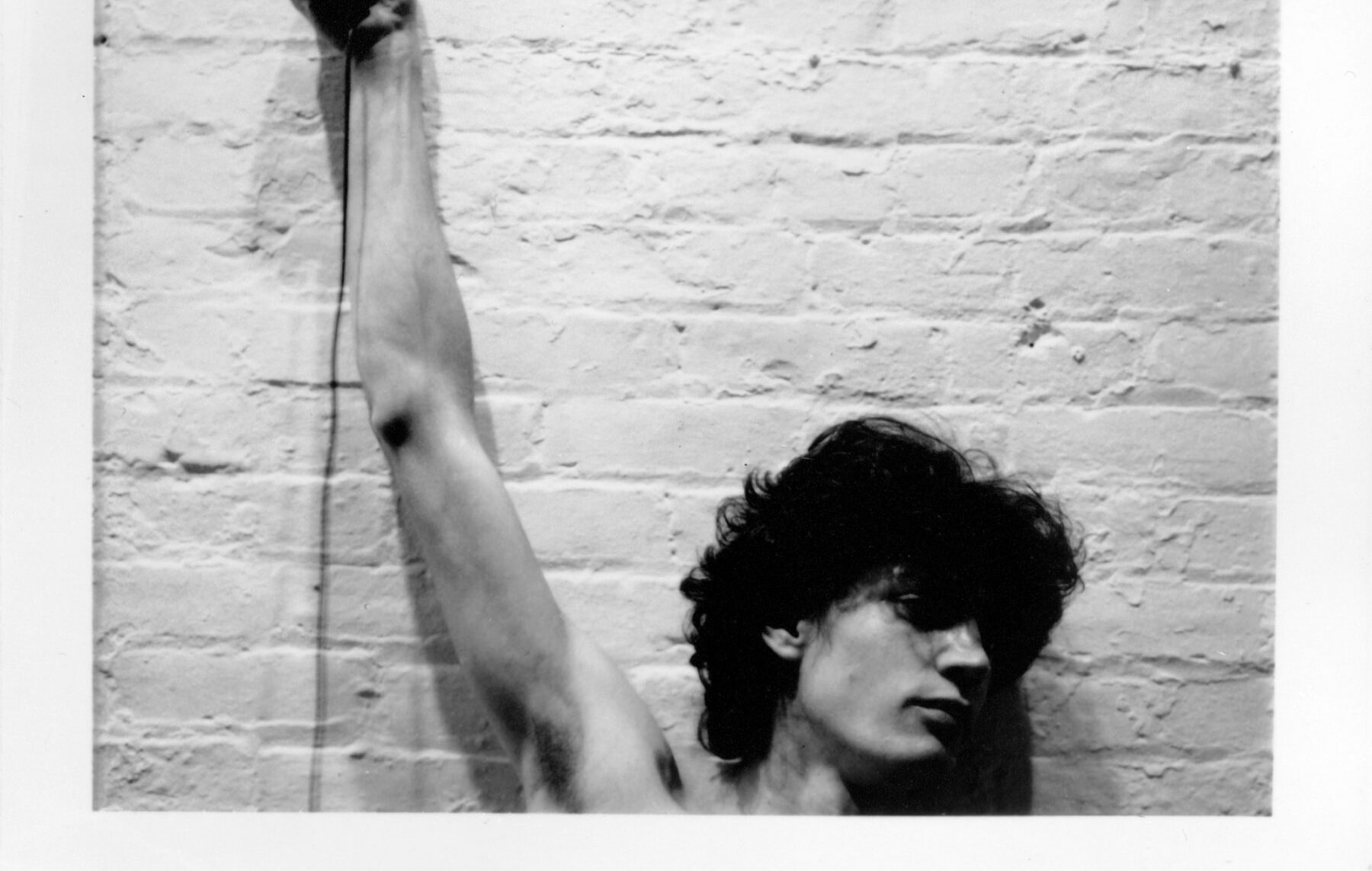
Robert Mapplethorpe
One of the most iconic figures in black and white photography, Robert Mapplethorpe (1946–1989) was born in Queens, New York, and became known for his meticulously composed images. Originally studying painting and sculpture at the Pratt Institute, he transitioned to photography in the early 1970s, using a Polaroid camera before moving on to large-format prints. His work is characterized by a refined, classical aesthetic, whether capturing the raw physicality of the human form, the delicate curves of a flower, or the intensity of New York’s underground BDSM scene.
Mapplethorpe’s portraits are among his most enduring works, featuring celebrities, artists, and cultural icons of his time. His deep friendship and creative partnership with Patti Smith, the legendary musician and poet, was particularly significant. The two met in the late 1960s as struggling artists in New York and remained deeply connected throughout their lives. Mapplethorpe’s famous 1975 portrait of Smith, used for the cover of her album Horses, is one of the most iconic images in rock history.
Beyond portraiture, Mapplethorpe’s exploration of sexuality, gender, and the male form often in highly stylized and provocative compositions sparked both acclaim and controversy. His X Portfolio, which documented the underground gay leather scene, ignited debates on censorship and artistic freedom in the late 1980s.
Le Stanze della Fotografia in Venice will host the Robert Mapplethorpe exhibition from April 10 to November 23, 2025, curated by Denis Curti.


Peter Hujar
Peter Hujar (1934–1987) was also a main figure in New York’s downtown bohemian scene, capturing its essence through his evocative black-and-white photography. Born in Trenton, New Jersey, Hujar immersed himself in Manhattan’s counterculture, forging connections with artists, musicians, and writers who, like him, challenged societal norms. His work intimately documented this vibrant subculture, featuring portraits of luminaries such as William S. Burroughs, and Candy Darling.
Hujar’s photographs were included at the Barbican Art Gallery’s 2020 exhibition, “Masculinities: Liberation through Photography,” which explored the social constructs of masculinity from the 1960s onward. His inclusion highlighted his nuanced portrayal of gender and identity, reinforcing his status as a pivotal artist in examining these themes. Hujar’s work remains a testament to the raw beauty and complexity of the human experience, offering an unfiltered glimpse into the lives of those on society’s fringes.
During the AIDS crisis, Hujar documented the devastating impact of the epidemic on his community, capturing intimate and raw portraits of friends and lovers affected by the disease. One of his most moving photographs is of his partner, artist David Wojnarowicz, taken shortly after Wojnarowicz’s death from AIDS-related complications in 1987. Hujar ultimately passed away from AIDS-related complications later that same year.
The exhibition “Peter Hujar: Eyes Open in the Dark,” held at London’s Raven Row gallery from January 30 to April 6, 2025, provided a thorough exploration of Hujar’s later photography. It highlighted his intimate portraits of prominent figures from New York’s 1970s art scene, such as Susan Sontag and William Burroughs, alongside powerful street scenes and portraits of partners and people closest to him. Hujar had a remarkable ability to capture the raw, unfiltered essence of his subjects, imbuing his work with profound emotional depth.


Helmut Newton
Helmut Newton (1920–2004) was a German-Australian photographer whose bold, provocative high-contrast black-and-white images revolutionized fashion photography. Born in Berlin to a Jewish family, Newton fled Nazi Germany in 1938 and eventually settled in Australia before making his mark on the global fashion scene. His distinctive aesthetic—erotic, glamorous, and frequently provocative—challenged and expanded the portrayal of women in photography.
Newton’s work for Vogue, Harper’s Bazaar, and other fashion magazines redefined the genre, blending haute couture with themes of power, dominance, and voyeurism. His “Big Nudes” series, shot in the 1980s, remains one of his most iconic projects, presenting stark, imposing images of nude women that exuded strength and confidence. His subjects, often draped in leather and high heels, embodied a mix of seduction and authority, challenging traditional notions of femininity.
Beyond fashion, Newton’s portraits captured cultural icons such as Catherine Deneuve, David Bowie, and Charlotte Rampling with his signature cinematic style. His provocative, sometimes controversial approach sparked debates but cemented his status as one of the most influential photographers of the 20th century. His legacy continues to shape contemporary photography, with exhibitions and retrospectives showcasing his unmistakable vision of beauty, power, and desire.
On March 6, 2025, the Helmut Newton Foundation in Berlin opened Polaroids, a group exhibition presented as part of EMOP Berlin 2025, featuring works by Helmut Newton alongside numerous other photographers. The show runs until July 15th.


Francesca Woodman
Francesca Woodman (1958–1981) defied conventional self-portraiture by blurring the line between presence and absence. Her body often fades into peeling wallpaper, vanishes behind door frames, or is captured in fleeting, ethereal motions. Through her work, she delves into themes of identity, femininity, and transience, crafting an atmosphere that is both haunting and profoundly personal.
Born into an artistic family in Denver, Colorado, her father a painter and photographer, her mother a ceramicist and sculptor, Woodman was immersed in art from an early age. She began taking photographs in her early teens while attending boarding school. She would go on to capture over 800 images during her brief but impactful career.
Her artistic vision was influenced by European culture and surrealist art, particularly the works of Man Ray and Claude Cahun. Spending summers at her parents’ farmhouse near Florence, Italy, she absorbed elements that would later permeate her photography. At the Rhode Island School of Design, she refined her distinctive style, using long exposure times, unconventional framing, and dilapidated interiors to craft dreamlike narratives that seem to exist outside of time.
In 1979, Woodman relocated to New York with dreams of pursuing a career in fashion photography. Tragically, in 1981, at the age of 22, she took her own life. Despite her brief career, her powerful and intimate images have left a lasting impact.
The ALBERTINA Museum in Vienna is currently hosting Austria’s first museum exhibition dedicated to Francesca Woodman, featuring works from the Verbund Collection, on display from April 4th to July 6th.


Hiroshi Sugimoto
Hiroshi Sugimoto, born in 1948 in Tokyo, Japan, is a photographer and contemporary artist whose work explores the themes of time, memory, and the metaphysical. After studying politics and sociology at Rikkyō University in Tokyo, he moved to the United States in 1970, earning a Bachelor of Fine Arts from the Art Center College of Design in Pasadena, California.
Sugimoto’s photography is characterized by a meticulous and concept-driven approach, often employing large-format cameras to create images that explore the passage of time and the boundaries between reality and illusion. His notable series include “Dioramas,” where he photographs natural history displays to question perceptions of reality; “Theaters,” capturing entire films in a single exposure to depict the accumulation of time; and “Seascapes,” presenting minimalist images of sea and sky that evoke a sense of timelessness.
Through his diverse body of work, Sugimoto continues to invite viewers to contemplate the ephemeral nature of reality and the enduring passage of time. He had an exhibition earlier this year in January at Lisson gallery Los Angeles.


Carrie Mae Weems
Carrie Mae Weems, born in 1953 in Portland, Oregon, explores themes of power, history, and identity in her work. Her art often delves into themes of race, identity, gender, and history, reflecting both personal and collective experiences. Weems rose to prominence with her 1990 series The Kitchen Table Series, which portrayed intimate narratives and challenged societal norms surrounding family, relationships, and power dynamics. Through her work, she engages with complex cultural issues, using visual storytelling to prompt reflection and conversation.
From January to February 2025, Fraenkel Gallery in San Francisco presented an exhibition featuring new works alongside key pieces from her career. A highlight was the debut of two photographs from her ongoing “Museum Series,” created in fall 2024, where Weems engages with the architecture of San Francisco’s Legion of Honor and its Rodin sculpture, “The Thinker.” The series explores how power is embedded in cultural institutions. Also featured were large-scale colour photographs from “Painting the Town,” capturing boarded-up storefronts in Portland, Oregon, after the George Floyd protests. These abstract images, with paint covering anti-racist graffiti, reflect on the erasure of Black voices and histories. Her 2021 series Painting the Town will be on view at the Rijksmuseum from February 7 to June 9, 2025.
Though varying styles, subjects, and eras differ, these photographers utilize black and white to reveal something deeper, whether it’s the raw intimacy of Francesca Woodman, the cinematic grandeur of Helmut Newton, or the meditative stillness of Hiroshi Sugimoto. From the social commentary of Carrie Mae Weems to the uncanny, Bohemian portraits of Peter Hujar, each artist uses monochrome not as a limitation, but as a means to strip away distraction and heighten emotion. Their works prove that even in a world saturated with colour, black and white photography remains timeless, evocative, and essential.
From Bauhaus to his ‘Colour Magic’: The Enduring Impact of Josef Albers
Josef Albers, widely regarded as the master of the square, is renowned for his groundbreaking exploration of colour, form, spatial relationships, and perception. Through his use of simple geometric shapes, Albers investigated chromatic interaction—the way colours shift and transform based on their surrounding hues. As he once said, “The aim of art is to reveal and evoke vision. I indicated indirectly that art is not an object, but art is an experience.”
In this article, we explore the groundbreaking career of Josef Albers, a pioneering artist and educator who continually pushed the boundaries of modern art. Notably, he was the first student from the Bauhaus to be invited by its founder, Walter Gropius, to join the faculty—a rare honour that marked the beginning of a distinguished teaching legacy. Decades later, Albers made history again as the first living artist to be honoured with a solo retrospective at The Metropolitan Museum of Art. This article also examines Albers’s iconic Homage to the Square series, analysing the qualities that render these works so powerful, enduring, and significant in the history and evolution of modern art.

Josef Albers was born on March 19, 1888, in Bottrop, Germany, to a father who worked as a
master carpenter, house painter and plumber. His father taught him the materials and techniques of these trades, an experience that proved fundamental to Albers later on in his career. He enrolled in the Bauhaus in Weimar in 1920, just one year after the school was established. Founded by Walter Gropius in 1919, the Bauhaus was a groundbreaking German school that fundamentally reshaped modern art, design, and architecture by uniting form and function, bridging the gap between fine art and industrial design. The Bauhaus believed that well-crafted design had the power to enhance people’s lives, with simplicity and accessibility as its core principles. Studying at the Bauhaus profoundly transformed Albers’ artistic practice and as he noted about joining the school, “I was 32… I threw all the old junk overboard and went right back to the beginning again. It was the best thing that I ever did in my life”. The Bauhaus was a major source of inspiration for Albers’s iconic Homage to the Square series. One especially important influence was Johann Wolfgang von Goethe’s Theory of Colours, published in 1810, which explores how colour behaves in relation to shadows, refraction, and chromatic aberration. Widely taught at the Bauhaus, Goethe’s theory became a lasting foundation for Albers’s artistic approach and remained central to his practice throughout his career. Albers became a prominent figure in the Bauhaus movement, joining as a student in 1920 and graduating as a master in 1933, when the Bauhaus forced to close by the Nazi’s.

The Bauhaus masters on the roof of the building in 1928. From left to right: Josef Albers, Marcel Breuer, Gunta Stölzl, Oskar Schlemmer, Wassily Kandinsky, Walter Gropius, Herbet Bayer, Lazslo Moholoy-Nagy, Hinnerk Scheper. Image from Kandinsky.net.
Today, Albers is best known as a painter, but he also designed furniture for Gropius’s office and created glass objects. Gropius honoured Albers by appointing him as the first Bauhaus student to become a member of the faculty. Albers worked with Paul Klee in the stained-glass workshop and was also the longest-serving faculty member when the school closed. One notable work was His Tea Glass with Saucer and Stirrer (1925), which capture the Bauhaus spirit and aesthetic. Albers extensively explored glass, and starting in 1925, his glass pieces became the first true expressions of his lifelong dedication to colour and geometry. Fabrik (Factory) (1925) is a prime example of this.

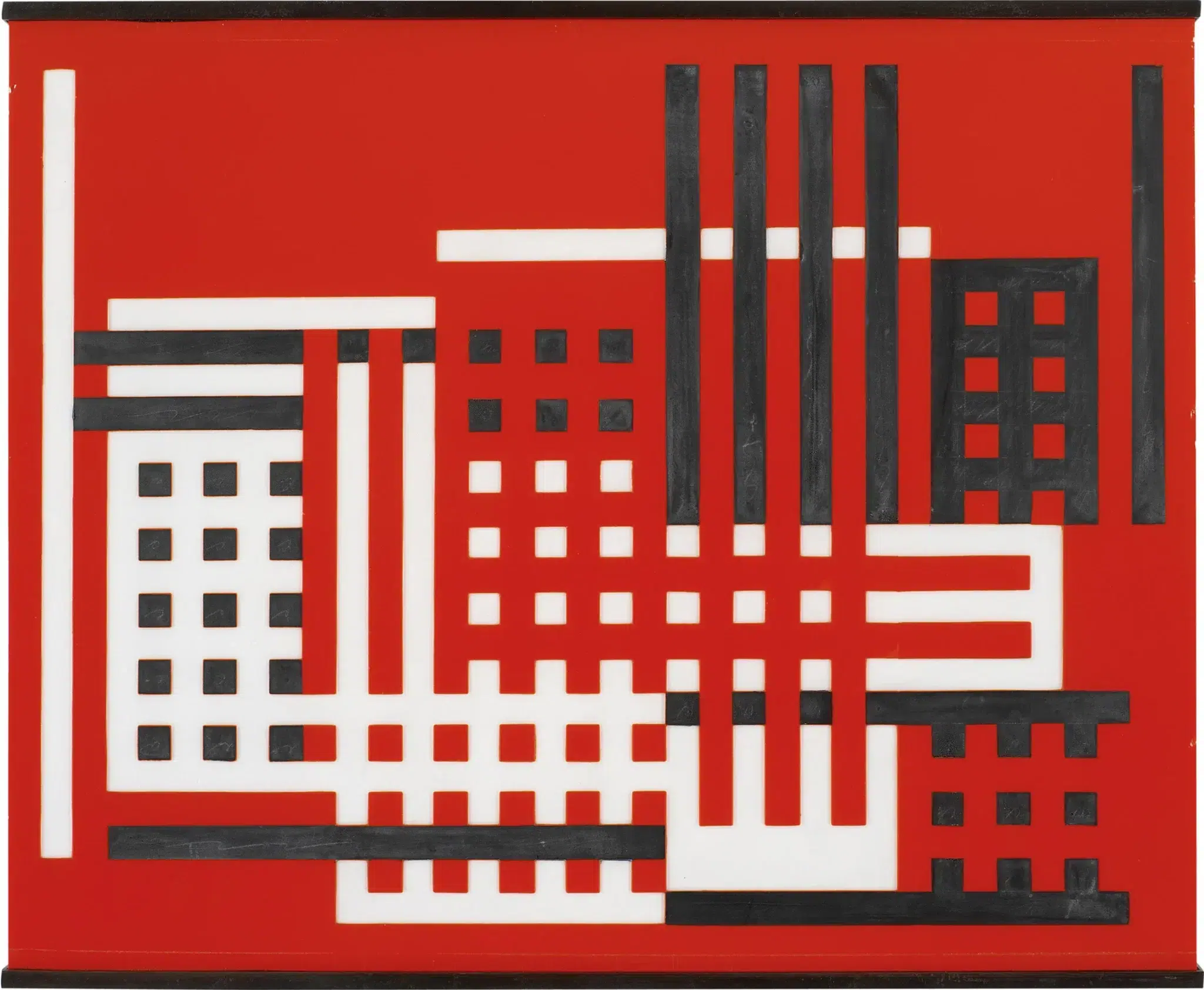
In 1933, shortly after he and his wife, artist Anni Albers, immigrated to the United States, they played a pivotal role in founding the art department at Black Mountain College. There, he became a key influence on the next generation of American artists, teaching notable figures such as Ruth Asawa and Robert Rauschenberg, among others. The Albers’ stayed at Black Mountain until 1949, and in 1950, they relocated to New Haven, Connecticut, where Josef led the design department at the Yale University School of Art.
In 1949, he began developing what would become his seminal Homage to the Square series, a body of work he continued until his death in 1976. By this time, he had already been exploring the diverse optical and psychological effects that colours can produce based solely on their placement and proximity to other colours. However, the Homage to the Square series marked the culmination of that exploration. Each work followed the same format: three or four progressively smaller squares nested within one another, each rendered in a distinct colour. Despite the uniform structure, every work was meticulously planned and visually unique from the others. This series was not only the most critically acclaimed of his career but also one of the most pivotal and influential in the history of contemporary art. A crucial element of his Homage to the Square series is his choice to shift the centre of the composition downward. By doing this he activates the squares, deliberately guiding your vision, aiming for the colours to feel dynamic rather than static, as if they’re in motion. Albers aimed to create “colour magic,” where the interaction between colours sparks a “creative act of seeing,” transforming the work from a static object into an experience.

Albers’s technique was distinctive; he favoured a palette knife over a brush, applying pure pigment straight from the tube and only adding white occasionally to adjust the hue. Before starting on his canvas’, he meticulously explored colour combinations through extensive studies on paper. Albers meticulously documented his choices, such as colours and materials, on the backs of his canvas’, helping him track his process and the evolution of his colour experiments. As sources of information, the reverse sides of Josef Albers’ paintings are in a category of their own. His efficiency and prolific output were rooted in his design training. His technique traces back to childhood, when he painted doors for his father’s business. Josef’s father taught him to always start at the centre and work outward to the edges when painting a door, which Josef then applied to his paintings. Art historian Kelly Feeney connects this idea of the door to Albers’s works beautifully noting, “The Homages operate like doors – physically, optically, psychologically, and metaphorically. They are entrances, exits, and thresholds, beginnings and endings. Sometimes it is not clear on which side of the door we are. The door opens both out and in, onto the past, the present, and onto an endless, inescapable hall of doors…. And the possibilities are both limited and limitless, just as Albers conceived of his paintings…” (Kelly Feeney, Josef Albers: Works on Paper, Alexandria, Virginia, 1991, p. 86.)

Josef Albers’ legacy goes beyond his iconic Homage to the Square series — his impact as a teacher, theorist, and writer shaped generations of artists and the art historical cannon. He brought Bauhaus principles to America and revolutionized colour theory. He retired from teaching in 1958, yet his academic journey continued with the publication of his influential book Interaction of Colour, which would become a seminal text. Following a string of successful gallery and museum exhibitions, including a major show at the Museum of Modern Art in 1964 and participation in documenta 1 (1955) and documenta 4 (1968), Albers made history in 1971 as the first living artist to have a solo exhibition at The Metropolitan Museum of Art, with a career-spanning retrospective.
After retiring from teaching Albers spent his remaining years in New Haven, where he continued to paint until his passing on March 25, 1976. His work transcended simple squares, offering profound explorations of colour and the shifting relationships within different environments. As he famously said, “When you really understand that each colour is changed by a changed environment, you eventually find that you have learned about life as well as about colour.”


Streets as Galleries: How Sculptures Are Shaping Our Cities
Public art has been a part of our cities for centuries. Public art fulfills a range of roles: it can provide educational insights, commemorate individuals and moments, convey social messages, and embody the spirit and values of a community. Public artworks today breathe new life and meaning into everyday ordinary spaces, inviting us to challenge the way we perceive our surroundings.

There has been a notable shift from static monuments, which often represent outdated ideals or honor controversial figures, to dynamic, rotating public art programs that reflect the present community and address themes relevant today. The transformative impact of new public art programs, which often include trails or routes to follow, has fostered new connections and increased the public’s engagement with art, sparking conversations and strengthening a sense of community. Around the globe, cities are increasingly acknowledging the importance of public art, with many now embracing rotating art programs to keep their urban spaces exciting. One of the most notable public sculpture trails is the High Line in New York City, which is built on a historic freight rail line elevated above the streets on Manhattan’s West Side. Opened in 2009, the High Line is a 0.5-mile-long public park that features not only lush plants and greenery but also rotating artworks, transforming this unique park into an outdoor gallery. A more recent example of a city launching a public art initiative is Abu Dhabi, which unveiled its first-ever Public Art Abu Dhabi Biennale, titled “Public Matter,” last year. This public sculpture park delves into how the environment, community, and urban development shape the city’s unique identity. Beautifully curated, The Abu Dhabi Art Biennale balanced a selection of established and emerging artists, mostly from and working in the region, alongside a few select international artists.

In exploring the topic of public art and monumental sculptures, LVH Art spoke with Stella Ioannou, the Artistic Director of Sculpture in the City (London) and Founding Director of LACUNA, a studio renowned for executing large-scale public art, to gain deeper insight into this area. As the driving force behind Sculpture in the City since 2010, she has been a pioneer in bringing monumental sculptures into London’s urban environment. Sculpture in the City brings contemporary sculptures into the heart of London’s financial district, one of the most architecturally dense places in the city. We spoke with Stella about the crucial role that scale plays in such a tightly packed urban environment, where large, bold works must interact thoughtfully with towering buildings and busy public spaces. As Stella remarked, “When I first started working on the project back in 2010 the galleries thought I was crazy when I was calling and saying, ‘I need big pieces, and I need them in color’. And they said, ‘Well, what do you mean Stella?’ And I said, ‘Well, come and stand next to the Gherkin with me, and then let’s have a conversation about scale.’ In the intervening 14 years, we’ve got a lot more tall buildings in that particular vicinity of the city, which has created a really dynamic urban environment. So the consideration of scale is about being able to place works which will not get lost, and which will sometimes even challenge those kinds of really monumental buildings.”

In a district where people are often rushing to work, many in professions unrelated to art, public art offers a unique opportunity to engage with a new audience. While Sculpture in the City has become a highly anticipated event in the London art community, with art enthusiasts following the trail set out by the organisation and voyaging to see specific works, most people encounter the sculptures unexpectedly, often while going about their daily routines. This unplanned interaction eliminates any barriers of entry that exist in the artworld. Even though many museums in London offer free admission, the physical structure and formal nature of the art world is still a barrier for many. For many, being unexpectedly stopped on their way to work by a sculpture may be their first step into the art world. As Stella told us, “Public art really brings joy, life, humanity, inspiration, and is something that welcomes people into public spaces that they’re not always necessarily comfortable in doing. Can we call it a gateway drug to more art? I mean, the threshold isn’t there. We’ve removed the threshold completely so it’s fully accessible. And people then get to experience art naturally and familiarize themselves with contemporary art, which can be quite a difficult subject for a lot of people.”

This shift in one’s environment, created for example by placing a public artwork along their daily commute route, is stimulating and prompts people to react in different ways. More on this, Stella discusses how effective public art often elicits a strong response, and that the response isn’t always a positive one. She shares the story of someone who initially disliked a work, only to develop an appreciation for it over time, demonstrating how public art has the power to evolve in people’s minds, transforming from something uncomfortable to something beloved. Stella noted that perhaps the most controversial work they featured in the past was Martin Creed’s “Work No. 2814,” which consisted of plastic bags attached to a tree. As Stella shared with us, “We faced so much criticism at so many different levels and by people from all walks of life. Some didn’t like it because the artwork didn’t show the artist’s hand. But it was really interesting, because when I dug into it with people, it turned out that the piece reminded a lot of them of either themselves, a partner, or their parents hoarding plastic bags. Interestingly, Martin used the bags because he hoarded them. The strong reaction from these people stemmed from the anxiety they were carrying. Actually, someone I know quite well came on a tour of this work with me, and they were extremely vocal about how they despised it. We had a long dialogue about it. Then that same person, eight months later, came to me and said, ‘You know what I told you about Martin’s work all those months ago? Well, I’ve completely changed my mind now. I really love it, and I’m going to be really upset when it goes.’ That goes to show how people often react to something slightly foreign and different that they have no familiarity with. But then they normalize it through seeing it everyday. This person worked in the area where the work was located, so they would have walked past it often. Eight months later, the artwork had become a familiar part of their daily routine, allowing them to sit with the emotions that had initially made them so uncomfortable.”

A crucial aspect of successful public art is ensuring it fits with its environment and context. While Sculpture in the City showcases preexisting sculptures, the team collaborates with the artist to select a location that enhances the artwork and its surroundings. In our conversation Stella stressed the importance of collaborating with the artist and remaining flexible to new ideas: “When I met the artist Alice Channer, I remember her explicitly saying, ‘I really want to cite this work in an urban space’. And I said, ‘great, let’s go look at all the urban spaces together and see what we can do’. And we found a few spaces, but none of them sang to her or worked particularly well with the work. I told her I knew of one other space that I can think would work really well, but that it’s not urban. I took her to the churchyard at St Botolph-without-Bishopsgate. She’d literally caught a glimpse of the churchyard, and she was like, ‘That’s it. That’s where I want it to be.’ And what was lovely is that the piece is called Burial, and we cited it on an ancient burial ground. There are all these connections that you can find if you are open to it and trust the process.”

Public art undoubtedly presents more challenges than displaying monumental pieces in a museum setting or on museum grounds. First, you’re working with a much larger group of stakeholders. Second, the artwork is often placed in bustling areas where art hasn’t been installed before. Stella walked us through both of these points. When discussing the challenges of working with various stakeholders, Stella explained to us, “You become a diplomat. And you speak lots of different languages. You speak artist language, you speak landowner language, you speak partner language, you speak engineer language, and so on. We have to go through a whole legislative process from the City of London side, which includes compliance, health and safety, everything that brings fear to everybody. There are so many steps a public sculpture must go through that people don’t see. But when I feel as though nothing is progressing, I remind myself to trust the process, and that with determination, things always fall into place.”

To give us a better understanding of just how complicated it can be to install a public work of art, Stella walked us through the entire process of realising Bridging Home, London by Do Hu Shu. “We started off with Do Hu Shu wanting to make the artwork out of fabric. The question of, ‘How do you install a fabric work on a walkway that doubles as afire escape, located above a busy road?’, became all we thought about. We spent two months working on that, which included countless tests to determine if we could make the fabric fire-resistant in any way. In the end, we agreed that fabric was not the suitable material, and Do Hu Shu reverted to using polystyrene. The artwork isa replica of the house he grew up in, but it needed to be designed so that if people needed to escape the building on fire, there was a wide enough opening for them to run through. The installation itself was difficult as well.Normally if we need to close roads for an intal we can, but because this was a bus route, we weren’t able to close it. We ended up doing single lane closures, so the traffic was still running whilst the artwork was being installed. I can go on and on about how challenging it was, but that just gives you a little taster of what it can take to realize a public work of art.”
Foundations with a Vision
Art institutions and foundations are essential for the growth and preservation of art and culture. These institutions serve as platforms for artists to showcase their work and for the public to engage with and appreciate the beauty and significance of art.
They also offer educational programs and workshops to inspire and educate the next generation of artists and art enthusiasts. We highlight some of the most anticipated art institutions and foundations of 2023.
Bally Foundation, Lugano
The Bally Foundation has opened its new headquarters in Switzerland’s Villa Heleneum with an exhibition titled “Un Lac Inconnu,” which translates to “An Unknown Lake.” The show takes its title from Marcel Proust’s novel Time Regained, in which he refers to the subconscious as an unknown lake. The exhibition aims to evoke a meditative state in the viewer by featuring artworks that oscillate between internal narratives and physical expressions. The exhibition features works such as Petrit Halilaj and Álvaro Urbano’s forsythia flowers, Hélène Muheim’s delicate drawings made with eyeshadow and graphite powder, and French artist Elise Peroi’s gossamer silk works on a loom that depict imaginary natural landscapes. These works invite viewers to fill in the negative spaces with their own connotations, further blurring the line between internal narratives and physical representations.

The new space features a wall-sized window with a view of the spectacular Lake Lugano, which appears to float just above the water, encircled by lush green hills. The view and a text work by artist Haim Steinbach, which reads “close your eyes,” prompt conflicting impulses in the viewer, both to close their eyes and to keep looking. The effect is a meditative soft focus that the foundation’s director and curator, Vittoria Matarrese, hopes to induce in viewers. The Bally Foundation’s meticulously restored 1930s Villa Heleneum houses the inaugural exhibition “Un Lac Inconnu,” spread across three floors and the garden. The show features artworks that blur the line between internal narratives and physical expressions, inviting viewers to explore their own connotations in the negative spaces. The villa’s association with mythology is intertwined with its namesake, Hélène Bieber, who was a Parisian dancer and art patron. She was the one who commissioned the Heleneum in 1930, intending it to be modeled after the Petit Trianon of Versailles. Her aim was to create a community of interdisciplinary artists who could explore their creativity freely, much like the Monte Vérita commune located near Lake Maggiore. Unfortunately, her vision was derailed by the outbreak of World War II.

Nita Mukesh Ambani Cultural Centre, Mumbai
The Nita Ambani Mumbai Centre for the Arts (NMACC), located in the Jio World Centre in Mumbai’s Bandra Kurla Complex, is considered the crown jewel of the area, boasting three state-of-the-art theaters and exhibition spaces. The building’s profile, designed by Nita Ambani’s daughter, Isha Ambani Piramal, features three distinct golden leaves that hold great spiritual significance in Indian culture, representing the holy trinity of Hindu Gods and the sacred syllable Om. Inside the building, traditional motifs and marble floors are displayed, and the concourses feature public art, including a stainless steel structure by Yayoi Kusama and the largest ever commissioned Pichwai paintings. The NMACC is currently hosting the exhibition “Sangam/Confluence” which highlights connections between Indian and international artists, and “India in Fashion,” showcasing India’s embroidery and textile heritage and its impact on global style since the 18th century. The main theatre was inaugurated with the performance “Civilisation to Nation: The Great Indian Musical,” which condensed India’s history into 90 minutes of dance and music performance. The NMACC’s founder, Nita Ambani, considers art to be one of the strongest forms of expression in society.

The philanthropic arm of India’s largest private sector company, Reliance Industries, the Reliance Foundation, established the NMACC to celebrate the cultural essence of India. The exhibition spaces, theaters, and public art installations, including the “cuff” designed by Isha Ambani Piramal, offer a platform for artists to showcase their work and for visitors to experience the cultural heritage of India. The NMACC’s current exhibitions, “Sangam/Confluence” and “India in Fashion,” exemplify the diverse and transcultural history of India, featuring both international and Indian artists. The NMACC is a grandiose structure modelled after Hollywood’s iconic Dolby Theatre, and its design, including the large sculptural chandelier and private box silhouettes, offers a seamless blend of ancient traditions and Bollywood style. In this way, the NMACC represents a cultural hub that celebrates India’s artistic heritage while providing a platform for contemporary artists to express themselves.
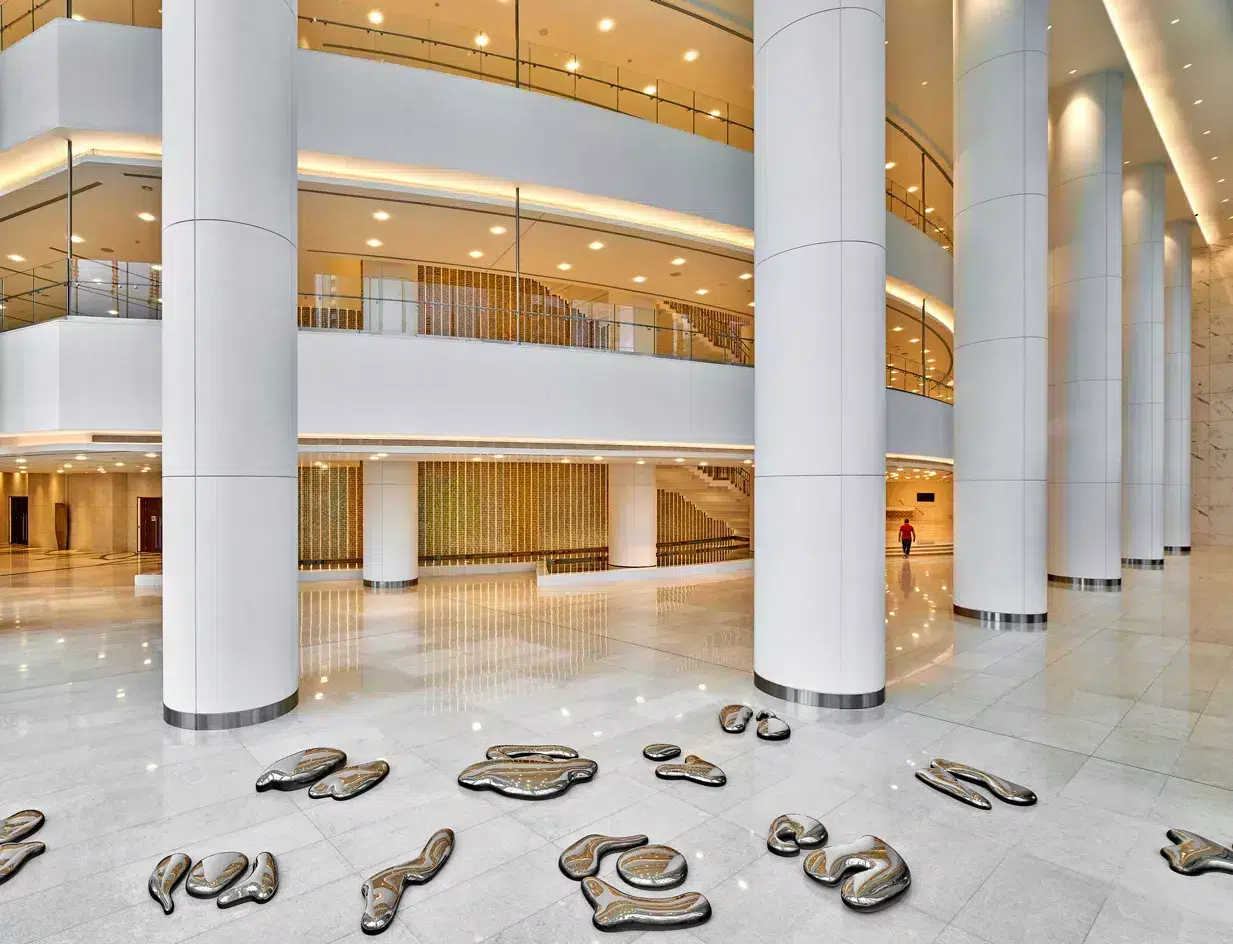
“Art opens the mind to new things, new ideas, it helps you embrace diversity,’ says Ambani, who also sits on the board of The Metropolitan Museum of Art in New York. ‘We have been planning the NMACC for the last nine years and it has finally come to fruition. The intent is to showcase India’s vibrant heritage to the world and, at the same time, bring the best of international art to India.”
X Museum, Beijing
The X Museum is moving to a new location in the Chaoyang District this spring. The new space, designed by architects Studio NOR, is approximately 32,000 square feet in total and will offer visitors an unparalleled museum experience. With a complete renovation of both the interior and exterior spaces, the X Museum’s new location represents a significant brand upgrade for the institution. The new building features a long rectangular footprint, which the architects are responding to with a proposal for a “valley” that runs west to east and serves as the museum’s main circulation path. This will be located under a massive skylight, surrounded by galleries. The museum facade will have metal frames that can host various projects and artworks, making it yet another “exhibition gallery” that will be visible from outside the building.

The inaugural exhibition, titled “X PINK 101,” is scheduled to take place this May and will include international and domestic artists from the X Museum’s collection, such as Nicolas Party, Christina Quarles, and Zhang Zipiao. This exhibition will trace the development of contemporary art over the past century and will feature artists ranging from the pioneering female artist Heidi Bucher in the 1920s to the leading figurative millennial artist Quarles, investigating topics such as body, gender, race, identity, and surreal landscapes. The exhibition will feature artists from over 15 countries and regions and will explore the memories of individuals and collectives, highlighting the diverse cultural patterns of our time. The museum aims to provide visitors with an unrivalled museum experience that showcases contemporary art and cultural patterns from various parts of the world. The X Museum’s new location and inaugural exhibition represent a significant step forward for the institution, and it will be exciting to see how it continues to evolve and grow in the coming years.

Factory International, Manchester
Yayoi Kusama, renowned for her surreal world of dots and pumpkins, brings her largest-ever immersive environment to the soaring spaces of Factory International. Celebrating three decades of Kusama’s pioneering inflatable artworks, the exhibition titled “You, Me and the Balloons” features over 10-meter-tall giant dolls, spectacular landscapes, and a vast constellation of polka-dot spheres. Journey through Kusama’s psychedelic creations and feel part of something greater as she takes us beyond ourselves and asks bigger questions about human existence. Kusama’s ability to conjure wonder and awe is unparalleled, and her immersive environments, such as her Infinity Mirror Rooms, have attracted millions of visitors worldwide. With a career spanning eight decades, Kusama is now a global phenomenon, and this exhibition offers a unique opportunity to experience the vastness of her playful and kaleidoscopic universe. Don’t miss the chance to be transported up and away by Yayoi Kusama’s extraordinary imagination.


Summer Dreams: Artists designed Pools
LVH journal takes a look at how artists play with the unconventional medium of the pool to expand the experience of their art. From Nicolas Party’s tile mirage pool on the Amalfi, to Bernar Venet’s serene garden piscine, eleven artists designed pools that redefine our usual summer swim.
James Turrell, Stone Sky, Napa Valley, California
Stone Sky, 2005, by James Turrell features a view that changes with the seasons, time of day, and weather. A pavilion leads to an infinity pool set against the Napa Valley landscape and the Memento Mori vineyard. What sets Stone Sky apart is its unique access: you swim underwater to enter. Upon emerging, you’ll find yourself in a reflective chamber, where an 8 x 8 square oculus at the center reveals the sky.

Nicolas Party, Positano, Italy
It’s a pool party. Swiss artist Nicolas Party designs his first pool for Le Sirenuse hotel on the Amalfi coast. Party’s inaugural mosaic piece blends blue shades reminiscent of the Mediterranean using tiles crafted by Bisazza, a premier Italian glass manufacturer. Known for his paintings of overlapping mountainscapes, Party aimed to evoke a sense of land, water, and sky merging for the observer.

David Hockney, Private Pool, Los Angeles
David Hockney had his fascination with swimming pools. The pool, painted by Hockney himself, is reoccuring in his work. This pool was at his house, however he also painted a pool at Los Angeles hotel The Roosevelt. The very French “Dufy – esque” marks are a motif he learned to appreciate during his time in Paris. The marks caricature sunlight water. California swimming pools began to appear in his work after his first West Coast trip. His iconic works, such as “A Bigger Splash,” “The Splash,” “A Little Splash,” are some of the most recognizable paintings of the 20th century.

Richard Woods, Little Milton, United Kingdom
Site specific pool by Richard Woods at Albion barn in Little Milton, UK. The coloured porcelain tiles appear like painted wood, giving the 60 foot long pool a pop, comic book illustration appearance. Michael Hue-Williams created the Albion Barn, a contemporary art space in Oxfordshire, England. The barn is known for its domestic and intimate atmosphere, blending together art, architecture, and nature in a unique setting.

Salvador Dali, Private Pool, Costa Brava, Spain
Salvador Dalí resided in the small fishing village of Port Lligat on the Costa Brava. His home, now a museum, showcases the influence of his playful art on his surroundings. He purchased and renovated a small building used for storing fishing equipment, transforming it into a unique home with his wife, Gala. Over 40 years, Dalí expanded the property into a labyrinthine structure of rooms, hallways, gardens, and varying floor levels, all reflecting his distinctive surrealist style. To go along with the play of Surrealism, Dali designed his pool phallic shaped.

Bernar Venet, Venet Foundation, Le Muy, France
Bernar Venet is a renowned French conceptual artist and sculptor known for his striking steel sculptures and mathematical precision. Venet’s home in Le Muy, Provence, a former mill and factory, brings together the industrial past with his monumental steel sculptures. The Venet Foundation was established in 2014 and has a beautiful sculpture park, home not only to Venet sculptures but also to other artists including Donald Judd, James Turrell, and Sol LeWitt.

Niki de Saint Phalle, Capalbio, Italy
Niki de Saint Phalle designed a pool within the Giardino dei Tarocchi, the Tarot Garden. The Tarot Garden is an expansive sculpture garden located just outside the quaint town of Capalbio in the Maremma region, outside of Rome. This site is a pilgrimage destination for art lovers, featuring monumental figures representing the major arcana of the tarot cards.

Ed Rusha, Studio City, California
Ed Rusha’s 1989 pool with his iconic text based work features white tiles arranged to form an underwater registration form, confronting swimmers with blanks for their name, address, and phone number. The pool was photographed exclusively for the inaugural issue of PUSH! magazine in 1991. Ruscha created this piece for his brother’s home in Studio City.

Pablo Picasso, “El Bailarín,”Marbella, Spain
In 1961, Pablo Picasso honored his friend, the renowned flamenco dancer and actor Antonio Ruiz Soler, by painting and signing the bottom of the pool at Villa El Martinete in Marbella, Spain. Antonio was nicknamed was “el Bailarín,” the dancer, and was the original owner of the villa. How the image came to be in the pool is the representative of when Picasso met the animated dancer.

Katherine Bernhardt, Nautilus Hotel, Miami, Florida
Katherine Bernhardt’s pool design at the Nautilus Hotel in Miami. Swim with sharks, socks, bananas, and Sharpies on her pool-bottom mural. The pool was commissioned by Artsy in 2015. Bernhardt also designed towels with prints of toucans and French fries. These works exemplify the New York-based artist’s distinctive style, blending tropical imagery with urban essentials in bold, vibrant colors.

Keith Haring, Carmine Street Mural, New York City
A permanent mural was done by Kieth Haring at the City of New York Parks and Recreation public swimming pool at Carmine Street and Seventh Avenue in Greenwich village. Harring painted the pool mural in 1987 and the mural is part of the Keith Haring foundation. It is closed for renovation but hopefully will be open for a swim soon.

Where do we find ourselves? Land Art’s Dual Tendency
“Where do we find ourselves?” a question Ralph Waldo Emerson asks himself at the onset of his essay“Experience,” feels increasingly relevant in our current social climate. This reflection, that brings about the study of space and human’s position in space, as well as in relation to the land, is the common motif behind the Land Art movement.
Both historically and ideologically tied to conceptual art, the genre relies heavily on the realms of the symbolic, and more recently, there has been substantial discourse and examination about its motivations.Although the movement coincided with the rejection of urban living and an enthusiasm for that which is rural, it simultaneously relies heavily on documentation to be able to exist in public consciousness, creating a controversy regarding Land Art’s dual tendency.
As Richard Long has commented “Nature has always been a subject of art, from the first cave paintings to 20th century landscape photography.” With roots deriving from early archaic references, Land Art has historically and inextricably been linked with the back-to-the land movement and environmentalism. These works, and the spirit in which they were created, are doubtlessly products of the times, as artists were acutely aware of the rise of ecological concerns and a shared appreciation for the land’s vulnerability, asWalter de Maria’s statement implies: “I like natural disasters and I think that they may be the highest form of art possible to experience.”

Land Art as a form of social protest developed in the 1970s and emerged from the trauma of war. As ecology escalated, more artists started to challenge earthworks’ domination of land, reclaiming the meanings of earth and territory ownership. Regardless of whether or not the movement set out to promote these values, the artists acknowledged how the installation of a piece of art in nature demanded the viewers’ attention to its context, and its rising deterioration. As Robert Smithson recognises, “The miner who cuts into the land can either cultivate or devastate it… Depending on how conscious he was of nature in himself and the landscape. A mine could be as natural as wilderness.” Although Smithson sought to distance himself from the literary historians, artists, and environmentalists who responded to the industrial sprawl of the 1950s and 60s conveying land as an intact, pastoral paradise, his work still resonated with many conservationists. Smithson’s installations strived to be an assimilation, an integral part of nature; picturing a fully engineered space that remains as relevant to environmental thought today as it did then.

Although Land Art has previously been associated to American tradition and its perpetual discovery of the land, similar works existed in entirely different geographical contexts. Israeli Artist Micha Ullman’s political commentary “Messer-Metzer,” a piece of Land Art involving digging two equally sized pits on either side of the Israeli-Palestinian border and moving the soil from one pit to the other’s had a pronounced political resonance, and opened a discourse regarding the political and geographical connotations of Land Art. Even the juxtaposition of the word land, with the word art, which references human-made objects, creates a dichotomy that calls for resolution.

Environmental and political commentary aside, modern earthworks, such as Robert Smithson’s Spiral Jetty, were more inclined towards challenging the conventions of where high art belonged, as resistance to the gallery space. During the 60s, artists including Dennis Oppenheim and Walter de Maria sought to liberate sculpture and installation from the podium of the museum space, and thus made work that was inevitably bound to its site. These works were often large-scale and ephemeral – the natural materials used in the artworks tend to decay, wither, melt or fall apart, restricting many pieces to exist in a temporary dimension.

This transient quality encouraged art galleries and museums to exploit the need of camera-use and documentation to capture these works, which consequently created a field of commercial opportunity offered through photographs and moving image. Likewise, large-scale Land Art was often expensive to complete and required financial support from the system that the artist attempted to critique, creating a tension that is the origin of Land Art’s dual tendency. The works’ dependency on the dissemination of documentary photographs in popular media leads us to wonder whether its circulation is a fundamental aspect of Land Art’s existence, and brings up challenges and controversies about the aura and reproduction of the work of art. As Walter Benjamin argued, “even the most perfect reproduction of a work of art is lacking in one element: Its presence in time and space.”

Gerry Schum’s video installation “Land Art,” showing eight artists and their works of art in rural sites, is a commentary on the works’ mediatic dependency – his objective was to expand the message of the emergent movement and sidestep the gallery / collector distribution channels, instead creating a new, modern system of communication. With the participation of artists such as Richard Long, Dennis Oppenheim, Robert Smithson, and Mike Heizer, Schum achieved a prolific critique of artistic conventions, and successfully conveyed that “Art should no longer be made for the privacy or exclusiveness of dealers or collectors.”

Land Art’s purposes can be seen as diverse and at times paradoxical, however, all in all, the movement found new alternatives in using and perceiving time and space. Without a manifesto, the collection of artists and works can hardly be called a “movement,” but rather a group of individuals connected through similar ideas – always challenging the viewer with an aesthetic discourse on our relationship to art, and the land that we live in.
WHY IS LEE UFAN’S ‘DIALOGUE’ SERIES SO IMPORTANT?
Lee Ufan, the famed Korean artist, has become known as the master of the brushstroke. Considered to be one of the most influential painters in South Korea, as well as one of the most important artists working today, Lee has cultivated a distinct style and approach to the act of creation. One series in particular shines through – his Dialogue series.

Raised in a traditional household in a Korea torn by two consecutive wars, Lee Ufan practised the Confucian arts of painting, poetry, and calligraphy as a child before moving to Japan in 1958, where he studied philosophy. Lee is recognised for his unconventional artistic processes—which underscore relationships between viewer, artwork, and the spaces they inhabit—and for philosophical writings that explore these dynamics. Lee has cultivated an oeuvre which taps into concepts of the interconnectedness of consciousness and physical form.

He refers to his artworks as ‘living structures’, taking a philosophical approach to creating them and viewing his raw materials and gestures as entities, each granting some insight into our own lives and our relationship to the world around us. His Dialogue series has tapped into concepts exploring questions of process, material and spatial relationships. Ufan empowers the viewer to take a step back and reflect and meditate on the passage of time and accept that patience and attentiveness to beauty are natural and essential parts of the human experience.
Like the layered philosophy behind the Dialogue series, the preparation and process of creating his paintings is also deeply thought-out and ritualistic. Lee begins each Dialogue work by placing one to three touches of pigment, mixed with glue and crushed stone onto a crisp white canvas. Taking a large brush, Lee distills the act of painting into a solitary moment.

Each painting is created in a highly controlled manner with brushstrokes that relate to the artist’s breath. Each work may take a month or more to complete, focusing on the resonance of space, colour, light, and tension. These paintings introduce gestural strokes as well as unaltered expressionistic elements, including dots and specks of paint. These forms invite communication from the viewer, completing the concept of a dialogue, this series’ name.
At its core, the Dialogue series strips away all the unnecessary facets of mark-making to focus the viewer’s attention on what is directly in front of them. According to Lee, he does not begin his creative process with an idea or image he needs to express; rather he feels he is the conductor of his materials, an equal to them, communicating with the canvas or sculptural objects to create his works.
The Enduring Allure of Pierre Soulages’ Outrenoirs
Soulages is not only the most famous living French painter, he is a giant of painting. Today his work is shown in 110 museums around the world and has been exhibited on every continent. Soulages once said that he was truly born from painting.

In 2019, on the occasion of the artist’s 100th birthday the Musée du Louvre in Paris dedicated a solo exhibition to the artist in the prestigious Salon Carré, the greatest tribute an artist can receive. In November 2018, his painting “Peinture 186 x 143 cm, 23 Décembre 1959” fetched an auction record at $10.6million. Since 2017, the demand for his paintings has skyrocketed. These figures come at no surprise, as it is not unusual to see that by the time celebrated artists reach the age of 99, they often enjoy considerable prestige and celebrity, generating an aura on which museums, galleries and auction houses, have learnt how to capitalize.

In a career spanning decades, Soulages’ radically original and forcefully disruptive body of work has made no reference neither to images nor to language, and yet it is not pure formalism: it accepts that the viewer interprets it freely for himself, as opposed to many of the informal or non-figurative abstract works of the period. In 1948, Soulages wrote this striking formula:
“Painting is an organization, a collection of relationships between forms (lines, colored surfaces) on which the meanings we attribute to it come together and break apart.” -P.S.
From the 1940s to the 1970s, black progressively conquered the surface of his calligraphic-like abstract paintings, which also incorporated subtle hints of colors (mainly ocher and blue). His aesthetics radically shifted towards monochrome in 1979, when he initiated his lifelong series Outrenoir. He has been known as “the painter of black and light” ever since. Literally translating as “beyond black,” Outrenoir opens onto a new realm that transcends purely gestural and monochromatic abstraction. Systematically applied in thick layers on canvas, black paint is meticulously scraped, striated and overall sculpted to create smooth or rough areas reflecting light in various ways. By masterfully turning black into a luminous color, Pierre Soulages powerfully evokes the Genesis of the world, which came out of darkness, addressing the question of meaning.

Emerging at the beginning of the 1970s, after 33 years of painting, or right in the middle of Soulages’ activity between 1946 to today, Outrenoir was a profound disruption that inaugurated a new kid of painting, without interrupting the overall coherency of his oeuvre. As always, since his first works in 1946, and even since his childhood, Soulages interrogated the relationship between light and dark, but from this point on he used the light outside of the canvas, which he considered his own veritable instrument.
“Outrenoir refers to a reflected light that is beyond black, transformed by black. Outrenoir is a black that ceases to be black, instead emitting light, a secret light. Outrenoir is a mental space that is beyond mere black. I attempted to analyze the poetry inherent in my own practice as I created these works and explored their relationship to space and time. The light emitted by the canvas projects a certain aura around the painting, and the viewer becomes part of that space. There is an instantaneity of vision, regardless of the point of view from which you approach the painting; as you move around it, that first vision dissolves, disappears, and is then replaced by another. The canvas is present at the moment you see it.”
——Pierre Soulages, extract from “Les Éclats du Noir: Entretien avec Pierre Encrevé”, in Beaux-Arts Magazine, Hors série, 1996
Among the numerous exhibitions to present this major evolution on all continents, we particularly recall those of Paris (1979), Salzburg (1980), Copenhagen (1982), Tokyo (1984), Melbourne (1989), as well as those of Seoul, Beijing and Taipei (1994), Paris, Montréal and São Paulo (1996), Saint Petersburg and Moscow (2001), New York (2005 and 2014), and the great retrospective at Centre Pompidou in Paris (2009).

Since 2004, Soulages no longer works with oils, but with resins that provide him thicknesses of paint that he had never before attained. A new kind of work with light, via reflection, appeared: on the peaceful clarity of a vast surface of solid black, he engraves one or two very deep scarifications, sensual wide gashes, in which a vivid light settles to further accentuate the mystery. Most recently, Soulages has used the contrast between glossy or semi – glossy black and matte black, offering never before seen views of pictorial light.
“With ‘outrenoir’, the viewer is much more implicated, much more alone. I think that I make paintings so that anyone who looks at them, whether it’s me or anyone else, can find himself in front of a painting, alone with himself. Soulages’ painting, whether on canvas, on paper or expressed in stained glass, in representing nothing, and reflecting nothing, reflects myself back to me. Because it calls for no decoding, no imposition of meaning, it invites me to constitute meaning in myself.”
—— Pierre Encrevé, extract from the lecture by Pierre Encrevé, October 19, 2010 in Rodez, published in its entirety in The Soulages Notebooks, Soulages Museum, September 2015
“The radical originality of Soulages’ outrenoir consists in creating works that are entirely painted with black pigment, yet do not appear monochromatic to the viewer. I’ve called them ‘mono-pigmentary paintings with a chromatic versatility’: in these works, black is no longer a color but rather appears as the source of the light that strikes it, adopting the colors that its environment gives it.”
—— Pierre Encrevé, extract from “Alight in our darkness”, published in Soulages in Japan, Perrotin publishing, 2017
“What I consider real light is not optical, physical light; the light that affects me most profoundly is another type of light, one that emerges from the shadows… What’s important is the light that comes from the darkness, from the darkness that we each have within us. The light that moves me is the light of the night, the night that we each carry within ourselves.”
—— Pierre Soulages in conversation with Pierre Encrevé, January 12, 2013 and November 22, 2013, published in Soulages in Japan, Perrotin publishing, 2017

The information included in this Journal Post with regards to the Outrenoir paintings has been gathered from Galerie Perrontin’s website.