

(index.php)
5 MONUMENTAL ANTONY GORMLEY SCULPTURES AND WHERE TO FIND THEM
The Turner Prize-winning artist Sir Antony Gormley has become synonymous with British contemporary sculpture inciting a regeneration of interest in the human form on both intimate and monumental scales.
His work is concerned with the space we inhabit within and without our bodies, making us question not only how we perceive sculpture, but also how we perceive our own bodies and the spaces we occupy. Indeed, Gormley describes his work as ‘an attempt to materialise the place at the other side of appearance where we all live.’ In this way, he attempts to treat the body not as a thing but a place to identify a condition common to all human beings. To further emphasise on this idea, the British sculptor has a tendency to place his sculptures around the world in site-specific locations, as for him, the location of the piece is as important as the piece itself.

Inside Australia
Inside Australia, 2003 is installed on the western end of Lake Ballard in Western Australia, consisting of 51 life-size in height human figures positioned about 750 metres apart. The horizon is flat for most of its 360 degrees, and there is an iron stone mound 120 feet high that allows a vantage point from where you can see the entire installation. As people move across the work, they leave a tracery or drawing of connecting lines between the works across the sharp whiteness of the lake. This is a sign of the viewers’ participation in the work which changes, as does the sky, throughout each interval of the year.
“The works are like tuning forks which allow one to see an implicit attitude that is normally hidden by the accidents of appearance. The core set of the body is revealed; a concentration in mass of the darkness of the body. I was trying to achieve the highest level of tension between mass and space with highly concentrated and individualised body forms distributed sparsely across this chemical surface.”
Antony Gormley

Angel of the North
Built in 1998, the Angel of the North is a majestic, giant figure of an angel placed in Gateshead, near the A1, the road connecting London with Edinburgh. Dominating the skyline, this 20-metre tall sculpture has become as much a part of Gateshead’s identity as the Statue of Liberty is to New York. Since it first spread its wings in February 1998, it has become one of the most talked about and recognisable pieces of public art ever produced. According to Gormley, the significance of an angel was three-fold: first, to signify that beneath the site of its construction, coal miners worked for two centuries; second, to grasp the transition from an industrial to an information age, and third, to serve as a focus for our evolving hopes and fears.

Exposure
Taking over the landscape at 25 meter high, Antony Gormley’s Exposure, 2010 sculpture is rooted to ground in central Netherlands, reacting over time to the changing environment. Gormley placed his isolated squatting figure on a thin piece of land between the Dutch town of Lelystad and the sea. With time, as the water levels rise, the sculpture will gradually be buried in water.
“My concept of how sculpture works in the landscape is that it is a still point in a moving world. The whole idea of Exposure is that this work, made at a particular time, rooted to ground, reacts over time to the changing environment. One of the known environmental changes that is currently happening is the rising of the sea level through global warming. It is critical to me that at the time of its making, this work reacts with the viewer, the walking viewer on the top of the polder, and that the surface that the viewer stands on is the surface that the work stands on. The work cannot have a plinth. Over time, should the rising of the sea level mean that there has to be a rising of the dike, there should be a progressive burying of the work.”
Antony Gormley

Sound II
This mysterious life-size statue of a man contemplating the water held in his cupped hands is actually a plaster cast of the artist’s own body, placed in the Winchester Cathedral crypt, which floods during rainy months, in fact, this silent sentry in the crypt below the large Gothic cathedral is often knee-deep in water.
‘How do you make memory? What is the relationship between memory and anticipation? Can you make something that is physical which at the same time evokes the process of remembering? Is it possible to do this and make something fresh, like dew or frost – something that just is, as if its form had always been like this.’
Antony Gormley, Thoughts on Domain FieldThe installation of the sculpture was part of an effort by the cathedral to introduce contemporary art into the Gothic masterpiece. Know before you go, Winchester is 70 miles southwest of London, near Southampton. The Cathedral is open every day of the year.

Another Place
Another Place, 1997 is located at Crosby Beach in Liverpool, England. The installation consists of 100 cast iron figures facing towards the sea. The figures are modelled on the artist’s own naked body. Each and every sculpture faces out towards the horizon. The installation stretches over three kilometres of the shore and as far as one kilometre out to sea. Depending on the tide, the figures are more or less visible. At times water reaches up tot heir necks. This piece is another example of the artist’s dialogue with landscape and time.
“The sculptures are all standing in a similar way, with the lungs more or less inflated and their postures carrying different degrees of tension or relaxation. The idea was to test time and tide, stillness and movement, and somehow engage with the daily life of the beach. This was no exercise in romantic escapism. The estuary of the Elbe can take up to 500 ships a day and the horizon was often busy with large container ships.”
Antony Gormley

5 WORKS THAT DEFINED THE FOUNDATION LOUIS VUITTON’S ROTHKO SHOW
As the art world gathers in Paris for Paris+ Art Basel, the doors to a monumental retrospective on one of the most important artists of the 20th century opens its doors.
For many, Mark Rothko is synonymous with colour field painting—large swaths of red and burnt umber that float above moody monochrome-like backgrounds. But he did not arrive at that style overnight, and the Fondation Louis Vuitton is tracing his evolution with a grand exhibition spread across four floors of its museum’s Frank Gehry–designed building. We’ve taken a closer look at five works – all included in this historic retrospective – that defined the career and artistic evolution of Rothko.

Often overlooked, the exhibition opens with Rothko’s origins as an artist – intimate scenes and urban landscapes such as visions of the New York subway – that dominate Rothko’s output in the 1930s, before his transition to a repertoire inspired by ancient myths and surrealism which Rothko uses to express the tragic dimension of the human condition during the War.
In 1923, Rothko gave up his studies at Yale University and moved to New York City. There he spent hours at the Metropolitan Museum of Art and attended classes at the Art Students League, briefly studying under American Cubist, Max Weber. In the late 1920s, he met the modernist painter Milton Avery, whose simplified and colorful depictions of domestic subjects had a profound influence on Rothko’s early development. At this time, Rothko was particularly interested in Self-portrait by Rembrandt from the National Gallery of Art in Washington especially caught his eye and echoed in Rothko’s Self-Portrait from 1936.

From 1946, Rothko makes an important shift towards abstract expressionism. The first phase of this switch is that of Multi-forms, where chromatic masses are suspended in a kind of equilibrium on the canvas. Gradually, these decrease in number, and the spatial organization of his painting evolves rapidly towards Rothko’s “classic” works of the 1950s, where rectangular shapes overlap according to a binary or ternary rhythm, characterized by shades of yellow, red, ochre, orange, but also blue, white. In the pivotal year of 1949, Rothko distanced himself from his Surrealist-inspired work of the 1940s and began to explore pure abstraction by painting soft-focus squares in diaphanous colours. 1949 is also the year that Matisse’s 1911 painting The Red Studio, in which the artist’s room is subsumed by a brilliant field of solid Venetian red, went on view at the Museum of Modern Art. This work represents the transitional phase in Rothko’s artistic development.

On the museum’s ground floor, visitors are immediately thrust into Rothko’s breakthrough to colour field abstraction, with a room dedicated to canvases produced during the 1950s, when the Rothko we know now emerged. These 1950s works, in contrast to his earlier figurative explorations, exude brightness and levity. At the heart of this ground floor is Rothko’s luminescent’Light Cloud, Dark Cloud’ (1957), which in many ways encapsulates each of the characteristics of this decade in Rothko’s artistic development.

In early 1958 Rothko was commissioned to paint a series of murals for the exclusive Four Seasons restaurant in the Seagram Building in New York, designed by Mies van der Rohe and Philip Johnson. Rothko was interested in the possibility of having a lasting setting for his paintings to be seen as a group. He wanted to create an encompassing environment of the sort he had encountered when visiting Michelangelo’s vestibule in the Laurentian Library in Florence in 1950 and again in 1959:
“I was much influenced subconsciously by Michelangelo’s walls in the staircase room of the Medicean Library in Florence. He achieved just the kind of feeling I’m after – he makes the viewers feel that they are trapped in a room where all the doors and windows are bricked up, so that all they can do is butt their heads forever against the wall.”

Mark Rothko’s ‘Dark Paintings’ of 1969-1970 are by far some of his most misunderstood works. As the artist neared the final years of his life, his palette took an unexpected, monochromatic turn. Rothko abandoned his bright, vibrant hues in favour of a series of grey, black and white canvases. Often assumed by the general public to be a visual reflection of his deteriorating mindset and depression, the artist himself and the critics regarded the series as his “most profound” work, a magnificent culmination of decades of exploration of the abstract. Foundation Louis Vuitton have dedicated a room to Rothko’s Dark Paintings, directly asking viewers to “avoid associating the use of greys and blacks with depression and suicide”. They have displayed his Dark Paintings alongside Alberto Giacometti’s large-scale sculptural figures, creating an environment that is close to what Rothko had in mind for a UNESCO commission that was never realised.
14 Artists We Loved in 2022
As innovating as ever, the art world is taking advantage of new technologies, while recognizing the importance of the natural environment, and making time for nostalgia in equal measure. Here is our guide to captivating artists that we loved in 2022.
Solange Pessoa
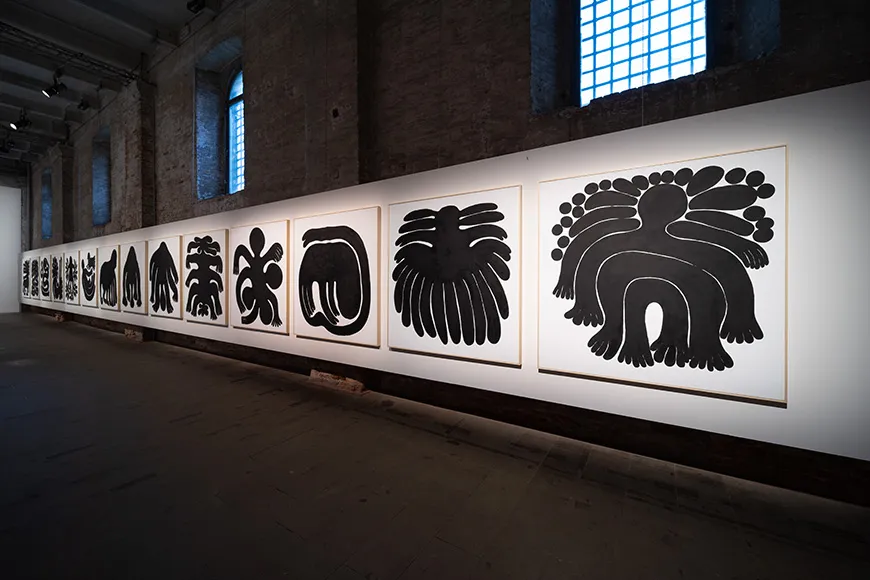
Solange Pessoa creates immersive, sublime and emotional experiences with her work. She adopts a visceral and astounding relationship with her local landscape in south-eastern Brazil. This year she represented Brazil at the Venice Biennale, with her Sonhíferas series, that consists of bold black and white drawings alongside a series of carved soapstone sculptures (pedra-sabão).
Pessoa was also featured in a collective exhibition at Palais de Tokyo later this year, Réclamer la terre. This exhibition was about starting a dialogue around ecologic emergency, which is more and more relevant in today’s landscape.

Alex Katz
Alex Katz emerged at the opening of Gathering at the Guggenheim. This retrospective exhibition shows works from the 1940s to the present, and his creative continuity was portrayed eloquently in Guggenheim’s spiral ramp. Having lived and worked in New York for most of his life, the artist’s collection has become a record of the city’s creative scene.

Anne Imhof
Imhof is considered the artistic voice of the new generation. This year, the artist’s work was featured in Miami Art Basel by Sprueth Magers, alongside a solo exhibition at their London galleries, Avatar II, where Imhof displays a restrained approach to installation art.

Her exhibition YOUTH at Stedelijk Museum marked her first solo exhibition in the Netherlands and welcomed the viewers for an immersive experience.

Jiang Cheng
Jiang Cheng’s works are informed by the process of conceptualism and by his strategies of repetition. His latest exhibition at the ICA takes place in the museum’s Ray Ellen and Allan Yarkin space that is especially dedicated in support of important emerging artists. The artists first institutional presentation features a selection of new and recent paintings that build on Cheng’s exploration of the psychological force of portraiture.


Harminder Judge
Harminder Judge’s most recent body of work engages with the history of Indian abstract painting, and borrows techniques from Italian fresco and Indian reverse glass painting.

Following his solo exhibition, at the Sunday Painter, ‘Harminder Judge: Rising Skin from Rock and Chin’, his new works were featured in a solo booth curated by the gallery at Frieze London. Judge was part of a group exhibition later this year at Blindspot Gallery in Hong Kong, ‘New Beginnings’.

Brice Guilbert
Guilbert’s works are created from memory, in attempts to capture his encounters of the volcanic landscape of his home. Abstraction is the manner in which Guilbert can convey a spiritual and philosophical understanding of nature.

This year, Guilbert had a solo exhibition at Pace Gallery, titled Fournez where a new body of works were beautifully displayed, alongside being praised for his unique approach to Abstract art by numerous publications and auction houses.

Doron Langberg
An increasingly prominent voice among a new generation of figurative painters, Doron Langberg is renowned for his often large-scale works that are luminous in color and portrays sense of intimacy.

Langberg was featured in Victoria Miro’s booth in Miami Art Basel this year and presented a beautiful display at Rubell Museum.

Ha Chong Hyun
Predominantly known for his Dansaekhwa paintings, Ha Chong-Hyun has devoted his lifelong career to exploring and understanding materials and their properties. The artist’s works were displayed in an astonishing retrospective curated by Sunjung Kim, at Fondazione Bevilacqua la Masa, in Venice.

Ettore Spalletti
Spalletti’s works embody continued investigations into the use of color and light, he explores the system of color effects that provoke a serious of questions about the rigid order of forms and volumes, shifting attention from the surface of painted images to the painting of surfaces of objects.

Spalletti was featured at Paris Art Basel, and at Diocesan Museum alongside historical pieces in Naples creating a dialogue between ancient and contemporary art.

Wolfgang Tillmans
Wolfgang Tillman’s creative process is based on a irrepressible curiosity, extensive research and an everlasting engagement with the technical and aesthetic potential of the medium of photography. His visual language is expressed by a close observation that explores a deeply human approach to our surroundings.

This year the artist had his first museum survey at MoMA, New York that encapsulated his practice at its best.

Rachel Jones
Rachel Jones disrupts art spaces with stunning yet unsettling abstractions. Following her exhibition “SMIIILLLLEEEE” at Thaddeus Ropac last year, the artist’s works were beautifully displayed at her solo exhibition “say cheeeeese” at Chisenhale Gallery, in London.


Simone Leigh
Simone Leigh’s practice embodies sculpture, video, and installation all informed by her ongoing exploration of black female-identified subjectivity. Leigh representing the United States this year at the Venice Biennale, has received praise for her installation, ‘Brick House’, and was honored with the Golden Lion Prize.

Poppy Jones
Jones transfers her own closely cropped, photographic imagery onto intimately sized panels of recycled suede, silk and leather through a process of monotype printing and overpainting. Nuanced shifts in colour and tone are unique to each work, creating unforeseen interactions with her often familiar subject matter. In this way, Jones celebrates the ephemeral nature of the everyday, prompting a reconsideration of the fleeting and discarded.

Jones had a solo exhibition this year at Mai 36 Gallery in Zurich, featuring 14 works of the artist.

Klára Hosnedlová
Being part of the first post-Communist Czech generation, Hosnedlová fuses elements of science fiction, technology and the natural world in her charged, narrative. Inspired by ‘novel spaces’, including the ’60s and ’70s Modernist and Brutalist architecture of Central Eastern Europe, Hosnedlová combines performance, sculpture and embroidered painting in works which can be understood as a single artwork entity.

Recently joining White Cube, Hosnedlová’s next solo exhibition ‘To Infinity’ opens at Kestner Gesellschaft, Hanover, in early 2023.

15 What’s Up Artists With Institutional Shows This Year
Gerhard Richter: Painting After All
at The Metropolitan Museum of Art, New York
March 4th – July 5th 2020
The exhibition Painting After All features the artist’s six decade-long preoccupation with the twin modes of painterly naturalism and chromatic abstraction, in relation to photographic and other representational iconographies.

Yayoi Kusama: Infinity Mirrored Rooms
at Tate Modern, London
May 11th 2020 – May 9th 2021
Step into infinite space will present a rare chance to experience two of Kusama’s most breathtaking immersive installations, creating the illusion of a boundless universe. Infinity Mirrored Room- Filled with the Brilliance of Life and Chandelier of Grief, will be exhibited together with a small presentation of photographs.

Adam Pendleton: Who is Queen?
at MoMA, New York
July 25th – October 4th 2020
The Museum of Modern Art will present this summer Adam Pendleton: Who Is Queen?, a large-scale multimedia installation that will transform the museum’s atrium into a theatrical stage, bringing the formal mechanics of musical counterpoint into contact with the aesthetics of protest.

Tracey Emin / Edvard Munch: The Loneliness of the Soul
at The Royal Academy, London
November 15th 2020 – February 28th 2021
Tracey Emin took an interest in Munch from a young age: “I’ve been in love with this man since I was eighteen”. The Loneliness of the Soul will reveal the way in which Munch has been a constant inspiration and will showcase Emin’s wide-ranging skills as an artist.

Alex Katz
at Museo Thyssen Bornemisza, Madrid
June 23rd – October 4th 2020
For the first time in Spain, the museum will be presenting a retrospective on the American painter Alex Katz. The display will include around 30 large-format oils accompanied by various studies, offering a survey of the artist’s habitual themes.

Alicja Kwade: Kausalkonsequenz
at the Langen Foundation, Düsseldorf
April 20th – September 20th
Alicja Kwade’s sculptural work will be displayed in the backdrop of the prestigious Langen Foundation later this year. Designed by renowned architect Tadao Ando, the foundation’s concrete, grand galleries make a striking setting for Alicja Kwade’s work, which invade the space to trick the audience’s perception, experimenting with space and time, exploring what is real and what is not.

Antony Gormley: FEEL
at Busan Museum of Art, South Korea
until April 19th 2020
The Busan Museum of Art in Korea is showing a solo exhibition by Antony Gormley titled Feel and representing the inaugural event in a new series of exhibitions called “Lee Ufan and His Friends” that will begin to take place at Lee Ufan’s space.
Andy Warhol
at TATE Modern, London
March 12th – September 6th 2020
Popularly radical and radically popular, Warhol was an artist who reimagined what art could be in an age of immense social, political and technological change. This major retrospective is the first Warhol exhibition at Tate Modern for almost 20 years, including works never seen before in the UK.

Dan Flavin
at ICA, Miami
until April 12th 2020
Building on Puerto Rican light (1965) in the museum’s permanent collection, one of the artist’s early signature fluorescent tube light sculptures, ICA Miami is presenting a focused presentation of his works from the mid-1960s.

David Hockney: Drawing from Life
at the National Portrait Gallery, London
February 27th – June 28th 2020
David Hockney: Drawing from Life, will explore Hockney as a draughtsman from the 1950s to the present by focusing on depictions of himself and a small group of sitters close to him: his muse, Celia Birtwell; his mother, Laura Hockney; and friends, the curator, Gregory Evans, and master printer, Maurice Payne.

Thomas Ruff
at K21, Düsseldorf
May 9th – August 16th 2020
This exhibition will focus on Ruff’s photographic series from the past twenty years. For his often large-format images, the artist often used found photographs from a wide variety of sources, hence, the exhibition will not only offer an overview of Ruff’s work, but also of nearly 170 years of photographic history.

Katharina Grosse: It Wasn’t Us
at Hamburger Bahnhof, Berlin
April 24th – October 4th 2020
For her upcoming exhibition It wasn’t Us, Katharina Grosse will use the historical hall of the Hamburger Bahnhof, including its walls, floors and ceilings to conceive a three-dimensional atmosphere of vibrating colour that will radically renegotiate the existing order of the space of the museum.

Alexander Calder: Modern from the Start
at MoMA, New York
Sep 13th 2020 – Jan 2nd 2021
Modern from the Start looks at Calder’s work through the lens of his connection with MoMA. Drawn from the museum’s collection and augmented with key loans from the Calder Foundation, this exhibition covers the full scope of Calder’s work, from the earliest wire and wood figures to the monumental abstract sculptures of his later years.

Do Ho Suh: 348 West 22nd Street
at LACMA, Los Angeles
until March 29th 2020
Best known for his full-size, fabric reconstructions of his former residences in Seoul, Berlin and New York, Suh’s creations address issues of home, displacement, individuality, and collectivity, articulated through the architecture of domestic space. A recent gift to LACMA, 348 West 22nd Street replicates the artist’s residence in New York.

Laure Prouvost: Deep See Blue Surrounding You
at Les Abattoirs, Toulouse
until May 31st 2020
If you missed the French pavilion at the 58th edition of the Venice Biennial last year, you still have a chance to see it at Les Abattoirs in Tolouse. In Deep See Blue Surrounding You, the artist Laure Prouvost has conceived a liquid and tentacular pavilion structured around a reflection on who we are, where we come from, and where we are headed.

Nine artists on the complexity of form, light and colour
Earlier this year Loie Hollowell, one of our favourite female painters, curated a group show at Grimm Gallery titled “Romancing the Surface”.
The exhibition brought together nine artists who explore through their work “esoteric ideas surrounding the body, the primal nature of materials and the complexity of form, light and colour”. Contextually varied and executed through a myriad of practices, these artists explore the sensorial dynamics of materiality in relation to the physical nature of both painting and sculpture. For our latest line up of artists to watch, we shine a light on their work and practice. Remember their names because you are certain to hear them often in the near future:
Angela Heisch
Angela Heisch looks to nature in her paintings. Through investigating the natural world, Heisch hopes to replicate the balanced beauty of organic compositions in her own work via repetition and patterns. Heisch paints psychological spaces, or a subconscious reality through which the viewer can pass. With uncanny precision, the abstract paintings play with perfection and perceived perfection, revealing and concealing biomorphic symmetry.


Daniel Sinsel
Daniel Sinsel’s paintings explore shape, object-hood and the erotics of space. Sinsel manipulates the viewer’s sense of perspective and material by using tromp l’oeil techniques combined with assemblage. He redesigns decorative motifs into various forms with technical virtuosity while investigating virtual space until it becomes an emotional and semantic flow.


Louise Giovanelli
Louise Giovanelli’s delicate, luminous works explore the fidelity of images through a meticulous representational style influenced by early Renaissance painting. She has an unsentimental approach, more concerned with the immediate experience of seeing than projected meanings and associations. The subjects of her paintings are primarily chosen for their formal qualities and include film stills, vintage photographs and architectural elements and ornamentation, which are rendered in a precise and layered approach.

Thaddeus Mosley
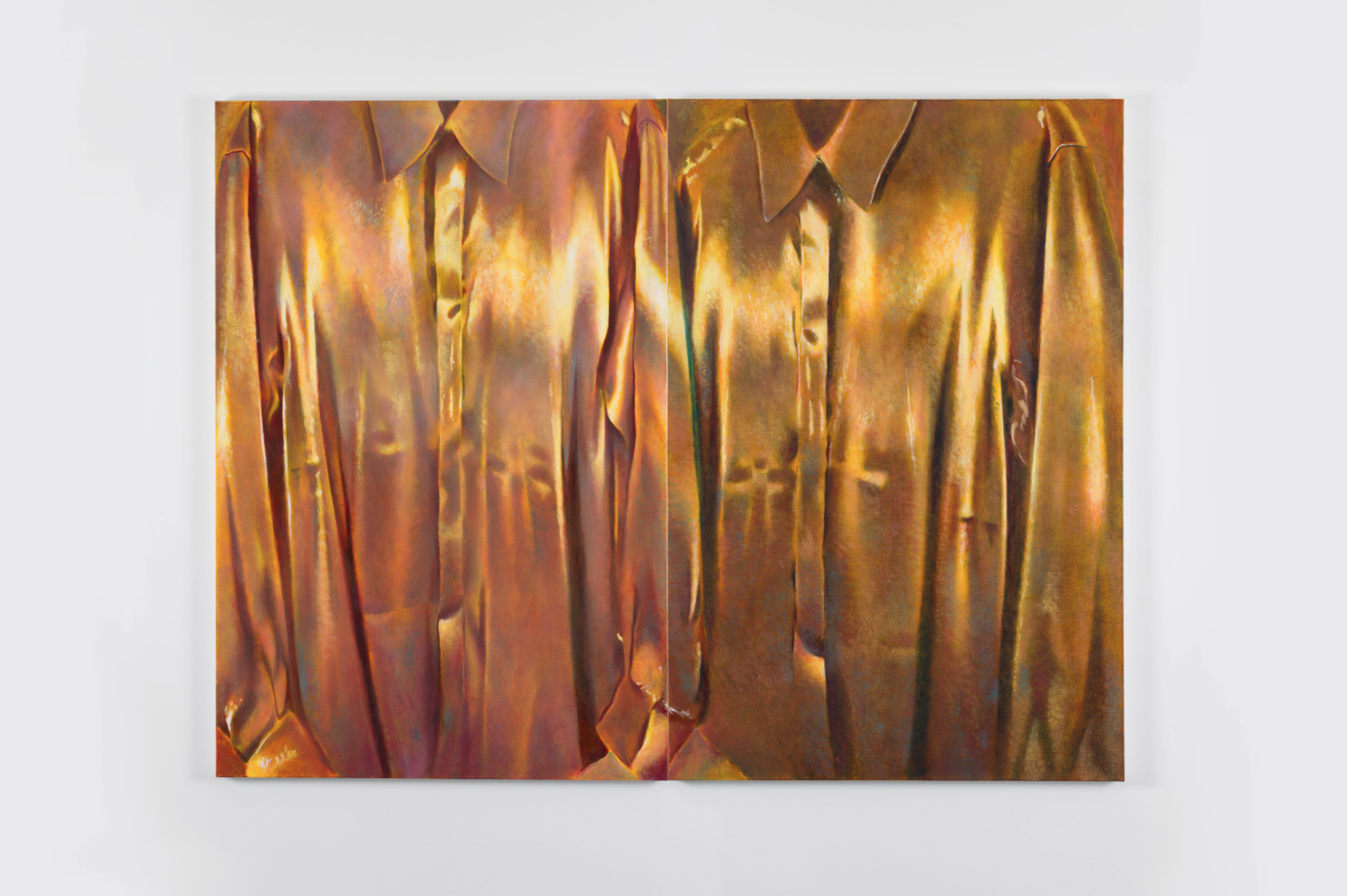
Thaddeus Mosley is an autodidactic sculptor who makes large abstract works composed of multiple, carefully assembled pieces of salvaged wood. Mining local sawmills, building facilities and the city’s Forestry Division in the environment of his hometown Pittsburgh, Mosley gives new life to objects that already carry an urban history. Using only a mallet and chisel, he reworks the timber into biomorphic forms. These “sculptural improvisations,” as he calls them, take cues from the modernist traditions of jazz.

Camille Henrot
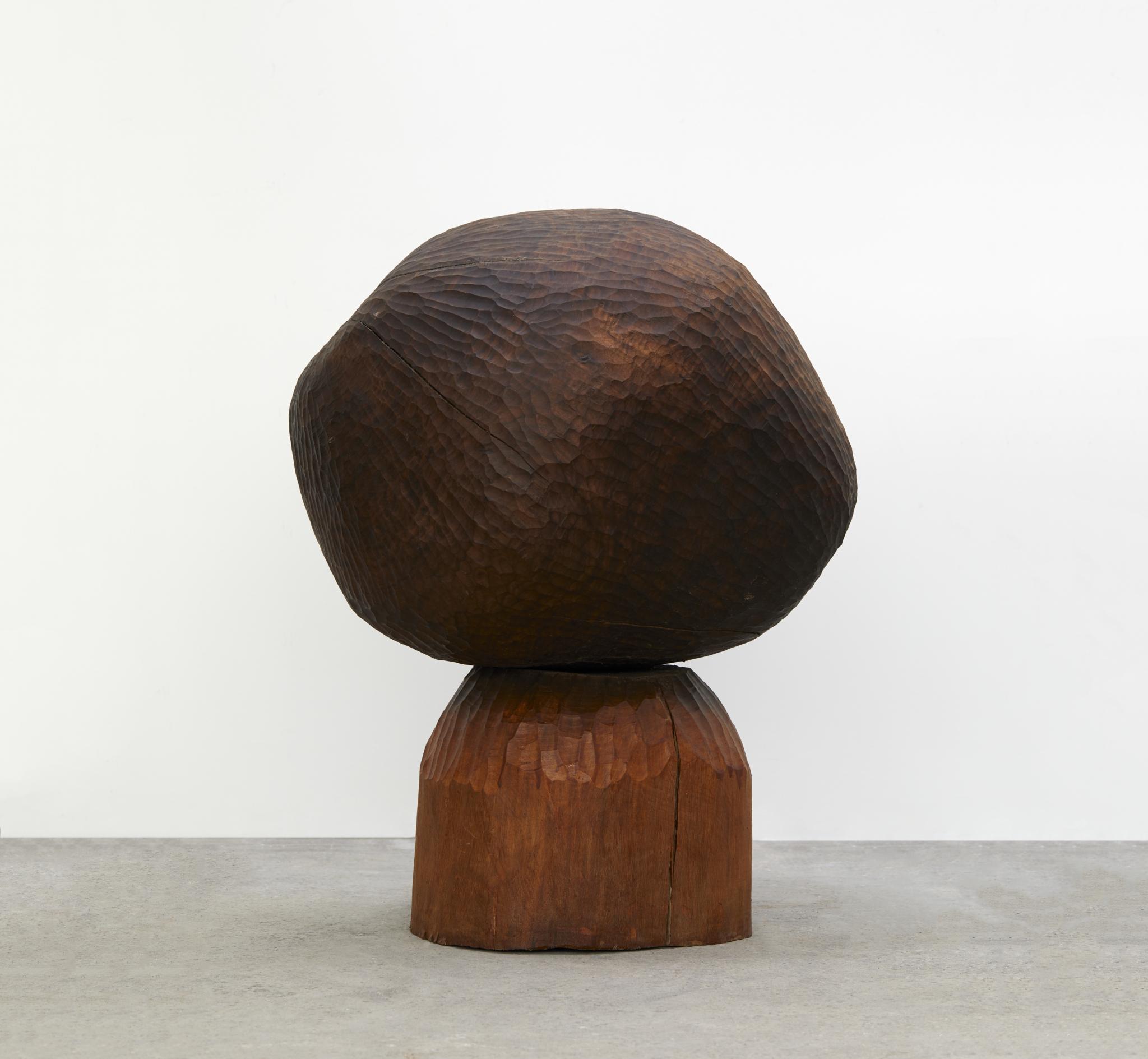
Camille Henrot’s paintings underscore her ever-developing exploration of power dynamics on both personal and social levels. Despite the generous simplicity Henrot arrives there through deep research and reading. Events from life occasionally sneak into her works, however these are never meant to be autobiographical. Choosing instead what she describes as ‘common material, about how the ego relates to totality’. The works interweave the external systems that influence the structure of our lives, with the unconscious internal works of dreams and fantasies.


Matthew Ronay
Matthew Ronay’s sculptures have a sensual aura and transmit ideas of processes happening in nature; penetrating, gestating, twining, and evolving. The works appear to be soft, yet are made of wood. With their vibrant colours, they cohabitate a world of peculiar abstraction: Dealing with sexuality, growth, death and decay, their organic forms oscillate between the primordial and futuristic.


Lui Shtini
Lui Shtini makes drawings and paintings which show a complex relationship between surface, material and medium. His work shows organic forms that are reminiscent of body parts that could also be landscapes, at the same time remaining abstract. These anthropomorphic shapes are rendered with sharp attention to detail, while using layers and unusual textures to create light, space and three-dimensionality.


Sascha Braunig
Sascha Braunig’s paintings originate from still lives she creates in her studio, although their appearance belies her process of painting from direct observation. Braunig uses clay modelling in combination with vivid hues to render plastic-like forms, while projecting a luscious surface tension that never lets the viewer rest at ease. Braunig investigates the restraining confines of the canvas through a haunting mixture of references to stage performance, portraiture, Surrealism, and luminescent abstraction.


Loie Hollowell
Loie Hollowell’s paintings radiate with energy stemming from an ongoing stream of consciousness. Taking the body as a starting point she creates a new visual, abstract, language that captures the overarching themes of the intimate relationship between the body, the self, sex, time, and space. The paintings are built-up as wall reliefs from which an internal logic and subject matter gradually unfold. Their curvaceous surfaces break down the formal barrier between painting and sculpture.


7 Inspiring Books to Understand the Dynamics of the Art World
Here is our curated list of books to learn about art history, cultural movements and the art market:
Boom: Mad Money, Mega Dealers, and the Rise of Contemporary Art
by Michael Shnayerson
This book is perfect for someone who wants to understand the current dynamic of the art market and what brought us here. Dealers operate within a private world of handshake agreements, negotiating for the highest commissions. Michael Shnayerson, a longtime contributing editor to Vanity Fair, writes the first ever definitive history of their activities. He has spoken to all of today’s so-called mega dealers-Larry Gagosian, David Zwirner, Arne and Marc Glimcher, and Iwan Wirth. This kaleidoscopic history begins in the mid-1940s in genteel poverty with a scattering of galleries in midtown Manhattan, takes us through the ramshackle 1950s studios of Coenties Slip, the hipster locations in SoHo and Chelsea, London’s Bond Street, and across the terraces of Art Basel until today. Now, dealers and auctioneers are seeking the first billion-dollar painting. It hasn’t happened yet, but they are confident they can push the price there soon.

Just Kids
by Patti Smith
In this autobiographical book, the writer and poet Patti Smith conjures a beautiful tribute to the life she shared with artist Robert Mapplethorpe. The book covers every chapter of their story and oeuvre, starting with their romantic affair as two young starving artists in New York, to the beginning of the most genuine and ever lasting friendship. Patti Smith and Robert Mapplethorpe lived together in the Chelsea Hotel, the Mecca of art in New York City at the time for artists, writers and musicians, where Smith and Mapplethorpe promptly installed themselves as visible members of the hotel community. Their romantic affair ended at a young age, as Robert soon discovered his homosexuality, yet their loving friendship and artistic connection lasted a lifetime, constantly inspiring and feeding from one another. The result is a legacy of unparalleled genius, legacy that Patti Smith has stunningly put into words in this great novel, adding yet another masterpiece to their artistic offspring.

The Auctioneer, Adventures in the Art Trade
by Simon de Pury
In this autobiographical book, Simon de Pury, the ultimate art player, walks us through his exhilarating career. The former Chairman of Sotheby’s Europe, and former owner of Sotheby’s rival Phillips de Pury, and currently a London-based dealer and advisor to great collectors around the world, Simon has one of the highest profiles in the art world. Even though he has an ancient title and the aura of an elegant Swiss banker, Simon is famous as an iconoclast and is known as “The Mick Jagger of Auctions” for his showmanship and exuberance. His whole life in art has been devoted to bringing art to the public and to the juxtaposition of high and low. Movie stars, musicians, and athletes compete with hedge funders and billionaires for the great art, and Simon is their pied piper; he wants to turn the world onto art.

What Are You Looking At?: 150 Years of Modern Art in the Blink of an Eye
by Will Gompertz
Written by the BBC Arts Editor and former director of London’s Tate Gallery Will Gompertz, this book is a wonderfully lively, accessible narrative history of Modern Art, from Impressionism to the present day. What is modern art? Why do we either love it or loathe it? And why is it worth so much money? Will Gompertz takes us on a dazzling tour that will answer all these questions whilst providing a tour through all the art movements that have shaped art history from the late 19th century until today. From Monet’s water lilies to Van Gogh’s sunflowers, from Warhol’s soup cans to Hirst’s pickled shark, in this book you will find all the stories behind the masterpieces, meet the artists as they really were, and learn everything you need to know about modern art history in a rather entertaining way.

The White Album
by Joan Didion
The White Album is a whimsical collection of essays by, arguably, America’s greatest 20th century author, Joan Didion. In this magically crafted book, Didion describes in detail into the foundations of American culture of the 60’s and 70’s, exploring every aspect of the country’s society and translating it into her unique writing style. Didion’s groundbreaking life takes her from sharing a studio with the legendary rock and roll band, The Doors, to becoming acquainted with the artist Georgia O’Keefe on the early days of the feminist movement. Joan Didion arrived in Los Angeles in 1964 on the way to becoming one of the most important writers of her generation, a cultural icon who changed L.A.’s perception of itself. Examining key events, figures, and trends of the era, through the lens of her own spiritual confusion, Joan Didion helped to define mass culture as we now understand it. Written with a commanding sureness of tone and linguistic precision, The White Album is a central text of American reportage and a classic of American autobiography.

Duveen: The Story of the Most Spectacular Art Dealer of All Time
by S. N. Behrman
A startling number of masterpieces now in American museums are there because of the shrewdness of one man, Joseph Duveen, art dealer to John D. Rockefeller, Andrew Mellon, Henry Clay Frick, and William Randolph Hearst. In a series of articles originally published in The New Yorker, playwright S.N. Behrman evokes the larger-than-life Duveen and reveals the wheeling and dealing, subterfuge, and spirited drama behind the sale of nearly—but not quite—priceless Rembrandts, Vermeers, Turners, and Bellinis.

The $12 Million Stuffed Shark: The Curious Economics of Contemporary Art
by Donald Thompson
Intriguing and entertaining, The $12 Million Stuffed Shark is an approach to the economics and psychology of the contemporary art world. Why were record prices achieved at auction for works by 131 contemporary artists in 2006 alone, with astonishing new heights reached in 2007? Don Thompson explores the money, lust, and aggrandizement of the art world in an attempt to determine what makes a particular work valuable while others are ignored.

10 Figurative Painters On Our Radar
Nicolas Party
Swiss-born artist Nicolas Party works across a wide range of different media. Primarily known for his colour-saturated paintings and murals, he also makes painted sculptures, pastels, installations, prints and drawings, and works as a curator. Party often paints portraits and still lifes of everyday objects, which he strips of all extraneous detail. Rather than creating faithful depictions from nature, he uses these seemingly innocuous subjects as springboards for an exploration into the art of painting itself. His concerns lie, therefore, less in the accurate depiction of nature, and more in its translation and transformation through colour, materials and composition. Painterly precision, a vibrant colour palette and a keen eye for composition coalesce into works that are accessible and seductive but, at the same time, continue a long standing art-historical dialogue between observation and the imagination. Party is also interested in the power of paint to alter our perception of the built environment and, within a gallery context, how we experience art.

Peter Uka
Peter Uka (Nigerian, born 1975), is based in Germany, where he completed his studies in 2017 as a Meisterschüler (Master Student) under artists such as Tal R and Eberhard Havekost. At the Kunstakademie in Düsseldorf Uka honed his practice of painting realistically with little reliance on photographs, and interim began to introduce abstraction and figuration into his work. Impeccable in detail, the figures therein exude a veritable self-confidence, irrespective of social demarcations. The mix of compositions capture the international reach of trends from the late 20th century and the ways in which ideas of “home” are enmeshed. Together, these narratives uncover historical precedents of globalization and dynamic cultural signifiers connecting two countries that Uka calls home, while reminding the rest of the world of collective reciprocity, closeness, and connection.

Daniel Richter
Daniel Richter is a German artist known for his large-scale paintings inspired by mass media and contemporary culture. Borrowing themes from both Christianity and German history, Richter constructs his contemporary scene with theatrical flair: his figures are staged in Baroque composition, their outlandish costumes and mask-like faces lend an element of surreal spectacle. The fervent emotion of grand drama is carried through Richter’s frenetic style of painting: thick brushwork battles with translucent drizzles and impassioned smears; acid tones are electrified against the sombre ground. Reminiscent of Ensor’s nightmarish crowds, Richter infuses this street scene with apocalyptic celebration.

Somaya Critchlow
Somaya Critchlow is a British artist whose figurative paintings of women explore facets of race, sex and culture through an instinctive, stream-of-consciousness process of image making. Working mostly on a small scale, her works depict bold, curvaceous and self-possessed female characters, of her own creation, that simultaneously combine and subvert the culture expectations of race, gender and power in the history of portraiture. Imbued with dark, rich hues of browns, Payne’s grey and purples, and using sensuous brushstrokes, her heroines emerge starkly against atmospheric backdrops of thinned oils evocative of classical European painting – Velázquez, Rubens et al – and David Lynch’s hazy, seedy environs. They are self-reflective and personal, and at the same time commentary of the cultural, class and political dynamics of contemporary society.

Lisa Yuskavage
For more than thirty years, Lisa Yuskavage’s (b. 1962) highly original approach to figurative painting has challenged conventional understandings of the genre and influenced subsequent generations of artists. Her simultaneously bold, eccentric, exhibitionist, and introspective characters assume dual roles of subject and object, complicating the position of viewership. At times playful and harmonious, and at other times rueful and conflicted, these characters are cast within fantastical compositions in which realistic and abstract elements coexist and color determines meaning. While the artist’s painterly techniques evoke art historical precedents, her motifs are often inspired by popular culture, creating an underlying dichotomy between high and low and, by implication, sacred and profane, harmony and dissonance.

Paul P
Paul P. is contemporary Canadian artist known for his drawings and paintings of young men. Influenced by the works of John Singer Sargent and James Abbott McNeill Whistler, the artist depicts his subjects—whose images are culled from 1970s gay pornography as well as his own snapshots—with a delicate reverence. “The figures in my work—anonymous and interchangeable—are caught in the moment of change, when they are successfully removed from their context, freed from degradation,” he said of his work. “I am searching for analogies and the touching of hands between the past and the present.”

Aks Misyuta
In Aks Misyuta’s work, the mise-en-scène against the background of distances is a reference to the old tradition of painting. Being hastily painted, they are the reflection of the past in the steamy mirror of the day: the details have been less of an issue in the world, which has gained pace. On their halfway to abstraction, they have still been narrative. This is where the pop culture, with its cartoon motives, sits side by side with the foretime allegories, somewhat like the red cherubs. The metaphoric pictures of our blurred interactions and self-cognition.

Lynette Yiadom Boakye
Lynette Yiadom-Boakye’s oil paintings focus on fictional figures that exist outside of specific times and places. Her paintings are rooted in traditional formal considerations such as line, color, and scale, and can be self-reflexive about the medium itself, but the subjects and the way in which the paint is handled is decidedly contemporary. Her predominantly black cast of characters often attracts attention, her work has contributed to the renaissance in painting the black figure.

Paula Kamps
The practice of Paula Kamps explores mediums peripheral to painting; it focuses mainly on a technique halfway between watercolour and drawing, emphasising the brilliance and intensity of color offered by these processes. Her work, between figuration and abstraction, gives pride of place to large flat areas – «stains» as Andre Butzer says – which, skillfully spread over the canvas, reveal human figures, scenes of daily life, always fragmented. With figures often hazy or obscured and a recurring, but arcane symbology, Kamps’ work’s elegantly hint on subjects persistent throughout art history – the unreliability of memory, the evasiveness of meaning, and our continual desire to understand one another.

Nicole Eisenman
Working from the heart and driven by the body, Nicole Eisenman explores the human condition in her critically acclaimed, wide-ranging prints, paintings, drawings, and mixed-media works. As she explains: “I reflect a certain desire in my work, I want my work to be authentic and reflective of my body, what it’s interested in. The work is nothing if not feeling-based.” Influenced by Expressionism, Impressionism and Pablo Picasso, Eisenman populates her works with emotionally resonant, cartoonish figures, formed out of exaggerated, painterly lines and intense colors. Full of pathos and dark humor, they are expressionistic portraits of herself and her friends, or imagined characters based on her critical observations of contemporary life and culture. Whether carousing at a beer garden or lounging dreamily, in groups or alone, Eisenman’s figures seem isolated and contemplative—products of our time, reflections of ourselves.

10 Mexican Artists We Love
This past week, art lovers, international collectors, galleries travelled to Mexico City, for Mexico City Art Week coinciding with the 19th edition of Zsona Maco, a contemporary art fair which features more than 210 exhibitors from 26 countries.
Well known for its beautiful, vibrant cultural sites like the Teotihuacan pyramids, La Casa Azul, or the Museo Nacional de Antropologia, as well as its significance as one of the largest and oldest metropolitan hotspots in the world, Mexico City’s galleries reflect the mixture of the old and new culture of its city center, which has been growing internationally for the past 30 years. In the aftermath of Mexico City Art Week, we reflect on some of the Mexican contemporary artists we love.
Pedro Reyes
Born 1972 in Mexico City, Mexico. Lives and works in Mexico City.
Pedro Reyes is a multidisciplinary Mexican artist who uses sculpture, architecture, video, performance, and interactive participation to present his creative process and work. As a prominent artistic figure, Reyes’ work requires attention from the public for its powerful messages and lessons addressing humanitarian and political issues that matter at a global scale. Reyes is deeply concerned by the inequality and violence that beholds the world. Through various practices, Reyes explores the power of individual and collective organizations to incite change through communication, creativity, happiness, and humor. His constant intention is to improve lives through artistic expression.


Hilda Palafox
Born 1982 in Mexico City, Mexico. Lives and works in Mexico City.
Hilda Palafox paints elegant, commanding women with outsized bodies in compositions that envision a matriarchal society. The line, as a continuous succession of points, becomes important in Palafox’s work, in which it is possible to observe the intersection of disciplines. The movement of the brush in both curved and straight lines traces the bodies of her figures that cover large parts of the canvas, made up of colorful and textured planes.Trained in graphic design, Palafox is best known for large-scale canvases and murals in which these women are portrayed alongside symbols such as snakes, vessels, columns, and celestial orbs. She focuses on the color and syntax of the image, as well as on the connection with the viewer through images that show daily activities turned into subtle analogies about emotions and intimate experiences of the human psyche. The legacies of local art icons like Frida Kahlo, José Guadalupe Posada, and Nahui Olin have inspired her creative contemporary interpretations of Mexican mythology and folklore. Her art has appeared in cities like Denver, Montreal, and Madrid, at times signed with her pseudonym, Poni.


Edgar Orlaineta
Born 1972 in Mexico City, Mexico. Lives and works in Mexico City.
Orlaineta’s creative practice focuses on hybrid sculptural forms that are inspired by modernism, pop culture, and moments from history. He primarily explores post-war design and architecture that ordinarily depicted biomorphic shapes owing to strong surrealist influence. In his body of work, Orlaineta explores the symbolic and economic value of industrial design objects, which began as mass-produced products and later transformed into coveted collector’s items, by either combining craft elements or combing them into assemblages with everyday items that lack historical significance. In these interventions and collections, Orlaineta seeks to create new perspectives around these design objects through denial of their functionality, and historical or cult value in order to reinvigorate the legacy of the historical avant-garde.


Eduardo Terrazas
Born 1936 in Guadalajara, Jalisco, Mexico. Lives and works in Mexico City.
A pioneering force in the Mexican contemporary art scene, the career of Eduardo Terrazas has been characterized by fifty years of dedication to the areas of art, architecture, design, museology, and urban planning. Terrazas first came to prominence as a young architect when he was selected to co-design the logo and prevalent design elements for the 1968 Olympic games in Mexico City. The logo, which was traced in concentric circles, was inspired by Huichol artisan techniques from Jalisco, Durango, and Nayarit, setting a precedent for the geometric forms that have come to define the artist’s visual language. In the following years, Terrazas began his experimentations of the relationships between geometric elements through drawings. These investigations, combined with the use of elements from Mexican folk art, have resulted in a unique creative language that navigates both contemporary art and craft traditions in Terrazas’ body of work.

Héctor Zamora
Born 1974 in MexicoCity, Mexico. Lives and works in Mexico City.
Héctor Zamora’s work surpasses the conventional exhibition space, reinventing it, redefining it, and generating friction between the accepted roles of public and private, exterior and interior, organic and geometric, savage and methodical, real and imaginary. From his technical expertise and knowledge of architecture, and a cautious emphasis on the process of conceptualization and construction of each piece, Zamora implicates the viewer’s participation and requires them to question the everyday uses of materials and the functionality of a space. The artist provokes surprising and unexpected situations, through determinate and often repetitive actions. “Outside the museum, there are no barriers: any person is going to have an interaction with the works, and I think I force it in someway to that. In this way, you get reactions that often surprise more than you can find within the space of the museum. Obviously, this also comes from my concerns about social and political issues, ” says Zamora.


Perla Krauze
Born 1953 in Mexico City, Mexico. Lives and works in Mexico City.
Perla Krauze is a Mexican post-war and contemporary artist that utilizes numerous materials from lead, clay and water to stone in her body of work. Using graphite from stones and pavements and engraved volcanic rocks from El Pedregal, her paintings are considered to be abstract topographies and mappings. Stone is a fundamental material in her practice, it can be transformed and eroded yet it is also linked to memory and durability. The patterns in her paintings derive from the lines made in stone cutting, emphasizing the transformation of stone from raw material to an object of art. Krauze’s technique in altering and arranging stones to make miniature landscapes, complete in themselves but still referencing their origins. Much of her work welcomes the discussion of geography and petrology, documenting the El Pedregal area of Mexico City in particular. Mythical and raw, this region houses the ruins of Cuilcuilco, the oldest city in Mexico, and Copilco, both covered by lava from the eruption of the Xitle volcano three thousand years ago.


Damián Ortega
Born 1967 in Mexico City, Mexico. Lives and works in Mexico City.
Damián Ortega is famous for deconstructing familiar objects and processes, altering their functions and transforming them into novel experiences and scenarios, with his sense of wit and humor. Ortega’s work plays with a scale that ranges from the molecular to the cosmic, and combines the cosmic with the accidental, applying the concepts of physics to human interactions where chaos, accidents and instability produce a system of relations in flux. Ortega explores the tension that underlies every object and the infinite world inside them, inverting and dissecting, reconfiguring and zooming in. The results of this process reveal the interdependence of diverse features either within a social system, or a complex engineered machine. Envisioning his projects in forms such as sculpture, installation, performance, film and photography Ortega views the work of art to always be an action: an event. His experiments envision a space where possibility and the everyday converge, to activate a transcendent new way of looking at simple objects and daily life.


José León Cerrillo
Born 1976 in San Luis Potosí, Mexico. Lives and works in Mexico City.
José León Cerrillo is a multifaceted artist who explores the possibilities and contradictions of thinking about genuine abstraction through a wide range of media, from printed posters to sculptures, installations and performances. Often using creative language as a starting point and drawing from different sources. Cerrillo also works from simple geometrical systems and reinvents the symbols and iconography of modernism and constructivism. His objects, sculptures and installations disturb the space in which they are presented, echoing its architecture and at the same time deconstructing it. He interprets the legacies of modernist design, architecture, and art, which are particularly palpable in Mexico City by working with simple geometric structures. Cerrillo’s oeuvre could be defined by two types of work: glass panels layered with geometric figures, and large metal forms, which act as framing devices for exhibition spaces. For Cerrillo, these symbols and shapes imply to the kinds of modernist tones advocated by the Bauhaus school and Russian constructivism. In Cerrillo’s mind, the meaningless juxtaposition of forms and symbols suggests the failure of modernism and highlights its status as a purely explicit language.


Gabriel Orozco
Born in 1962 in Jalapa, Veracruz, Mexico. Lives and works in Tokyo, Mexico City and New York.
Gabriel Orozco’s multidisciplinary practice includes sculpture, photography, painting and video, and questions of philosophical enigmas through a series of random encounters and spatial connections. He works with found materials that are altered and then photographed to create surprising, often whimsical scenarios from their basic, daily uses. Using everyday objects in the contemporary urban environment, Orozco makes visible the poetry of chance connections, humor and paradox. An essential component of Orozco’s artistic lexicon is his interest in mapping and geometry, overlaid and colored ellipses and spheres in his paintings are evidence of this. More recently in his creative process, Orozco has explored the phenomenology of structures, in which the symbol of the circle acts as a bridge between geometry and organic matter, and the layering of color is based on the principles of movement.


Rafael Lozano-Hemmer
Born 1967 in Mexico City, Mexico.
Rafael Lozano-Hemmer is a multidisciplinary media artist who envisions platforms for public participation using technologies such as telematic networks, digital fountains, computerized surveillance, robotic lights, and media walls. Infamous for his poetic and critical digital artworks,Lozano-Hemmer’s body of work is situated at the intersection of architecture and performance. Through his large-scale installations, he has questioned and examined literary histories, and natural, scientific, and physiological phenomena. Being the first artist to represent Mexico at the Venice Biennale with an exhibition at Palazzo van Axel in 2007, Lozano-Hemmer has also shown at biennials in Cuenca, Havana, Istanbul, Kochi, Liverpool, Melbourne, Moscow, New Orleans, New York, Seoul, Seville, Shanghai, Singapore, Sydney, and Wuzhen.

12 ESSENTIAL POP ARTISTS YOU SHOULD KNOW
To celebrate our forthcoming exhibition, Pop: Fame, Love and Power, at The Nita Mukesh Ambani Cultural Centre in Mumbai, we are taking a look at the twelve artists that created and defined American Pop as we know it today.
There are artists whose visions sought to challenge boundaries between art and culture, marking the Pop Art decade as one of the most creative chapters in the history of 20th century art.
Andy Warhol
Andy Warhol was fascinated by consumer culture, the media, and fame. Andy Warhol’s legendary factory also known as the “silver factory” was a volcano of 1960’s creativity. His factory was a hub for New Yorkers from all walks of life. Musicians, socialites, models, film stars and free thinkers came to unleash their creativity. Throughout his lifetime, the pop artist was enthralled by the aesthetics of celebrity culture and began to produce some of the most iconic portraits of the 20th century from Mick Jagger, Dolly Parton and Arethra Franklin. In 1975, the artist famously wrote “I’ve never met a person I couldn’t call a beauty”. Repetition was a key to Warhol’s work, the artist deliberately infused his work with a mechanical and impersonal character that intensified when he adopted his mass production silkscreen printing approach. The artist shed light on the power of mass media, using thought – provoking celebrity imagery seen on TV and from newspapers. Andy Warhol’s ‘Sixteen Jackies’, 1964 and ‘Forty Five Gold Marylins’ 1979, draw a spotlight on themes of tragedy and the spectacle of death, which recall some of the twentieth century’s most defining moments.

Claes Oldenburg & Coosje van Bruggen
Claes Oldenburg and Coosje van Bruggen, one of the 20th century’s most influential artist couples, are known for their monumental odes to the everyday. Over the course of their decades-long collaboration, the artists realised more than 40 large-scale public projects around the world, transforming familiar, seemingly mundane objects with character to pose questions about our perception of the world around us. Their collaborations draw a light on the powerful and beautiful creative journey of two artists who changed the history of art through their collaborative approach.

Ed Ruscha
Ed Ruscha’s career-long investigation of art and language has placed the artist at the forefront of the Pop Art movement. His works include text superimposed over theatrical mountains and landscapes, which are recreated with painstaking details, inspired by icons, signs and symbols in the twentieth Century’s cultural lexicon. In his oeuvre, Ruscha compositions cleverly causes doubt to his ambiguous titles as he plays with language using onomatopoeia, puns and contrasting meanings. Ruscha’s investigation and linguistic clichés of popular culture dismantle our accustomed ways of seeing, reinventing our sense of perception, making the meaning of his work deeply elusive and mysterious.

Elaine Sturtevant
Elaine Sturtevant was a master of appropriation who recreated works by iconic 20th century artists in order to explore themes surrounding authenticity, artistic celebrity, and the creative process. Calling her approach ‘repetition’, she began making exact copies of the works of her predecessors and contemporaries in 1964 from Roy Lichtenstein, Claes Oldenburg and Andy Warhol. Her renditions of Pop artists masterworks are imbued with additional layers of conceptual complexity, they force us to question how identification and authorship inform our perception of such iconic works of art. To read our full profile on Sturtevant, click here.

Keith Haring
Keith Haring was a prominent figure in the pop art movement during the 1980s, known for his bold, colourful artwork that often convey powerful messages. Haring’s dancing figures and radiant hearts evoke a sense of community and continuous joie de vivre. The artist re-energised the most universal and iconic symbols, which continues to inspire, as Haring once explained, “Art should be something that liberates your soul, provokes the imagination and encourages people to go further”.

James Rosenquist
A pioneer in the Pop Art movement, James Rosenquist is best known for his colossal paintings of enigmatically juxtaposed fragmentary images taken from advertisements and popular culture. From 1957 to 1960, the artist worked as a billboard painter developing this technique into his own brand of “new realism”. Rosenquist’s seemingly unrelated pictures of consumer products and images are ambiguous in meaning but unexpectedly unified in composition, yet his work also hints at the artist’s social, political and cultural concerns.

Jim Dine
Throughout his career Jim Dine incorporated common objects into his work that were meaningful to his own life. Having undergone intensive psychoanalysis, during the mid 1960s his assemblages sought to represent different facets of the artist’s personality. His self-portraits are recognised for their unconventional techniques, at times incorporating garments or parts of them, and appliances of everyday life. Dine suggests that these commonplace object’s are important subjects for artistic study, by doing this, these items take on a new meaning and are elevated from the ordinary.

Robert Rauschenberg
Throughout his career Robert Rauschenberg blurred the lines between painting and sculpture with an unorthodox choice of materials. His paintings and installations merge fabric collage, electrical components, and techniques such as solvent transfer photography. Rauschenberg further combined found objects into his work, redefining the line between scale and dimensional form. His experimental approach expands the traditional boundaries of art and creates a constant dialogue with the viewer.

Robert Indiana
Best known for his iconic LOVE series, Robert Indiana’s graphic style and popular language greatly shaped the Pop art movement, and are imbued with political as well as autobiographical themes. Indiana’s use of non – art materials and incorporation of eye-catching words has become a recognised universal symbol. The popularity of many of Indiana’s sculptures demonstrates the artist’s ability to blur fine art and popular culture to create icons of unity and inspiration.

Roy Lichtenstein
In the 1960s, Roy Lichtenstein became a leading figure in the new Pop Art Movement. Inspired by advertisements and comic strips, he is known for his boldly coloured parodies of comic strips and advertisements from American popular culture. Lichtenstein’s work challenged the History of Art to create a new visual perception which incorporated his pop aesthetic, from commercial printing techniques such as ben – day dots, stripes and flat colours. Throughout his career, Lichtenstein was fascinated between oppositions of reality and artificiality, high art and mass culture, abstract and figuration as he sought to reveal their interrelationship and confront traditional notions of art.

Tom Wesselmann
Tom Wesselmann is considered as one of the leading American Pop artists of the 1960s, rejecting expressionism in favour of classical representation of nudes, still life and landscape. Wesselmann gives a new intimacy to the traditional depiction of these subjects. He is best known for his Great American Nude Series, which depicts Wesselmann’s talent to capture sensuous form and intense colour. His ‘standing cutout pieces’ from the late 60s, play with scale to joyfully re-imagine still life painting to grand scale installations. Wesselmann’s work engages in all our senses “to make figurative art as exciting as abstract art”.
During a period of unprecedented change and mass consumerism these artists elevated popular culture into high art, redefining the traditional parameters of what constitutes art and what it means to be an artist. As Lichtenstein said, “Pop Art looks out into the world. It doesn’t look like a painting of something, it looks like the thing itself.”

17 Young and Rising Artists On Our Radar
As it has for most sectors of the global economy, 2020 has been a year without precedent for the art market. To the surprise of many, we noticed that collectors were charging after works by young and untested artists, despite the overall contraction of global sales. Indeed, according to ArtTactic, auction sales for artists 40 and younger at the top three houses surged 54% to $51 million in 2020 -a phenomenon that was unseen in previous economic recessions as collectors tended to go for more established and accommodating names.
This surge in demand by up-and-coming artists may be due to their original approach to art making, as well as reflect a collective desire to support and center the stories and perspectives of groups that have historically been marginalised, stories that this younger generation of artists is so engaged with. This shift towards more politically engaged subject matter has been playing out in the art market for years already, but undoubtedly gained urgency this year in the wake of BLM and LGBTQ protests, and it is this generation of young and rising artists who is beautifully managing to translate these urgencies into compelling bodies of work.
Throughout the following list, we shine a light on the most promising young artists whose practice is both notably original and politically grounded.
Vojtech Kovarik
B. 1993 in Czech Republic.
Lives and works in Czech Republic.
For Czech artist, Vojtěch Kovařík, iconography and mythology are fundamental to his work. His large-format, forceful and vividly colored compositions result in impactful paintings that evoke the strength of sculpture. His herculean figures are contorted, seemingly defeated by the frame of the canvas, flaunting their blue, green, and yellow flesh amongst vegetal backgrounds. Kovařík was first trained in ceramics and sculpture and started painting later as an autodidact. This self-taught formation led him to mix oil, acrylic, and spray paint suggesting relief in a plane surface. Figures from Greek mythology as well as pop culture references appear in Kovařík’s paintings, fully embracing figuration. His interest in Greek mythology comes from its importance in the European cultural collective unconscious but subverts its meaning by reconstructing its most prominent characters.
Kovařík’s tone sways ambiguously between violence and silliness. His giant, flagrantly flaunting their masculinity become caricatures, ridiculous objects of curiosity. His purposeful exaggeration of human anatomy creates a sense of honesty and naïveté, questioning the traditional notion of physical strength and power.

Alvaro Barrington
B. 1984 in Venezuela.
Lives and works in London.
Born in Venezuela to Grenadian and Haitian migrant workers, Alvaro Barrington was raised between the Caribbean and Brooklyn, New York, by a network of relatives. An unwavering commitment to community informs his wide-ranging practice. While Barrington considers himself primarily a painter, his artistic collaborations encompass exhibitions, performances, concerts, fashion, philanthropy and contributions to the Notting Hill Carnival in London. His approach to painting is similarly inclusive – embracing non-traditional materials and techniques such as burlap and sewing – and infused with references to his personal and cultural history.
Drawing on formative experiences with his grandmother in Grenada, Barrington creates richly textural mixed-media paintings on the burlap fabric used in Caribbean cacao production. The artist’s use of stitched yarn in paintings and postcards draws upon the traditionally gendered craft traditions passed down by the women in his family. His intimate compositions, rendered in a distinctive palette of reds, browns, yellows and greens, often focus on single subjects in close-up: tropical vegetation, abstracted portraits and body parts. Recurring motifs such as the hibiscus, the national flower of Jamaica, conjure a romanticised view of the Caribbean that no longer exists except in memory.
Influence and exchange are integral to Barrington’s work. He references personal touchstones including rapper Tupac and 90s hip-hop culture, jazz and the Harlem Renaissance in the 1920s, Jamaican political activist Marcus Garvey, modernist icons such as Willem de Kooning and Louise Bourgeois, and his art-world peers. In his recent, small-scale Date Paintings, Barrington considers different approaches to abstraction through the work of his predecessors including Paul Klee, Agnes Martin and Mark Rothko. Experimenting with the ‘logic’ found within these other artists’ work, Barrington translates it into his own idiom through simplified palettes, grid forms and expressive, bold brushstrokes.

Christina Quarles
B. 1985 in Chicago, Illinois.
Lives and works in LA, CA.
Legibility teeters on the edge of lack and excess-when we lack information about a thing, it is vague. However, as information accumulates, the risk for contradiction increases and legibility tips into ambiguity. As a Queer, cis-woman born to a black father and a white mother, Christina Quarles engages with the world from a position that is multiply situated. Her project is informed by her daily experience with ambiguity and seeks to dismantle assumptions of our fixed subjectivity through images that challenge the viewer to contend with the disorganized body in a state of excess.

Rachel Jones
B. 1991 in the UK.
Lives and works in theUK.
Rachel Jones has developed a deeply personal approach to abstraction, centred around an exploration of her own identity in relation to society’s readings of the black body throughout history. Jones’s paintings are informed by her research into the depiction of black figures in the arts from the eighteenth century to the present – how they are understood and culturally reproduced, and the potential role of these representations in dismantling existing power structures. The figure is notably abstracted in her works, as the artist is interested in ‘using motifs and colour as a way to communicate ideas about the interiority of black bodies and their lived experience’.
In her paintings, Jones grapples with the challenges of finding visual means to convey abstract, existential concepts. In depicting the psychological truths of being and the emotions these engender, she uses abstraction as a way of expressing the intangible. The artist repeats motifs and symbols across her series to create associative, even familial, relationships between them, underscoring their kinship as part of her ongoing investigation of identity. In recent works, Jones uses the abstracted forms of mouths and teeth to indicate a symbolic and literal entry point to the interior and the self. These oral forms emerge and recede from view, suggesting a vivid inner landscape.

Sara Anstis
B. 1991 in Stockholm, Sweden.
Lives and works in London, UK.
Anstis uses sensuous soft pastels and paint to build fantasy worlds at a remove from heteronormative patriarchy, yet strikingly transformative of it. The predominant concepts that Anstis’s works explore are “subjectivity, Eros, Thanatos, humour, personal mythologies, misunderstandings and (mis)anthropomorphisms.” These themes are woven together in her paintings alongside a plethora of otherworldly elements – strange creatures, surreal landscapes and plants – by which her feminine figures lay claim to desire, for better or for worse.

Klára Hosnedlová
B. 1990, Uherské Hradiště, (ČR).
Lives and works in Berlin.
Klára Hosnedlová’s work explores historical sentiments as they crystallize in modern and contemporary design and architecture. Her sculptures and environments are indebted to Eastern European histories and the past collective mythologies. Hosnedlová works in narrative sequences, exploring utopic architectural sites, such as the iconic Adolf Loos apartments in Pilsen or the Ještěd Tower in Liberec. The atmosphere of the places is captured in digital photography, which is later augmented through a manual reduction of pixels: rendered in silk thread on canvas, objects and faces become landscapes of lighter and darker tones, dissolving into the sculptural frames made from materials found on-site. Hosnedlová’s site specific installations recognize nostalgia as an essential feature of global culture and extrapolate the simultaneity of usually contradictory notions like reflection and longing, estrangement and affection.

Issy Wood
B. 1993, Durham, North Carolina.
Lives and works in London.
Painter Issy Wood turns subjects like Joan Rivers or an ornate silver tureen into dusty, sad relics of fading luxury. Her works are populated by an absurdist menagerie of subject matter that seems desultory, but is distinctly the artist’s own. Wood uses auction catalogues and a collection of items bequeathed to her by her maternal grandmother as source materials in some of her work, which includes painting and installation, as well as writing. Her searingly sardonic tone comes through in her titles, like Kettle (By which I mean you die in a fire) (2018). Wood, who calls herself a “medieval millennial” in reference to her classical style, envisions a dark world in which women have been battered by consumerism, heritage is turned into a transaction, and humor is as trenchant as a pair of gold teeth.

George Rouy
B. 1994 in Kent, UK.
Lives and works in London, UK.
Rouy’s approach to the body – and his pursuit of painting – is one of contradiction, harmony and perpetual transformation, criss-crossing gender, form and disposition. His work is a fever dream of amorphous, fluid embodiment: rhapsodic portraits of 21st century desire, of physical dissonance, mystery and secrecy, ecstasy and turmoil, proximity and distance. The human figure has long preoccupied artists of all times; its story dominates the history of art. In its imagination and in its image-making we find clues to how artists have grappled and engaged with the political and socio-cultural moods and attitudes of their moment. We are in a time of renewed and committed interest in figurative painting and Rouy uses the figure – constrained and liberated – as many-sided prism to examine and interrogate the contemporary crucibles of gender, fiction and technology.

Cindy Ji Hye Kim
B. 1990 in Incheon, South Korea.
Lives and works in New York.
Rendered mostly in black and white, and in a cartoonish style, Cindy Ji Hye Kim’s paintings and drawings may appear harmless at first glance. Up close, however, scenes of violence and impending catastrophe abound. With a recurring cast that consists of household items, flies, anonymous female bodies, and a family of three, Kim explores the otherwise invisible structures of image production.
Domesticity and hazard mingle in Kim’s work, subverting the expected safety of homes. Another recurring imagery in Kim’s work is that of SPAM, an American invention that made its way to Korea during the Korean War and has since become a staple there. Kim, who moved to Canada when she was 12, first began using images of SPAM in 2017 as a way of presenting a distinctive and commonplace item in an unfamiliar setting.

France Lise McGurn
Born 1983 in Glasgow, UK.
Lives and works in Glasgow, UK.
The atmospheric practice of France-Lise McGurn transports the viewer from the public realm of a museum or gallery and into the most personal quarters of the artist’s life: her studio, her bedroom, her mind and musings. McGurn’s figurative practice delivers a wholly immersive experience, launching the viewer into a three dimensional world of the intimate and relatable.
The figures that occupy McGurn’s world belong to her imagination. These archetypal women and men, often portrayed in a state of undress, whether in groups, in pairs or alone, recline in both ecstasy and agony. At times, they appear bare and exposed huddled in tense tableaux, seemingly withdrawn in defence. Elsewhere, McGurn’s characters are languid, bathed in air of euphoria.

Lenz Geerk
B. 1988 in Switzerland.
Lenz Geerk creates psychologically charged paintings that are removed from any specific time or place. Emphasizing his subjects in such a way as to draw out the hidden emotions of the human psyche, Geerk depicts people at the threshold of excitation and in the throes of exploration. With postures and gestures a fiction of representation, Geerk imagines how a certain fragile moment, derived from neither model nor photograph, can instead be expressed through atmosphere and body language. The nearly monochromatic palettes, only occasionally warmed by other colors, adds to the aura of emotional tension.

Jadé Fadojutimi
B. 1993 in the UK, 1993.
Lives and works in London.
Exploring a complex emotional landscape, Jadé Fadojutimi’s paintings offer an insight into the artist’s quest for identity and self-knowledge. For Fadojutimi, painting is like looking into a windowpane and seeing the reflection of her self, the context in which she lives, and the distorted fusion of these two. Using the canvas as a sounding board, she grapples with memories of everyday experiences, both good and bad. Through this process Fadojutimi examines how her sense of self is constructed so that her paintings communicate forms of emotion which are impossible to convey through language.
In her interrogation of identity, and how it informs and is informed by one’s surroundings, Fadojutimi is fascinated by the ways in which we adorn ourselves with clothes and accessories in order to construct a sense of self. The shapes of patterned stockings and bows, as well as eclectic swatches of fabric, recur in many of her paintings. Outlines of objects that resonate with the artist but often elude the viewer also feature surreptitiously. The artist also reflects on the trauma of feeling displaced or alienated from one’s surroundings. Many of her works depict mysterious landscapes which toe the line between figuration and abstraction, an attempt to create a form of reality which is parallel to but separate from the real world.
Fadojutimi explains that her works ‘question the existence of feelings and reactions to daily experiences. They question our perceptions and perspectives whilst manifesting struggles. They recognise a lack of self caused by automatically thinking that my identity is already defined, and also a frustration that paint can accept these characteristics better than myself.’

Aks Misyuta
B. 1984 in UK.
Lives and works in UK.
Filled with biomorphic gestures, fleshy characters and curves, Aks Misyuta’s seductive characters are “grotesque and cartoonish,” -as the artist describes them- a somewhat morphed depiction of the people and moments around her. Inspired by people, indeed, as she defines her working process as a “form of self-portrait”. “The ‘inflatable’ appearance is a way to depict our vulnerable nature.

Katherina Olschbaur
B. 1983 in Austria.
Lives and works in LA.
Katherina Olschbaur conjures seductive canvases of Surrealist resonance. Her paintings linger between abstraction and figuration to conceive an unprecedented image orgy of feminine bodies, horned beasts and fetish garments; where her animalistic figures revel in beauty and brutality as to examine the polarities that give our existence meaning. Using the body as a site of repressed desire, Katherina Olschbaur illuminates her own narratives regarding gender, power and sexuality, revealing a new understanding of female body language that questions, disrupts and dismantles the stereotypes and prejudices perpetuated by society’s ongoing expectations on women. Hence, in a spree of delicate hues and radiant shades, Olschbaur’s work explores the violence of power dynamics within a patriarchal order, subverting the status quo in both contemporary art and contemporary culture by drawing together mythology, religion and art historical references.

Alex Foxton
Born in England in 1980.
Lives and works in Paris.
The characters depicted by Alex Foxton are not spooky figures of the Devil but much more complex identities. Foxton starts working from illustrations of war-time propaganda that he finds uncomfortable and tries to make something new out of them. The strength of the political motive, seeking to demonize others, is as abhorrent as the images are intriguing for their directness and visual power. The visual quality and the political meaning of the diverse European, but also Indian, Japanese and Norwegian inspirations arouse a tension that pushes the figures out of prettiness and harmony. The imagery is mostly of soldiers and warriors and stereotypes of lazy, greedy or evil foreigners – smoking cigars, wearing fancy clothes. But there are also literal devils, hiding behind masks of politicians, or disguised as kings and queens. Alex Foxton reworks these figures to be more ambiguous, dreamlike, sexualized, sensitive, pensive. He also borrows techniques from the propaganda: enhancing sketchy, unfinished outlines and backgrounds; monochrome; back-lighting, to suggest burning fires or sunsets. Foxton gives movement and drama to the figures, but also wants to find tenderness within that drama.

Lucy Bull
B. 1990 in New York.
Lives and works in LA.
Lucy Bull’s abstract paintings play with dynamic texture, weight, and space that experiment with the auto-focusing power of eyes. Intuition is an inseparable part of her painting process as she builds rhythmic brushstrokes into a field of sensations. She remarked, “The marks oscillate from being imprints from the tip of my brush to more finessed and directionally specific as I start to trace these sensations.”

Louis Fratino
B. 1993 in Anapolis, US.
Lives and works in New York.
Louis Fratino is celebrated for his deeply personal paintings, which draw upon the artist’s intimate experiences, memories, and fantasies to portray the everyday lives of gay men in New York City. “I paint people I love, and I paint using the vocabulary of paintings I love,” Fratino explains. “So the influence is very straightforward; if I see a painting that sets me on fire, I want to try and make something that feels like that.” Whether capturing erotic scenes of lovers embracing in bed or subway passengers peering at their reflections, Fratino embues his contemporary subject matter with references to art history. His paintings often embody the visual style of early 20th century modernists like Pablo Picasso, Fernand Léger, and Henri Matisse. Heralding the young painter’s mastery of his medium, the New York Times critic Holland Cotter wrote, “Nearly every brush stroke and mark, every detail of furnishings and body hair, has a life of its own.”
